







Question: Answer in MATLAB!! create formula using information provided in question. Paclitaxel is a chemotherapeutic commonly used to treat breast cancer, ovarian cancer, and non-small cell
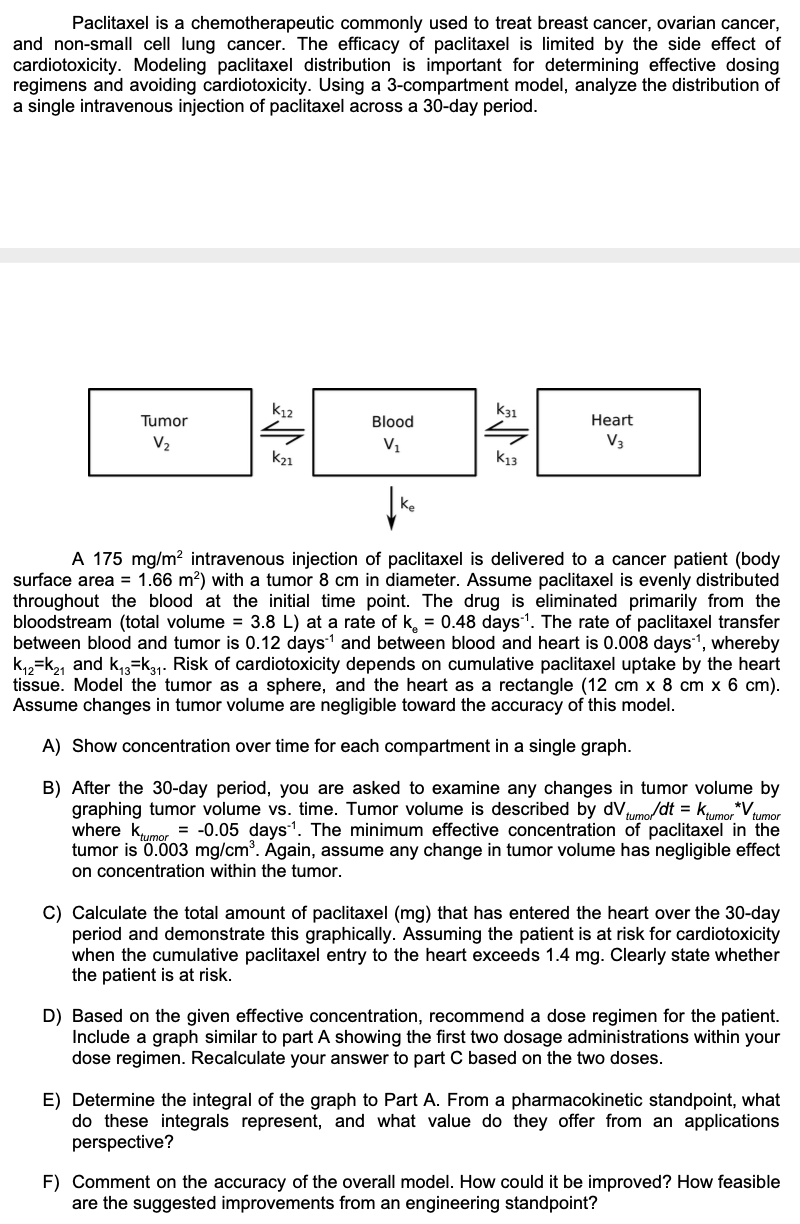
Answer in MATLAB!! create formula using information provided in question.
Paclitaxel is a chemotherapeutic commonly used to treat breast cancer, ovarian cancer, and non-small cell lung cancer. The efficacy of paclitaxel is limited by the side effect of cardiotoxicity. Modeling paclitaxel distribution is important for determining effective dosing regimens and avoiding cardiotoxicity. Using a 3-compartment model, analyze the distribution of a single intravenous injection of paclitaxel across a 30-day period. k12 K31 Tumor V2 4 Blood Vi Heart V3 k21 k13 ke A 175 mg/m2 intravenous injection of paclitaxel is delivered to a cancer patient (body surface area = 1.66 m) with a tumor 8 cm in diameter. Assume paclitaxel is evenly distributed throughout the blood at the initial time point. The drug is eliminated primarily from the bloodstream (total volume = 3.8 L) at a rate of k, = 0.48 days"!. The rate of paclitaxel transfer between blood and tumor is 0.12 days' and between blood and heart is 0.008 days?, whereby kz=kz, and k 3=k31. Risk of cardiotoxicity depends on cumulative paclitaxel uptake by the heart tissue. Model the tumor as a sphere, and the heart as a rectangle (12 cm x 8 cm x 6 cm). Assume changes in tumor volume are negligible toward the accuracy of this model. A) Show concentration over time for each compartment in a single graph. tumor B) After the 30-day period, you are asked to examine any changes in tumor volume by graphing tumor volume vs. time. Tumor volume is described by d tumo/dt = ktumor *V where ktumor = -0.05 days!. The minimum effective concentration of paclitaxel in the tumor is 0.003 mg/cm. Again, assume any change in tumor volume has negligible effect on concentration within the tumor. C) Calculate the total amount of paclitaxel (mg) that has entered the heart over the 30-day period and demonstrate this graphically. Assuming the patient is at risk for cardiotoxicity when the cumulative paclitaxel entry to the heart exceeds 1.4 mg. Clearly state whether the patient is at risk. D) Based on the given effective concentration, recommend a dose regimen for the patient. Include a graph similar to part A showing the first two dosage administrations within your dose regimen. Recalculate your answer to part C based on the two doses. E) Determine the integral of the graph to Part A. From a pharmacokinetic standpoint, what do these integrals represent, and what value do they offer from an applications perspective? F) Comment on the accuracy of the overall model. How could it be improved? How feasible are the suggested improvements from an engineering standpoint? Paclitaxel is a chemotherapeutic commonly used to treat breast cancer, ovarian cancer, and non-small cell lung cancer. The efficacy of paclitaxel is limited by the side effect of cardiotoxicity. Modeling paclitaxel distribution is important for determining effective dosing regimens and avoiding cardiotoxicity. Using a 3-compartment model, analyze the distribution of a single intravenous injection of paclitaxel across a 30-day period. k12 K31 Tumor V2 4 Blood Vi Heart V3 k21 k13 ke A 175 mg/m2 intravenous injection of paclitaxel is delivered to a cancer patient (body surface area = 1.66 m) with a tumor 8 cm in diameter. Assume paclitaxel is evenly distributed throughout the blood at the initial time point. The drug is eliminated primarily from the bloodstream (total volume = 3.8 L) at a rate of k, = 0.48 days"!. The rate of paclitaxel transfer between blood and tumor is 0.12 days' and between blood and heart is 0.008 days?, whereby kz=kz, and k 3=k31. Risk of cardiotoxicity depends on cumulative paclitaxel uptake by the heart tissue. Model the tumor as a sphere, and the heart as a rectangle (12 cm x 8 cm x 6 cm). Assume changes in tumor volume are negligible toward the accuracy of this model. A) Show concentration over time for each compartment in a single graph. tumor B) After the 30-day period, you are asked to examine any changes in tumor volume by graphing tumor volume vs. time. Tumor volume is described by d tumo/dt = ktumor *V where ktumor = -0.05 days!. The minimum effective concentration of paclitaxel in the tumor is 0.003 mg/cm. Again, assume any change in tumor volume has negligible effect on concentration within the tumor. C) Calculate the total amount of paclitaxel (mg) that has entered the heart over the 30-day period and demonstrate this graphically. Assuming the patient is at risk for cardiotoxicity when the cumulative paclitaxel entry to the heart exceeds 1.4 mg. Clearly state whether the patient is at risk. D) Based on the given effective concentration, recommend a dose regimen for the patient. Include a graph similar to part A showing the first two dosage administrations within your dose regimen. Recalculate your answer to part C based on the two doses. E) Determine the integral of the graph to Part A. From a pharmacokinetic standpoint, what do these integrals represent, and what value do they offer from an applications perspective? F) Comment on the accuracy of the overall model. How could it be improved? How feasible are the suggested improvements from an engineering standpoint
Step by Step Solution
There are 3 Steps involved in it

Get step-by-step solutions from verified subject matter experts
 Study Help