Question: answer on this article using the IBC format Abstract The article positions mixed-method research (MMR) as a principled complementary research method to the traditional quantitative
answer on this article using the IBC format
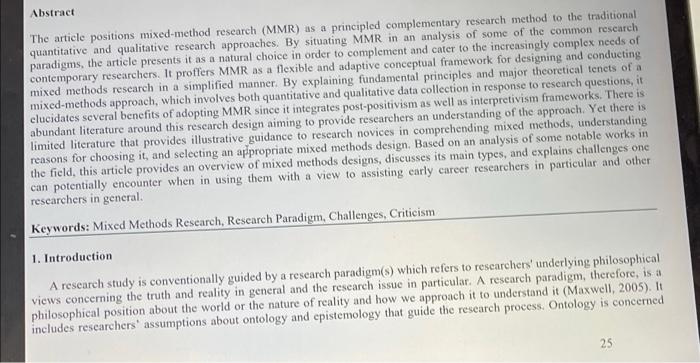
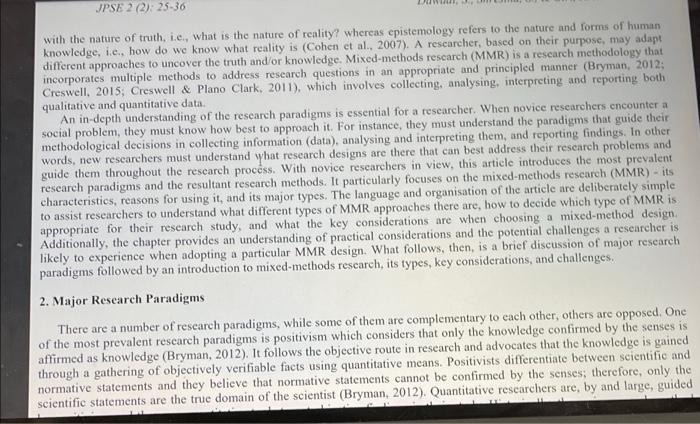
Abstract The article positions mixed-method research (MMR) as a principled complementary research method to the traditional quantitative and qualitative research approaches. By situating MMR in an analysis of some of the common research paradigms, the article presents it as a natural choice in order to complement and cater to the increasingly complex needs of contemporary researchers. It proffers MMR as a flexible and adaptive conceptual framework for designing and conducting mixed methods research in a simplified manner. By explaining fundamental principles and major theoretical tenets of a mixed-methods approach, which involves both quantitative and qualitative data collection in response to research questions, it clucidates several benefits of adopting MMR since it integrates post-positivism as well as interpretivism frameworks. There is abundant literature around this research design aiming to provide researchers an understanding of the approach. Yet there is limited literature that provides illustrative guidance to research novices in comprehending mixed methods, understanding reasons for choosing it, and selecting an appropriate mixed methods design. Based on an analysis of some notable works in the field, this article provides an overview of mixed methods designs, discusses its main types, and explains challenges one can potentially encounter when in using them with a view to assisting early career researchers in particular and other researchers in general. Keywords: Mixed Methods Research, Research Paradigm, Challenges, Criticism 1. Introduction A research study is conventionally guided by a research paradigm(s) which refers to researchers' underlying philosophical views concerning the truth and reality in general and the research issue in particular. A research paradigm, therefore, is a philosophical position about the world or the nature of reality and how we approach it to understand it (Maxwell, 2005). It includes researchers' assumptions about ontology and epistemology that guide the research process. Ontology is concerned 25 JPSE 2 (2): 25-36 with the nature of truth, i.e., what is the nature of reality? whereas epistemology refers to the nature and forms of human knowledge, ie, how do we know what reality is (Cohen et al., 2007). A researcher, based on their purpose, may adapt different approaches to uncover the truth and/or knowledge. Mixed-methods research (MMR) is a research methodology that incorporates multiple methods to address research questions in an appropriate and principled manner (Bryman, 2012; Creswell, 2015; Creswell & Plano Clark. 2011), which involves collecting, analysing, interpreting and reporting both qualitative and quantitative data. An in-depth understanding of the research paradigms is essential for a researcher. When novice researchers encounter a social problem, they must know how best to approach it. For instance, they must understand the paradigms that guide their methodological decisions in collecting information (data), analysing and interpreting them, and reporting findings. In other words, new researchers must understand what research designs are there that can best address their research problems and guide them throughout the research process. With novice researchers in view, this article introduces the most prevalent research paradigms and the resultant research methods. It particularly focuses on the mixed-methods research (MMR) - its characteristics, reasons for using it, and its major types. The language and organisation of the article are deliberately simple to assist researchers to understand what different types of MMR approaches there are, how to decide which type of MMR is appropriate for their research study, and what the key considerations are when choosing a mixed-method design Additionally, the chapter provides an understanding of practical considerations and the potential challenges a researcher is likely to experience when adopting a particular MMR design. What follows, then, is a brief discussion of major research paradigms followed by an introduction to mixed-methods research, its types, key considerations, and challenges. 2. Major Research Paradigms There are a number of research paradigms, while some of them are complementary to each other, others are opposed. One of the most prevalent research paradigms is positivism which considers that only the knowledge confirmed by the senses is affirmed as knowledge (Bryman, 2012). It follows the objective route in research and advocates that the knowledge is gained through a gathering of objectively verifiable facts using quantitative means. Positivists differentiate between scientific and normative statements and they believe that normative statements cannot be confirmed by the senses, therefore, only the scientific statements are the true domain of the scientist (Bryman, 2012). Quantitative rescarchers are, by and large, guided Abstract The article positions mixed-method research (MMR) as a principled complementary research method to the traditional quantitative and qualitative research approaches. By situating MMR in an analysis of some of the common research paradigms, the article presents it as a natural choice in order to complement and cater to the increasingly complex needs of contemporary researchers. It proffers MMR as a flexible and adaptive conceptual framework for designing and conducting mixed methods research in a simplified manner. By explaining fundamental principles and major theoretical tenets of a mixed-methods approach, which involves both quantitative and qualitative data collection in response to research questions, it clucidates several benefits of adopting MMR since it integrates post-positivism as well as interpretivism frameworks. There is abundant literature around this research design aiming to provide researchers an understanding of the approach. Yet there is limited literature that provides illustrative guidance to research novices in comprehending mixed methods, understanding reasons for choosing it, and selecting an appropriate mixed methods design. Based on an analysis of some notable works in the field, this article provides an overview of mixed methods designs, discusses its main types, and explains challenges one can potentially encounter when in using them with a view to assisting early career researchers in particular and other researchers in general. Keywords: Mixed Methods Research, Research Paradigm, Challenges, Criticism 1. Introduction A research study is conventionally guided by a research paradigm(s) which refers to researchers' underlying philosophical views concerning the truth and reality in general and the research issue in particular. A research paradigm, therefore, is a philosophical position about the world or the nature of reality and how we approach it to understand it (Maxwell, 2005). It includes researchers' assumptions about ontology and epistemology that guide the research process. Ontology is concerned 25 JPSE 2 (2): 25-36 with the nature of truth, i.e., what is the nature of reality? whereas epistemology refers to the nature and forms of human knowledge, ie, how do we know what reality is (Cohen et al., 2007). A researcher, based on their purpose, may adapt different approaches to uncover the truth and/or knowledge. Mixed-methods research (MMR) is a research methodology that incorporates multiple methods to address research questions in an appropriate and principled manner (Bryman, 2012; Creswell, 2015; Creswell & Plano Clark. 2011), which involves collecting, analysing, interpreting and reporting both qualitative and quantitative data. An in-depth understanding of the research paradigms is essential for a researcher. When novice researchers encounter a social problem, they must know how best to approach it. For instance, they must understand the paradigms that guide their methodological decisions in collecting information (data), analysing and interpreting them, and reporting findings. In other words, new researchers must understand what research designs are there that can best address their research problems and guide them throughout the research process. With novice researchers in view, this article introduces the most prevalent research paradigms and the resultant research methods. It particularly focuses on the mixed-methods research (MMR) - its characteristics, reasons for using it, and its major types. The language and organisation of the article are deliberately simple to assist researchers to understand what different types of MMR approaches there are, how to decide which type of MMR is appropriate for their research study, and what the key considerations are when choosing a mixed-method design Additionally, the chapter provides an understanding of practical considerations and the potential challenges a researcher is likely to experience when adopting a particular MMR design. What follows, then, is a brief discussion of major research paradigms followed by an introduction to mixed-methods research, its types, key considerations, and challenges. 2. Major Research Paradigms There are a number of research paradigms, while some of them are complementary to each other, others are opposed. One of the most prevalent research paradigms is positivism which considers that only the knowledge confirmed by the senses is affirmed as knowledge (Bryman, 2012). It follows the objective route in research and advocates that the knowledge is gained through a gathering of objectively verifiable facts using quantitative means. Positivists differentiate between scientific and normative statements and they believe that normative statements cannot be confirmed by the senses, therefore, only the scientific statements are the true domain of the scientist (Bryman, 2012). Quantitative rescarchers are, by and large, guided









 Study Help