







Question: answer only question C on each part please Assume that you are nearing graduation and that you have applied for ajob at a local bank.
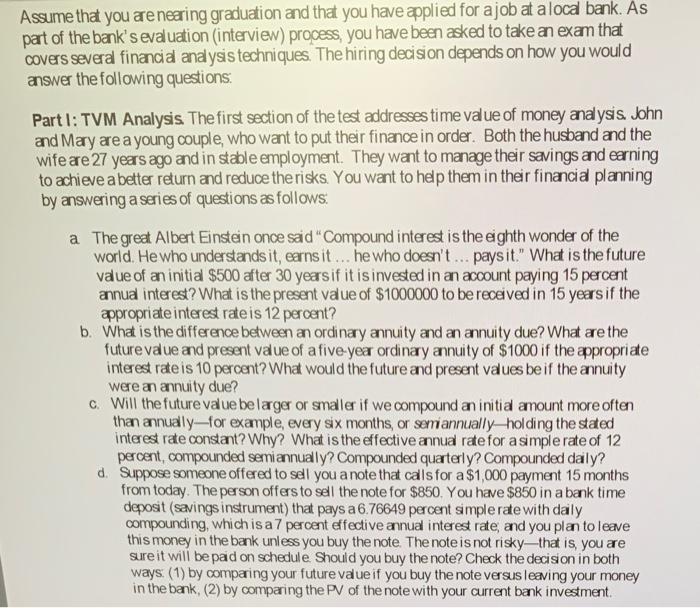
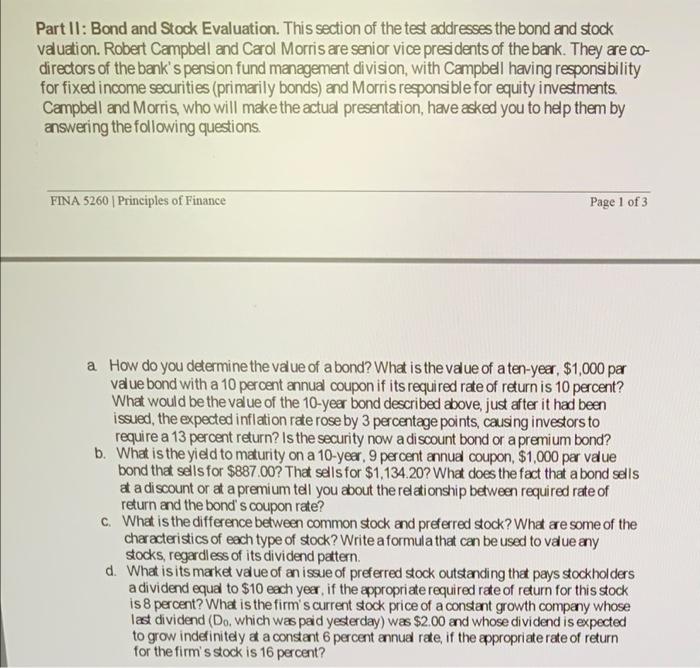
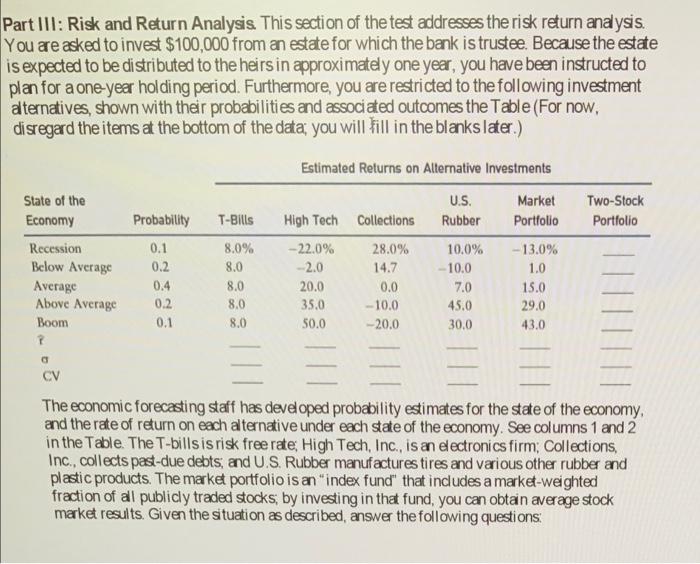
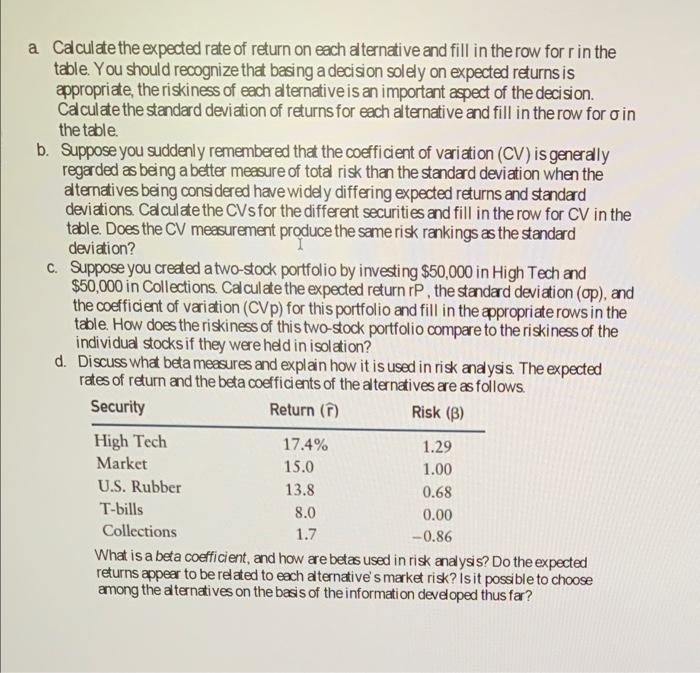
Assume that you are nearing graduation and that you have applied for ajob at a local bank. As part of the bank's evaluation (interview) process, you have been asked to take an exam that covers several financial analysis techniques. The hiring decision depends on how you would answer the following questions: Part 1: TVM Analysis. The first section of the test addresses time value of money analysis. John and May are a young couple, who want to put their finance in order. Both the husband and the wife are 27 years ago and in stable employment. They want to manage their savings and earning to achieve a better return and reduce the risks. You want to help them in their financial planning by answering a series of questions as follows: a The great Albert Einstein once said "Compound interest is the eighth wonder of the world. He who understands it, earns it... he who doesn't ... paysit" What is the future value of an initial $500 after 30 years if it isinvested in an account paying 15 percent annual interest? What is the present value of $1000000 to be received in 15 years if the appropriate interest rate is 12 percent? b. What is the difference between an ordinary annuity and an annuity due? What are the future value and present value of a five year ordinary annuity of $1000 if the appropriate interest rate is 10 percent? What would the future and present values be if the annuity were an annuity due? c. Will the future value belarger or smaller if we compound an initial amount more often than annually-for example, every six months, or semiannually holding the stated interest rate constant? Why? What is the effective annual rate for a simple rate of 12 percent, compounded semiannually? Compounded quarterly? Compounded daily? d. Suppose someone offered to sell you a note that calls for a $1,000 payment 15 months from today. The person offers to sell the note for $850. You have $850 in a bank time deposit (savingsinstrument) that pays a 6.76649 percent simple rate with daily compounding, which is a 7 percent effective annual interest rate, and you plan to leave this money in the bank unless you buy the note. The note is not risky--that is, you are sure it will be paid on schedule Should you buy the note? Check the decision in both ways: (1) by comparing your future value if you buy the note versus leaving your money in the bank (2) by comparing the PV of the note with your current bank investment. Part II: Bond and Stock Evaluation. This section of the test addresses the bond and stock valuation. Robert Campbell and Carol Morris are senior vice presidents of the bank. They are co- directors of the bank's pension fund management division, with Campbell having responsibility for fixed income securities (primarily bonds) and Morris responsible for equity investments. Campbell and Morris, who will make the actual presentation, have asked you to help them by answering the following questions. FINA 5260 | Principles of Finance Page 1 of 3 a How do you determine the value of a bond? What is the value of a ten-year $1,000 par value bond with a 10 percent annual coupon if its required rate of return is 10 percent? What would be the value of the 10-year bond described above, just after it had been issued, the expected inflation rate rose by 3 percentage points, causing investors to require a 13 percent return? Is the security now a discount bond or a premium bond? b. What is the yield to maturity on a 10-year 9 percent annual coupon, $1,000 par value bond that sells for $887.00? That sells for $1,134.20? What does the fact that a bond sells at a discount or at a premium tell you about the relationship between required rate of return and the bond's coupon rate? c. What is the difference between common stock and preferred stock? What are some of the characteristics of each type of stock? Write a formula that can be used to value any stocks, regardless of its dividend pattern d. What is its market value of an issue of preferred stock outstanding that pays stockholders a dividend equal to $10 each year, if the appropriate required rate of return for this stock is 8 percent? What is the firm's current stock price of a constant growth company whose last dividend (Do, which was paid yesterday) was $2.00 and whose dividend is expected to grow indefinitely a a constant 6 percent annual rate, if the appropriate rate of return for the firm's stock is 16 percent? Part III: Risk and Return Analysis. This section of the test addresses the risk return analysis. You are asked to invest $100,000 from an estate for which the bank is trustee. Because the estate is expected to be distributed to the heirs in approximately one year, you have been instructed to plan for a one-year holding period. Furthermore, you are restricted to the following investment alternatives, shown with their probabilities and associated outcomes the Table (For now, disregard the items at the bottom of the data, you will fill in the blanks later.) Probability Two-Stock Portfolio T-Bills State of the Economy Recession Below Average Average Above Average Boom 7 0 CV 0.1 0.2 0.4 0.2 0.1 8.0% 8.0 8.0 8,0 8.0 Estimated Returns on Alternative Investments U.S. Market High Tech Collections Rubber Portfolio - 22.0% 28.0% 10.0% - 13.0% - 2.0 14.7 -10.0 1.0 20.0 7.0 15.0 35.0 - 10.0 45.0 29.0 50.0 - 20.0 30,0 43.0 0.0 The economic forecasting staff has developed probability estimates for the state of the economy, and the rate of return on each alternative under each state of the economy. See columns 1 and 2 in the Table. The T-billsis risk free rate, High Tech, Inc., is an electronics firm; Collections, Inc., collects past-due debts, and U.S. Rubber manufactures tires and various other rubber and plastic products. The market portfolio is an "index fund" that includes a market-weighted fraction of all publicly traded stocks, by investing in that fund, you can obtain average stock market results. Given the situation as described, answer the following questions: a Calculate the expected rate of return on each alternative and fill in the row for r in the table. You should recognize that basing a decision solely on expected returns is appropriate, the riskiness of each alternative is an important aspect of the decision Calculate the standard deviation of returns for each alternative and fill in the row for o in the table. b. Suppose you suddenly remembered that the coefficient of variation (CV) is generally regarded as being a better measure of total risk than the standard deviation when the alternatives being considered have widely differing expected returns and standard deviations. Calculate the CVs for the different securities and fill in the row for CV in the table. Does the CV measurement produce the same risk rankings as the standard deviation? c. Suppose you created a two-stock portfolio by investing $50,000 in High Tech and $50,000 in Collections. Calculate the expected return rP, the standard deviation (op), and the coefficient of variation (CVp) for this portfolio and fill in the appropriate rows in the table. How does the riskiness of this two-stock portfolio compare to the riskiness of the individual stocks if they were held in isolation? d. Discuss what beta measures and explain how it is used in risk analysis. The expected rates of return and the beta coefficients of the alternatives are as follows. Security Return (0) High Tech 17.4% 1.29 Market 15.0 1.00 U.S. Rubber 13.8 0.68 T-bills 8.0 0.00 Collections 1.7 --0.86 What is a beta coefficient, and how are betas used in risk analysis? Do the expected returns appear to be related to each alternative's market risk? Is it possible to choose among the alternatives on the basis of the information developed thus far? Risk (B)
Step by Step Solution
There are 3 Steps involved in it

Get step-by-step solutions from verified subject matter experts
 Study Help