







Question: answer part b and question 2 type of technology will be available? How about climate change? Government regulations? etc.)? (b) Do you think the operating

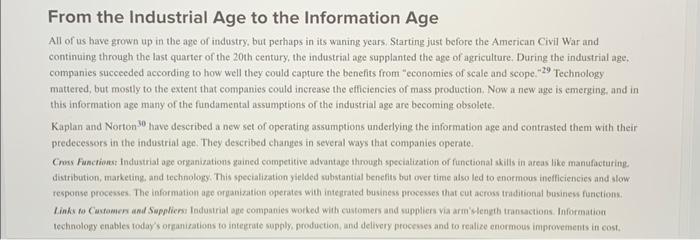
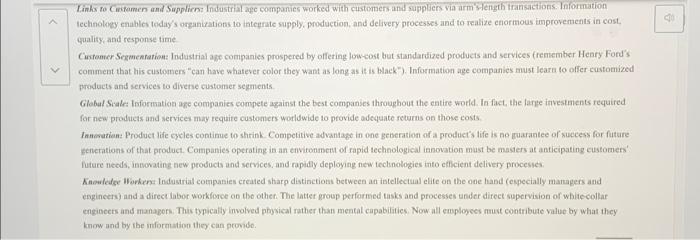
type of technology will be available? How about climate change? Government regulations? etc.)? (b) Do you think the operating assumptions of the information age on textbook page 502 will be still applied to organizations? 2. What will be the leader's role in this rapidly changing situation? From the Industrial Age to the Information Age All of us have growa up in the age of industry, but perhaps in its wuning years. Starting just before the American Civil War and continuing through the last quarter of the 20th century, the industrial age supplanted the age of agriculture. During the industrial age, companies succeeded according to how well they could capture the benefits from "economies of scale and scope. 29 Technology mattered, but mostly to the extent that companies could increase the efficiencies of mass production. Now a new age is emerging, and in this information age many of the fundamental assumptions of the industrial age are becoming obsolete. Kaplan and Nerton 30 have described a new set of operating assumptions underlying the information age and contrasted them with their predecessors in the industrial age. They described changes in several ways that companies operate. Cons Functions: Industrial age oryanizations gained competitive advantage through specialization of functional skills in areas like manufacturing. distribution, maketing, and technolog. This specialization yielded substantial benefits bot over time also led to enormous inelficiencies and slow response processes. The information ape orpaization operates with integrated business processes that cut across tnaditional busines furctions. Links fo Cusfamen and Suppliens Industrial ape companies wotked with customers and supplien via armislenytb transactions. Information technology enables today's organizations to integrute supply, production, and delivery proceses and to realize enormous improvements in cost. Iechnokogy enables today/s oreanirations to inteunte supply, production, and delivery processes and to realize enormous improvernents in cost. quality, and response time. Curfamer Seqmentathat: Indestrial ape companies prospered by olfering loweost but standardized products and services fremernber Heary Ford's conment that his customers "can have whatever color they want as long as if is black"). Information age companies must leara to offer ecustomized products and services to divene customer sepments. Glabul Swale Information ase companies eompete against the best companses throughout the catire world. In fiact, the larie investaients required far new products and services may require customers world wide to provide adequate returns an those costs. Innanatian: Product life cyeles contimue to shrink. Competitive advantage in one geberation of a product's life is ne guarantee of suceess for futare senctations of that product. Companies operating in an envifonment of rapid technological innovation must be masters at anticipating eustomen' future needs, insovatine new products and services, and rapidly deploying new teclinologies into efficient delivery processes. Knewlede Workene Industrial cotnpasies created sharp distinetion between an intellectual elite on the one hand (especially managers and enginects) and a direce labor workforce on the other. The latter group performed tusks and processes under difect supervision of whitecollar engineers and managern. This typically involved phosical rather than mental capabilities. Now all ecuplogess must contribute value by what they know and by the information they can promide
Step by Step Solution
There are 3 Steps involved in it

Get step-by-step solutions from verified subject matter experts
 Study Help