







Question: answer parts a thru d 1. Consider the linear programming problem shown here, which was on Test 2. Choose your own positive integer value for
answer parts a thru d
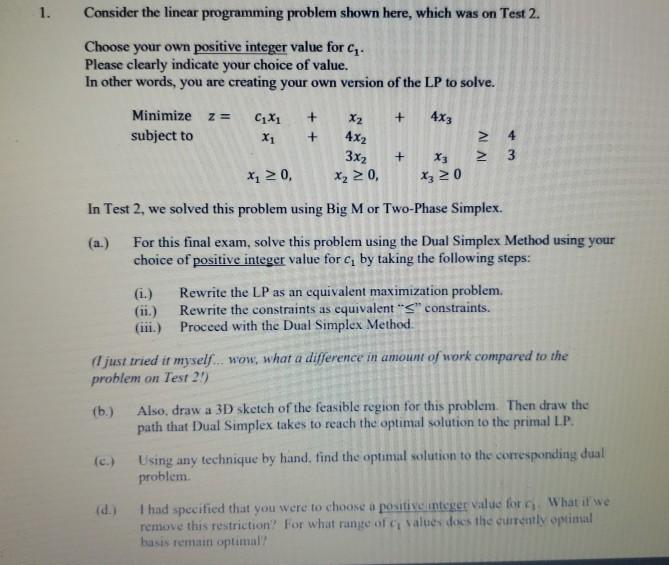
1. Consider the linear programming problem shown here, which was on Test 2. Choose your own positive integer value for C. Please clearly indicate your choice of value. In other words, you are creating your own version of the LP to solve. Z= + 4X3 Minimize subject to CX1 X1 + + X2 4X2 3x2 4 > 3 + *, 20, X3 x320 X220, In Test 2, we solved this problem using Big M or Two-Phase Simplex. For this final exam, solve this problem using the Dual Simplex Method using your choice of positive integer value for by taking the following steps: (i.) Rewrite the LP as an equivalent maximization problem. (ii.) Rewrite the constraints as equivalent "S" constraints. (ii.) Proceed with the Dual Simplex Method (ljust tried it myself... wow, what a difference in amount of work compared to the problem on Test 20 (b.) Also draw a 3D sketch of the feasible region for this problem. Then draw the path that Dual Simplex takes to reach the optimal solution to the primal LP (c.) Using any technique by hand, find the optimal solution to the corresponding dual problem (d) I had specified that you were to choose a positive integer value for What if we remove this restriction? For what range of values does the currently optimal basis remain optimal 1. Consider the linear programming problem shown here, which was on Test 2. Choose your own positive integer value for C. Please clearly indicate your choice of value. In other words, you are creating your own version of the LP to solve. Z= + 4X3 Minimize subject to CX1 X1 + + X2 4X2 3x2 4 > 3 + *, 20, X3 x320 X220, In Test 2, we solved this problem using Big M or Two-Phase Simplex. For this final exam, solve this problem using the Dual Simplex Method using your choice of positive integer value for by taking the following steps: (i.) Rewrite the LP as an equivalent maximization problem. (ii.) Rewrite the constraints as equivalent "S" constraints. (ii.) Proceed with the Dual Simplex Method (ljust tried it myself... wow, what a difference in amount of work compared to the problem on Test 20 (b.) Also draw a 3D sketch of the feasible region for this problem. Then draw the path that Dual Simplex takes to reach the optimal solution to the primal LP (c.) Using any technique by hand, find the optimal solution to the corresponding dual problem (d) I had specified that you were to choose a positive integer value for What if we remove this restriction? For what range of values does the currently optimal basis remain optimalStep by Step Solution
There are 3 Steps involved in it
1 Expert Approved Answer
Step: 1 Unlock

Question Has Been Solved by an Expert!
Get step-by-step solutions from verified subject matter experts
Step: 2 Unlock
Step: 3 Unlock
 Study Help