







Question: Answer Please , 2nd Question ?? Case Study Novels, new products and Harry Potter This case study explores the world of publishing and examines how
Answer Please , 2nd Question ??
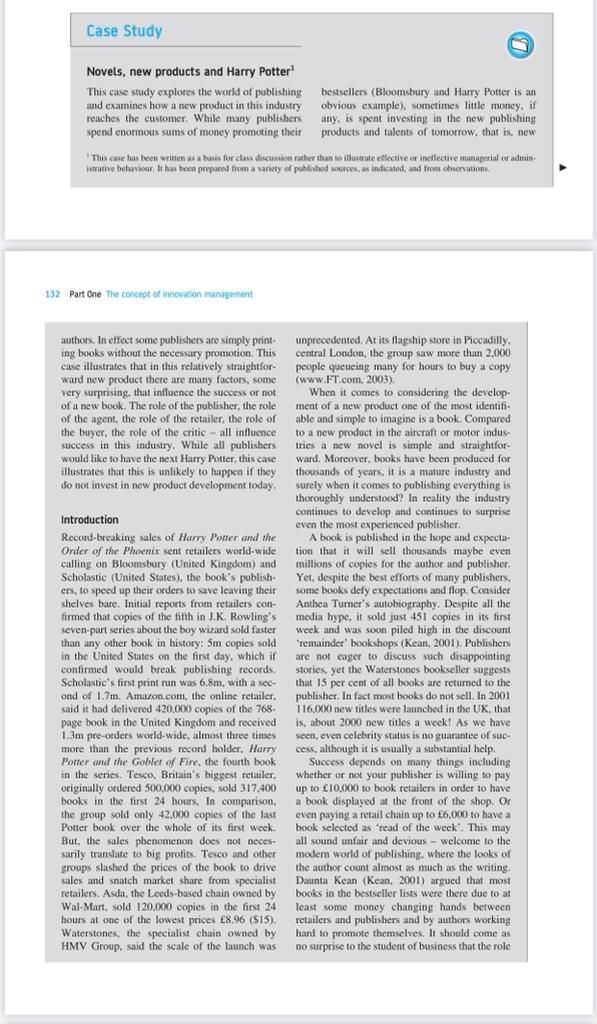
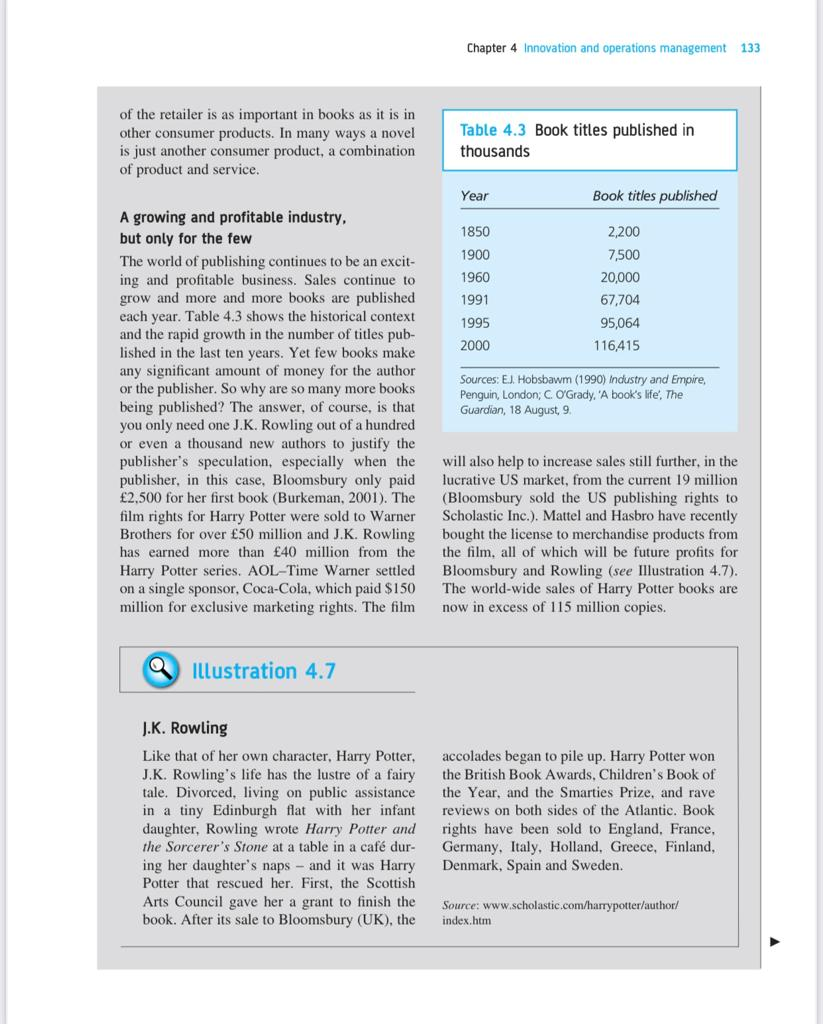
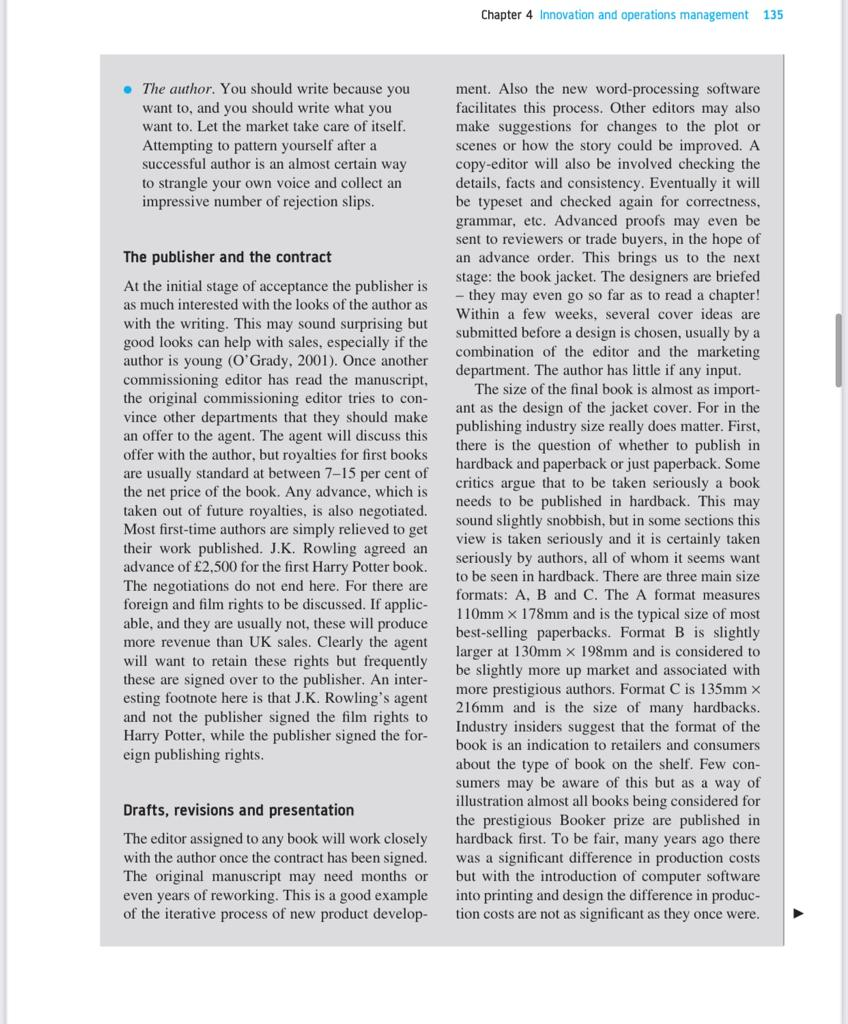
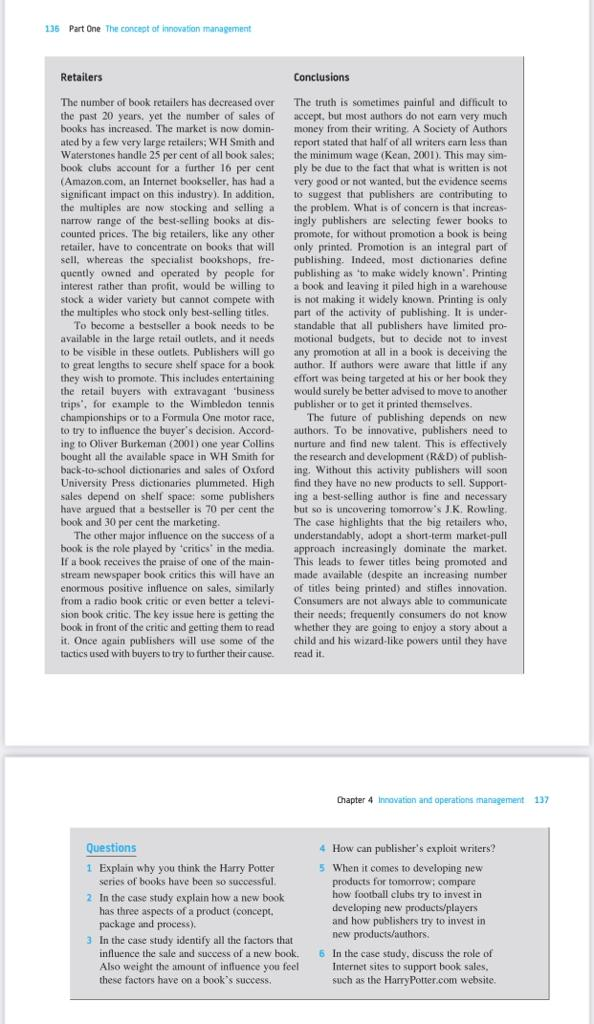
Case Study Novels, new products and Harry Potter This case study explores the world of publishing and examines how a new product in this industry reaches the customer. While many publishers spend enormous sums of money promoting their bestsellers (Bloomsbury and Harry Potter is an obvious example), sometimes little money, if any is spent investing in the new publishing products and talents of tomorrow, that is, new This case has been written as a basis for class discussion rather than to illustrate effective or ineffective managerial or admin istrative behavior. It has been prepared from a variety of published srces, as indicated and from observation 132 Part One The concept of innovation management authors. In effect some publishers are simply print ing books without the necessary promotion. This case illustrates that in this relatively straightfor- ward new product there are many factors, some very surprising, that influence the success or not of a new book. The role of the publisher, the role of the agent, the role of the retailer, the role of the buyer, the role of the critic - all influence success in this industry. While all publishers would like to have the next Harry Potter, this case illustrates that this is unlikely to happen if they do not invest in new product development today, Introduction Record-breaking sales of Harry Potter and the Order of the Phoenix sent retailers world-wide calling on Bloomsbury (United Kingdom) and Scholastic (United States), the book's publish- ers, to speed up their orders to save leaving their shelves bare. Initial reports from retailers con- firmed that copies of the fifth in JK Rowling's seven-part series about the boy wizard sold faster than any other book in history: Sm copies sold in the United States on the first day, which if confirmed would break publishing records, Scholastic's first print run was 6,8m, with a sec- ond of 1.7m. Amazon.com, the online retailer, said it had delivered 420,000 copies of the 768 page book in the United Kingdom and received 1.3m pre-orders world-wide, almost three times more than the previous record holder. Harry Potter and the Goblet of Fire, the fourth book in the series. Tesco. Britain's biggest retailer. originally ordered 500,000 copies, sold 317.400 books in the first 24 hours. In comparison, the group sold only 42,000 copies of the last Potter book over the whole of its first week But the sales phenomenon does not neces- sarily translate to big profits. Tesco and other groups slashed the prices of the book to drive sales and snatch market share from specialist retailers. Asda, the Leeds-based chain owned by Wal-Mart, sold 120.000 copies in the first 24 hours at one of the lowest prices 8.96 (515). Waterstones, the specialist chain owned by HMV Group, said the scale of the launch was unprecedented. At its flagship store in Piccadilly, central London, the group saw more than 2,000 people queueing many for hours to buy a copy (www.FT.com, 2003). When it comes to considering the develop ment of a new product one of the most identifi- able and simple to imagine is a book. Compared to a new product in the aircraft or motor indus- tries a new novel is simple and straightfor- ward. Moreover, books have been produced for thousands of years, it is a mature industry and surely when it comes to publishing everything is thoroughly understood? In reality the industry continues to develop and continues to surprise even the most experienced publisher A book is published in the hope and expecta- tion that it will sell thousands maybe even millions of copies for the author and publisher. Yet, despite the best efforts of many publishers. some books dely expectations and flop. Consider Anthea Turner's autobiography. Despite all the media hype, it sold just 451 copies in its first week and was soon piled high in the discount remainder' bookshops (Kean. 2001). Publishers are not eager to discuss such disappointing stories, yet the Waterstones bookseller suggests that 15 per cent of all books are returned to the publisher. In fact most books do not sell. In 2001 116,000 new titles were launched in the UK, that is, about 2000 new titles a week! we have seen, even celebrity status is no guarantee of such cess, although it is usually a substantial help. Success depends on many things including whether or not your publisher is willing to pay up to 10,000 to book retailers in order to have a book displayed at the front of the shop. Or even paying a retail chain up to 6,000 to have a book selected as "read of the week. This may all sound unfair and devious - welcome to the modem world of publishing, where the looks of the author count almost as much as the writing. Daunta Kean (Kean, 2001) argued that most books in the bestseller lists were there due to at least some money changing hands between retailers and publishers and by authors working hard to promote themselves. It should come as no surprise to the student of business that the role Chapter 4 Innovation and operations management 133 of the retailer is as important in books as it is in other consumer products. In many ways a novel is just another consumer product, a combination of product and service. Table 4.3 Book titles published in thousands Year Book titles published 1850 1900 1960 1991 2,200 7,500 20,000 67,704 1995 2000 95,064 116,415 A growing and profitable industry, but only for the few The world of publishing continues to be an excit- ing and profitable business. Sales continue to grow and more and more books are published each year. Table 4.3 shows the historical context and the rapid growth in the number of titles pub- lished in the last ten years. Yet few books make any significant amount of money for the author or the publisher. So why are so many more books being published? The answer, of course, is that you only need one J.K. Rowling out of a hundred or even a thousand new authors to justify the publisher's speculation, espe when the publisher, in this case, Bloomsbury only paid 2,500 for her first book (Burkeman, 2001). The film rights for Harry Potter were sold to Warner Brothers for over 50 million and J.K. Rowling has earned more than 40 million from the Harry Potter series. AOL-Time Warner settled on a single sponsor, Coca-Cola, which paid $150 million for exclusive marketing rights. The film Sources: EJ Hobsbawm (1990) Industry and Empire, Penguin, London, C. O'Grady. 'A book's life. The Guardian, 18 August, 9. will also help to increase sales still further, in the lucrative US market, from the current 19 million (Bloomsbury sold the US publishing rights to Scholastic Inc.). Mattel and Hasbro have recently bought the license to merchandise products from the film, all of which will be future profits for Bloomsbury and Rowling (see Illustration 4.7). The world-wide sales of Harry Potter books are now in excess of 115 million copies. Illustration 4.7 J.K. Rowling Like that of her own character, Harry Potter, J.K. Rowling's life has the lustre of a fairy tale. Divorced, living on public assistance in a tiny Edinburgh flat with her infant daughter, Rowling wrote Harry Potter and the Sorcerer's Stone at a table in a caf dur- ing her daughter's naps - and it was Harry Potter that rescued her. First, the Scottish Arts Council gave her a grant to finish the book. After its sale to Bloomsbury (UK), the accolades began to pile up. Harry Potter won the British Book Awards, Children's Book of the Year, and the Smarties Prize, and rave reviews on both sides of the Atlantic. Book rights have been sold to England, France, Germany, Italy, Holland, Greece, Finland, Denmark, Spain and Sweden. Source: www.scholastic.com/harrypotter/author/ index.htm Chapter 4 Innovation and operations management 135 The author. You should write because you want to, and you should write what you want to. Let the market take care of itself. Attempting to pattern yourself after a successful author is an almost certain way to strangle your own voice and collect an impressive number of rejection slips. The publisher and the contract At the initial stage of acceptance the publisher is as much interested with the looks of the author as with the writing. This may sound surprising but good looks can help with sales, especially if the author is young (O'Grady, 2001). Once another commissioning editor has read the manuscript, the original commissioning editor tries to con- vince other departments that they should make an offer to the agent. The agent will discuss this offer with the author, but royalties for first books are usually standard at between 7-15 per cent of the net price of the book. Any advance, which is taken out of future royalties, is also negotiated. Most first-time authors are simply relieved to get their work published. J.K. Rowling agreed an advance of 2,500 for the first Harry Potter book. The negotiations do not end here. For there are foreign and film rights to be discussed. If applic- able, and they are usually not, these will produce more revenue than UK sales. Clearly the agent will want to retain these rights but frequently these are signed over to the publisher. An inter- esting footnote here is that J.K. Rowling's agent and not the publisher signed the film rights to Harry Potter, while the publisher signed the for- eign publishing rights. ment. Also the new word-processing software facilitates this process. Other editors may also make suggestions for changes to the plot or scenes or how the story could be improved. A copy-editor will also be involved checking the details, facts and consistency. Eventually it will be typeset and checked again for correctness, grammar, etc. Advanced proofs may even be sent to reviewers or trade buyers, in the hope of an advance order. This brings us to the next stage: the book jacket. The designers are briefed - they may even go so far as to read a chapter! Within a few weeks, several cover ideas are submitted before a design is chosen, usually by a combination of the editor and the marketing department. The author has little if any input. The size of the final book is almost as import- ant as the design of the jacket cover. For in the publishing industry size really does matter. First, there is the question of whether to publish in hardback and paperback or just paperback. Some critics argue that to be taken seriously a book needs to be published in hardback. This may sound slightly snobbish, but in some sections this view is taken seriously and it is certainly taken seriously by authors, all of whom it seems want to be seen in hardback. There are three main size formats: A, B and C. The A format measures 110mm x 178mm and is the typical size of most best-selling paperbacks. Format B is slightly larger at 130mm x 198mm and is considered to be slightly more up market and associated with more prestigious authors. Format C is 135mm x 216mm and is the size of many hardbacks. Industry insiders suggest that the format of the book is an indication to retailers and consumers about the type of book on the shelf. Few con- sumers may be aware of this but as a way of illustration almost all books being considered for the prestigious Booker prize are published in hardback first. To be fair, many years ago there was a significant difference in production costs but with the introduction of computer software into printing and design the difference in produc- tion costs are not as significant as they once were. Drafts, revisions and presentation The editor assigned to any book will work closely with the author once the contract has been signed. The original manuscript may need months or even years of reworking. This is a good example of the iterative process of new product develop- 136 Part One The concept of innovation management Retailers Conclusions The number of book retailers has decreased over the past 20 years, yet the number of sales of books has increased. The market is now domin- ated by a few very large retailers: WH Smith and Waterstones handle 25 per cent of all book sales, book clubs account for a further 16 per cent (Amazon.com, an Internet bookseller, has had a significant impact on this industry). In addition, the multiples are now stocking and selling a narrow range of the best-selling books dis- counted prices. The big retailers, like any other retailer, have to concentrate on books that will sell, whereas the specialist bookshops, fre- quently owned and operated by people for interest rather than profit, would be willing to stock a wider variety but cannot compete with the multiples who stock only best-selling titles To become a bestseller a book needs to be available in the large retail outlets, and it needs to be visible in these outlets. Publishers will go to great lengths secure shelf space for a book they wish to promote. This includes entertaining the retail buyers with extravagant "business trips, for example to the Wimbledon tennis championships or to a Formula One motor race, to try to influence the buyer's decision. Accord- ing to Oliver Burkeman (2001) one year Collins bought all the available space in WH Smith for back-to-school dictionaries and sales of Oxford University Press dictionaries plummeted. High sales depend on shelf space: some publishers have argued that a bestseller is 70 per cent the book and 30 per cent the marketing, The other major influence on the success of a book is the role played by critics in the media. If a book receives the praise of one of the main- stream newspaper book critics this will have an enormous positive influence on sales, similarly from a radio book critic or even better a televi- sion book critic. The key issue here is getting the book in front of the critic and getting them to read it. Once again publishers will use some of the tactics used with buyers to try to further their cause. The truth is sometimes painful and difficult to accept, but most authors do not eam very much money from their writing A Society of Authors report stated that half of all writers earn less than the minimum wage (Kean, 2001). This may sim- ply be due to the fact that what is written is not very good or not wanted, but the evidence seems to suggest that publishers are contributing to the problem. What is of concem is that increas ingly publishers are selecting fewer books to promote, for without promotion a book is being only printed. Promotion is an integral part of publishing. Indeed, most dictionaries define publishing as 'to make widely known'. Printing a book and leaving it piled high in a warehouse is not making it widely known. Printing is only part of the activity of publishing. It is under- standable that all publishers have limited pro- motional budgets, but to decide not to invest any promotion at all in a book is deceiving the author. If authors were aware that little if any effort was being targeted at his or her book they would surely be better advised to move to another publisher or to get it printed themselves The future of publishing depends on new authors. To be innovative, publishers need to nurture and find new talent. This is effectively the research and development (R&D) of publish- ing. Without this activity publishers will soon find they have no new products to sell. Support- ing a best-selling author is fine and necessary but so is uncovering tomorrow's JK Rowling The case highlights that the big retailers who, understandably, adopt a short-term market pull approach increasingly dominate the market. This leads to fewer titles being promoted and made available (despite an increasing number of titles being printed and stifles innovation Consumers are not always able to communicate their needs; frequently consumers do not know whether they are going to enjoy a story about a child and his wizard-like powers until they have read it Chapter 4 Innovation and operations management 137 Questions 1 Explain why you think the Harry Potter series of books have been so successful 2. In the case study explain how a new book has three aspects of a product (concept. package and process). 3 In the case study identify all the factors that influence the sale and success of a new book. Also weight the amount of influence you feel these factors have on a book's success. 4 How can publisher's exploit writers? 5 When it comes to developing new products for tomorrow, compare how football clubs try to invest in developing new products/players and how publishers try to invest in new products/authors, 6 In the case study, discuss the role of Internet sites to support book sales. such as the Harry Potter.com websiteStep by Step Solution
There are 3 Steps involved in it
1 Expert Approved Answer
Step: 1 Unlock

Question Has Been Solved by an Expert!
Get step-by-step solutions from verified subject matter experts
Step: 2 Unlock
Step: 3 Unlock
 Study Help