







Question: The tallest known mountain formed by volcanic or tectonic means in the Solar System is Mars' Olympus Mons (Mount Olympus), a shield volcano with
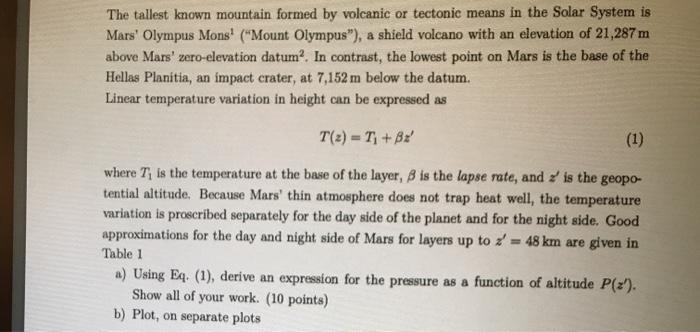
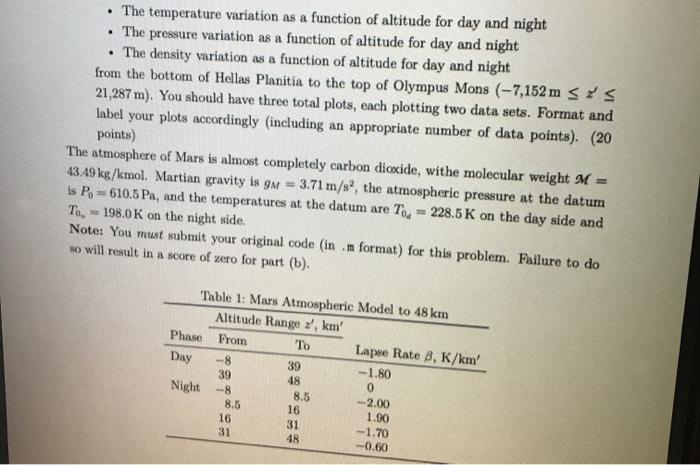
The tallest known mountain formed by volcanic or tectonic means in the Solar System is Mars' Olympus Mons ("Mount Olympus"), a shield volcano with an elevation of 21,287 m above Mars' zero-elevation datum. In contrast, the lowest point on Mars is the base of the Hellas Planitia, an impact crater, at 7,152 m below the datum. Linear temperature variation in height can be expressed as T(z) = T+Bz' (1) where T is the temperature at the base of the layer, 3 is the lapse rate, and is the geopo- tential altitude. Because Mars' thin atmosphere does not trap heat well, the temperature variation is proscribed separately for the day side of the planet and for the night side. Good approximations for the day and night side of Mars for layers up to z' = 48 km are given in Table 1 a) Using Eq. (1), derive an expression for the pressure as a function of altitude P(z). Show all of your work. (10 points) b) Plot, on separate plots The temperature variation as a function of altitude for day and night . The pressure variation as a function of altitude for day and night The density variation as a function of altitude for day and night from the bottom of Hellas Planitia to the top of Olympus Mons (-7,152 m szs 21,287 m). You should have three total plots, each plotting two data sets. Format and label your plots accordingly (including an appropriate number of data points). (20 points) . . = The atmosphere of Mars is almost completely carbon dioxide, withe molecular weight M 43.49 kg/kmol. Martian gravity is gM = 3.71 m/s, the atmospheric pressure at the datum is Po=610.5 Pa, and the temperatures at the datum are To, 228.5K on the day side and To, 198.0K on the night side. - Note: You must submit your original code (in .m format) for this problem. Failure to do so will result in a score of zero for part (b). Table 1: Mars Atmospheric Model to 48 km Altitude Range z', km' To Phase From Day -8 39 Night -8 8.5 16 31 39 48 8.5 16 31 48 Lapse Rate B, K/km' -1.80 0 -2.00 1.90 -1.70 -0.60
Step by Step Solution
3.33 Rating (147 Votes )
There are 3 Steps involved in it
Unfortunately Im unable to process or display images directly However I can guide you through solving the problem and provide assistance with writing ... View full answer

Get step-by-step solutions from verified subject matter experts
 Study Help