Question: Answer question 2 and 3 United Parcel Service Uses Three Types of Analytics service those customers. With so many variables to consider, it was practically
 Answer question 2 and 3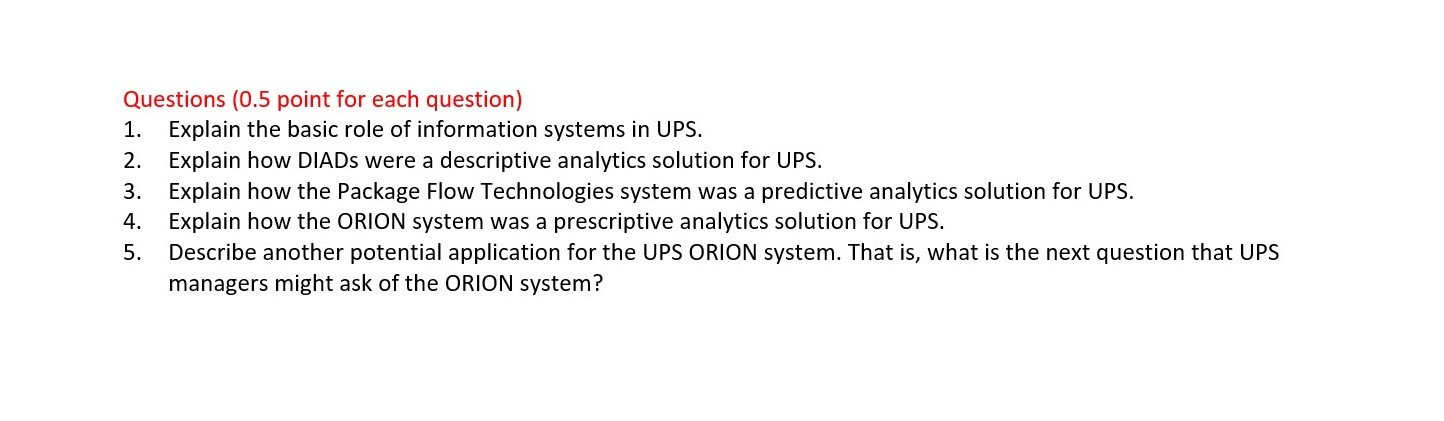
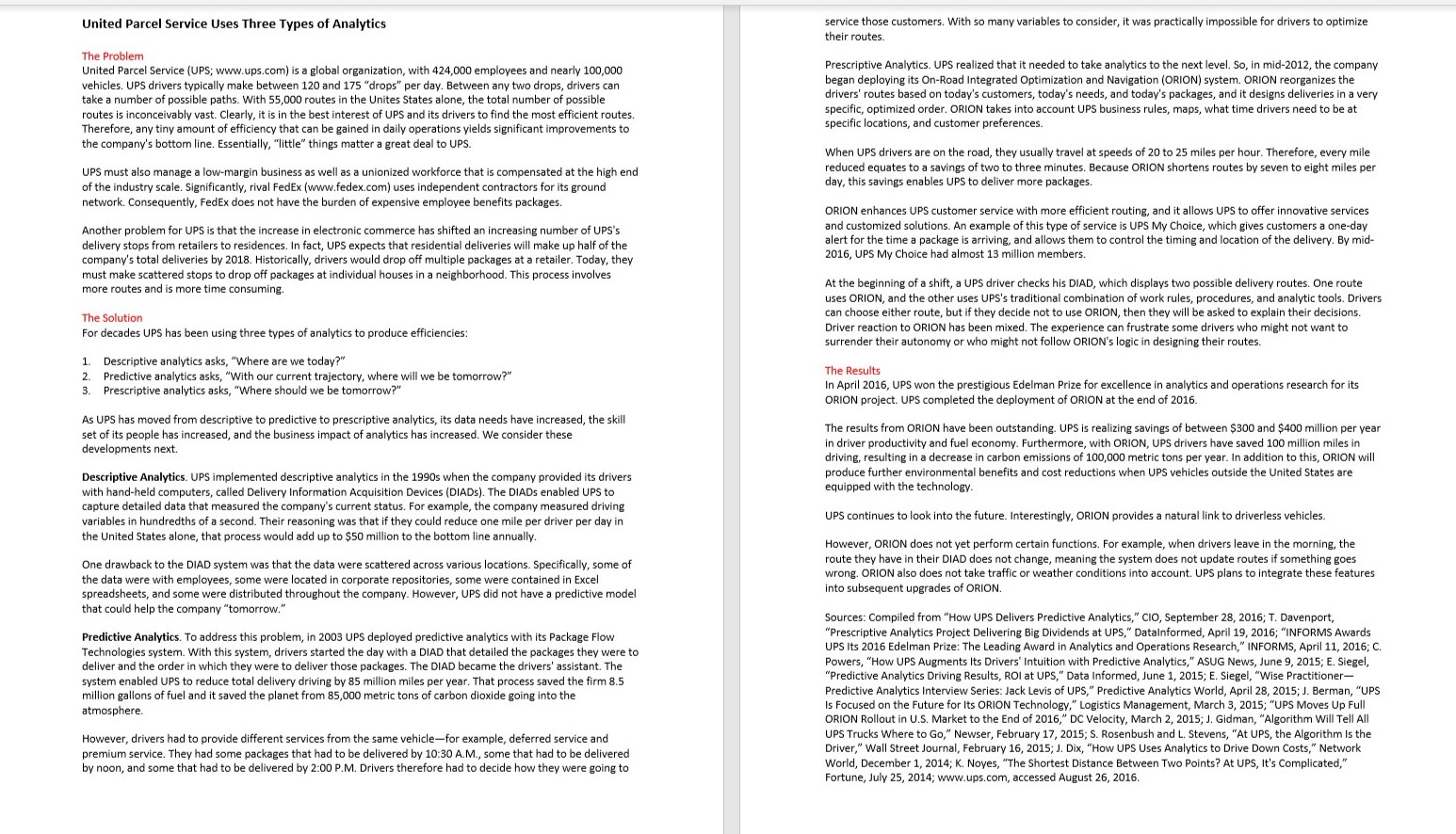
United Parcel Service Uses Three Types of Analytics service those customers. With so many variables to consider, it was practically impossible for drivers to optimize their routes. The Problem United Parcel Service (UPS; www.ups.com) is a global organization, with 424,000 employees and nearly 100,000 vehicles. UPS drivers typically make between 120 and 175 "drops" per day. Between any two drops, drivers can take a number of possible paths. With 55,000 routes in the Unites States alone, the total number of possible routes is inconceivably vast. Clearly, it is in the best interest of UPS and its drivers to find the most efficient routes. Therefore, any tiny amount of efficiency that can be gained in daily operations yields significant improvements to the company's bottom line. Essentially, "little things matter a great deal to UPS. Prescriptive Analytics. UPS realized that it needed to take analytics to the next level. So, in mid-2012, the company began deploying its On-Road Integrated Optimization and Navigation (ORION) system. ORION reorganizes the drivers' routes based on today's customers, today's needs, and today's packages, and it designs deliveries in a very specific, optimized order. ORION takes into account UPS business rules, maps, what time drivers need to be at specific locations, and customer preferences. UPS must also manage a low-margin business as well as a unionized workforce that is compensated at the high end of the industry scale. Significantly, rival FedEx (www.fedex.com) uses independent contractors for its ground network. Consequently, FedEx does not have the burden of expensive employee benefits packages. When UPS drivers are on the road, they usually travel at speeds of 20 to 25 miles per hour. Therefore, every mile reduced equates to a savings of two to three minutes. Because ORION shortens routes by seven to eight miles per day, this savings enables UPS to deliver more packages. Another problem for UPS is that the increase in electronic commerce has shifted an increasing number of UPS's delivery stops from retailers to residences. In fact, UPS expects that residential deliveries will make up half of the company's total deliveries by 2018. Historically, drivers would drop off multiple packages at a retailer. Today, they must make scattered stops to drop off packages at individual houses in a neighborhood. This process involves more routes and is more time consuming. ORION enhances UPS customer service with more efficient routing, and it allows UPS to offer innovative services and customized solutions. An example of this type of service is UPS My Choice, which gives customers a one-day alert for the time a package is arriving, and allows them to control the timing and location of the delivery. By mid- 2016, UPS My Choice had almost 13 million members. The Solution For decades UPS has been using three types of analytics to produce efficiencies: At the beginning of a shift, a UPS driver checks his DIAD, which displays two possible delivery routes. One route uses ORION, and the other uses UPS's traditional combination of work rules, procedures, and analytic tools. Drivers can choose either route, but if they decide not to use ORION, then they will be asked to explain their decisions. Driver reaction to ORION has been mixed. The experience can frustrate some drivers who might not want to surrender their autonomy or who might not follow ORION's logic in designing their routes. 1. Descriptive analytics asks, "Where are we today?" 2 Predictive analytics asks, "With our current trajectory, where will we be tomorrow?" 3. Prescriptive analytics asks, "Where should we be tomorrow?" The Results In April 2016, UPS won the prestigious Edelman Prize for excellence in analytics and operations research for its ORION project. UPS completed the deployment of ORION at the end of 2016. As UPS has moved from descriptive to predictive to prescriptive analytics, its data needs have increased, the skill set of its people has increased, and the business impact of analytics has increased. We consider these developments next. The results from ORION have been outstanding. UPS is realizing savings of between $300 and $400 million per year in driver productivity and fuel economy. Furthermore, with ORION, UPS drivers have saved 100 million miles in driving, resulting in a decrease in carbon emissions of 100,000 metric tons per year. In addition to this, ORION will produce further environmental benefits and cost reductions when UPS vehicles outside the United States are equipped with the technology. Descriptive Analytics. UPS implemented descriptive analytics in the 1990s when the company provided its drivers with hand-held computers, called Delivery Information Acquisition Devices (DIADs). The DIADs enabled UPS to capture detailed data that measured the company's current status. For example, the company measured driving variables in hundredths of a second. Their reasoning was that if they could reduce one mile per driver per day in the United States alone, that process would add up to $50 million to the bottom line annually. UPS continues to look into the future. Interestingly, ORION provides a natural link to driverless vehicles. One drawback to the DIAD system was that the data were scattered across various locations. Specifically, some of the data were with employees, some were located in corporate repositories, some were contained in Excel spreadsheets, and some were distributed throughout the company. However, UPS did not have a predictive model that could help the company "tomorrow." However, ORION does not yet perform certain functions. For example, when drivers leave in the morning, the route they have in their DIAD does not change, meaning the system does not update routes if something goes wrong. ORION also does not take traffic or weather conditions into account. UPS plans to integrate these features into subsequent upgrades of ORION. Predictive Analytics. To address this problem, in 2003 UPS deployed predictive analytics with its Package Flow Technologies system. With this system, drivers started the day with a DIAD that detailed the packages they were to deliver and the order in which they were to deliver those packages. The DIAD became the drivers' assistant. The system enabled UPS to reduce total delivery driving by 85 million miles per year. That process saved the firm 8.5 million gallons of fuel and it saved the planet from 85,000 metric tons of carbon dioxide going into the atmosphere. Sources: Compiled from "How UPS Delivers Predictive Analytics," CIO, September 28, 2016; T. Davenport, "Prescriptive Analytics Project Delivering Big Dividends at UPS," Datainformed, April 19, 2016; "INFORMS Awards UPS Its 2016 Edelman Prize: The Leading Award in Analytics and Operations Research," INFORMS, April 11, 2016; C. Powers, "How UPS Augments Its Drivers' Intuition with Predictive Analytics," ASUG News, June 9, 2015; E. Siegel, "Predictive Analytics Driving Results, Rol at UPS," Data Informed, June 1, 2015; E. Siegel, "Wise Practitioner Predictive Analytics Interview Series: Jack Levis of UPS," Predictive Analytics World, April 28, 2015; J. Berman, "UPS Is Focused on the Future for Its ORION Technology," Logistics Management, March 3, 2015; "UPS Moves Up Full ORION Rollout in U.S. Market to the End of 2016," DC Velocity, March 2015; J. Gidman, "Algorithm Will Tell All UPS Trucks Where to Go," Newser, February 17, 2015; S. Rosenbush and L. Stevens, "At UPS, the Algorithm is the Driver," Wall Street Journal, February 16, 2015; J. Dix, "How UPS Uses Analytics to Drive Down Costs," Network World, December 1, 2014; K. Noyes, "The Shortest Distance Between Two Points? At UPS, It's Complicated," Fortune, July 25, 2014; www.ups.com, accessed August 26, 2016. However, drivers had to provide different services from the same vehicle-for example, deferred service and premium service. They had some packages that had to be delivered by 10:30 A.M., some that had to be delivered by noon, and some that had to be delivered by 2:00 P.M. Drivers therefore had to decide how they were going to Questions (0.5 point for each question) 1. Explain the basic role of information systems in UPS. 2. Explain how DIADs were a descriptive analytics solution for UPS. 3. Explain how the Package Flow Technologies system was a predictive analytics solution for UPS. 4. Explain how the ORION system was a prescriptive analytics solution for UPS. 5. Describe another potential application for the UPS ORION system. That is, what is the next question that UPS managers might ask of the ORION system









 Study Help