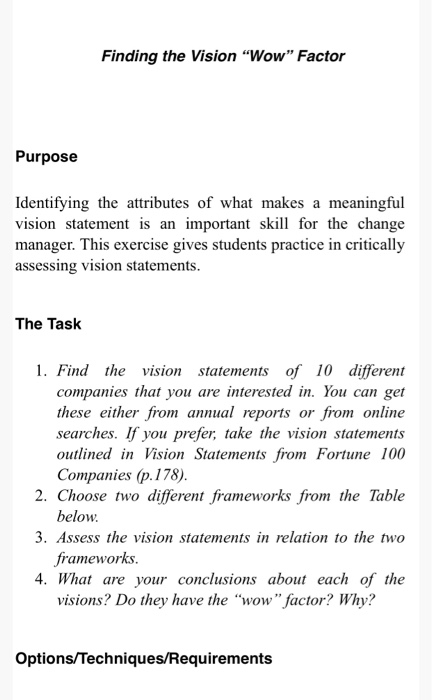
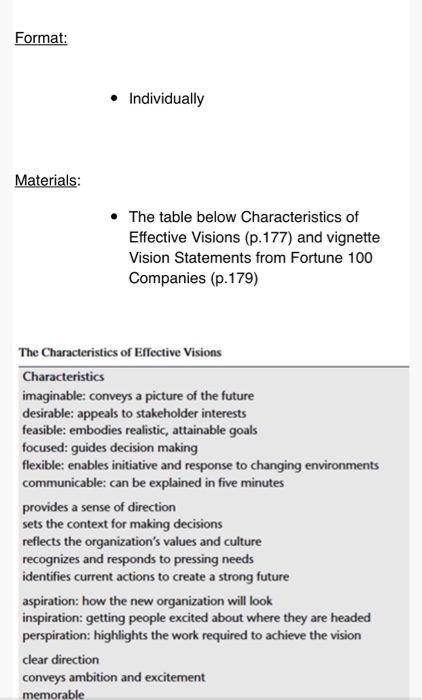
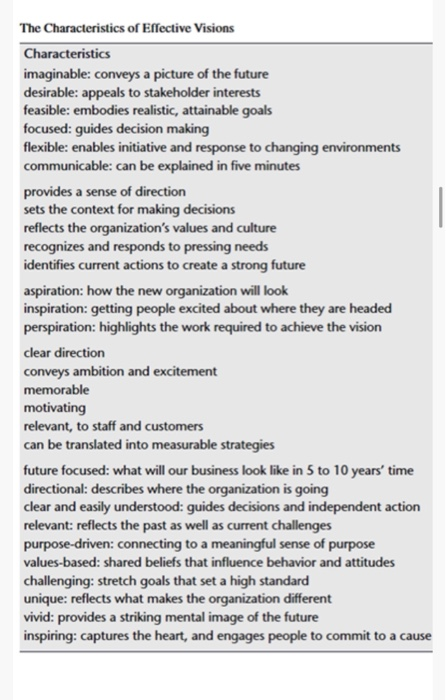
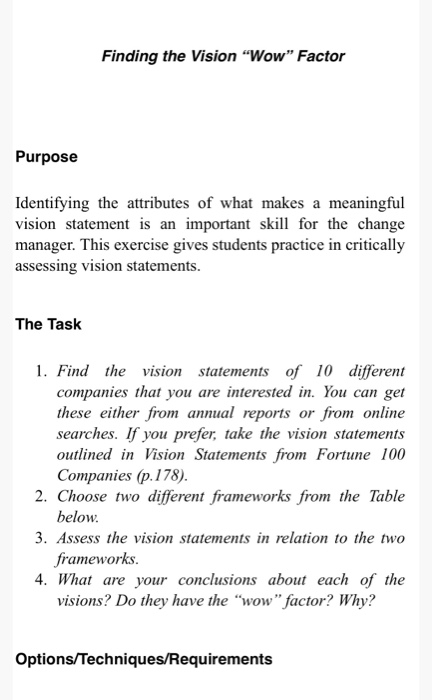
ANSWER QUESTION 3
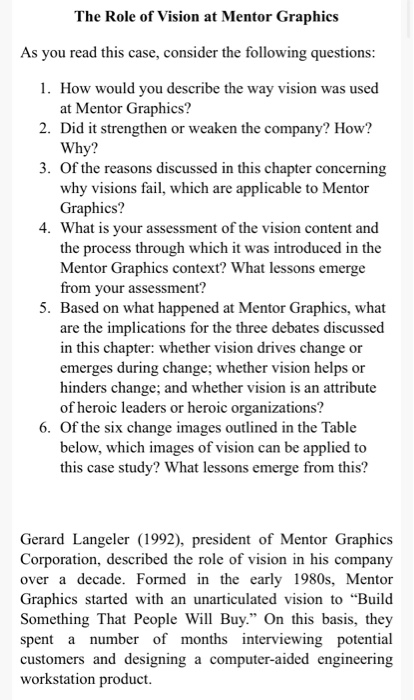
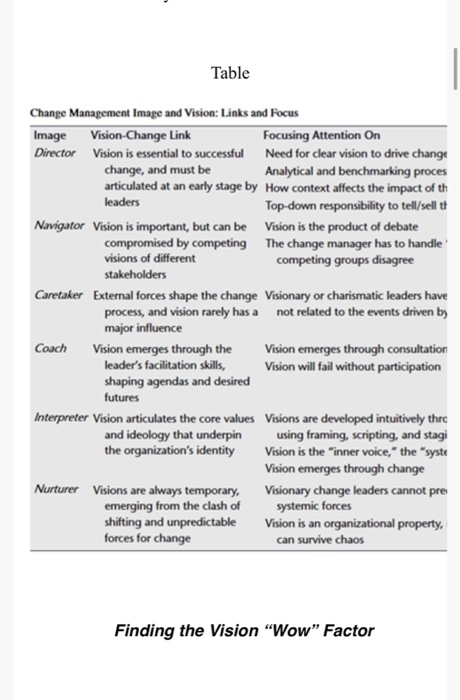
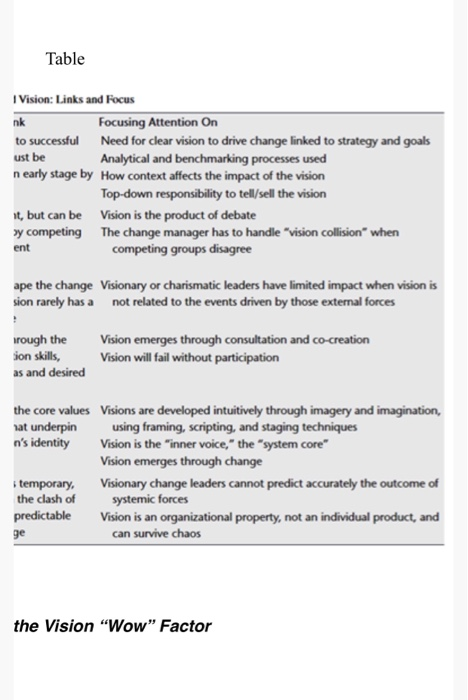
The Role of Vision at Mentor Graphics As you read this case, consider the following questions: 1. How would you describe the way vision was used at Mentor Graphics? 2. Did it strengthen or weaken the company? How? Why? 3. Of the reasons discussed in this chapter concerning why visions fail, which are applicable to Mentor Graphics? 4. What is your assessment of the vision content and the process through which it was introduced in the Mentor Graphics context? What lessons emerge from your assessment? 5. Based on what happened at Mentor Graphics, what are the implications for the three debates discussed in this chapter: whether vision drives change or emerges during change; whether vision helps or hinders change; and whether vision is an attribute of heroic leaders or heroic organizations? 6. Of the six change images outlined in the Table below, which images of vision can be applied to this case study? What lessons emerge from this? Gerard Langeler (1992), president of Mentor Graphics Corporation, described the role of vision in his company over a decade. Formed in the early 1980s, Mentor Graphics started with an unarticulated vision to "Build Something That People Will Buy. On this basis, they spent a number of months interviewing potential customers and designing a computer-aided engineering workstation product. At the same time, a competitor, Daisy Systems, was engaged in the same task and, in the early years, outcompeted Mentor Graphics. Eventually, Beat Daisy" became the new vision, driven by the need to survive as a business. By 1985 Mentor's revenues were higher than Daisy's; their vision had been realized. The company continued to grow despite the recession, but it suffered from typical growth problems, including decline in product quality and problems of internal company coordination. Stock value also suffered, and a number of staff approached Langeler seeking a new vision for the company. The new vision was developed based on Six Boxes," which represented the six different businesses in which the company sought market leadership. The Six Boxes became a company mantra, but in the late 1980s, one of the businesses, computer-aided publishing, was not paying dividends. However, the fact that it constituted one of the Six Boxes meant that they could not shut it down and be left with a Five Boxes vision. In this case, the existence of the vision disrupted the ability to make sound financial judgements. It also stopped them from moving more quickly to using Sun platforms, something they thought was too conventional for them. A new vision was developedthe 10X Imperative- that mirrored the push other companies were making toward quality through Six Sigma and other similar quality programs. However, customers did not really understand the new vision: it was too abstract and elusive. In 1989 yet another vision emerged: Changing the Way the World Designs Together. In retrospect, Langeler depicts this vision as the final extension of vision creep that began with Six Boxes. It was very grand and had little to do with the actual businesses in which Mentor Graphics operated, including the development of its new 8.0 generation of software. The realization, by the early 1990s, that the company's vision detracted from what the company was actually trying to achieve led to the dumping of the vision and its replacement with one that echoed the early beginning of the company: Our current short-, medium-, and long- term vision is to build things people will buy. This was seen as a more pragmatic vision for a company that had lost its way, caught up in a cycle of visions that were increasingly irrelevant to the core business and which inhibited their ability to make sound business decisions. Table Change Management Image and Vision: Links and Focus Image Vision-Change Link Focusing Attention on Director Vision is essential to successful Need for clear vision to drive change change, and must be Analytical and benchmarking proces articulated at an early stage by How context affects the impact of th leaders Top-down responsibility to tell/sell tt Navigator Vision is important, but can be vision is the product of debate compromised by competing The change manager has to handle visions of different competing groups disagree stakeholders Caretaker External forces shape the change Visionary or charismatic leaders have process, and vision rarely has a not related to the events driven by major influence Coach Vision emerges through the Vision emerges through consultation leader's facilitation skills, Vision will fail without participation shaping agendas and desired futures Interpreter Vision articulates the core values Visions are developed intuitively thrc and ideology that underpin using framing, scripting, and stagi the organization's identity Vision is the "inner voice," the "syste Vision emerges through change Nurturer Visions are always temporary, Visionary change leaders cannot pre emerging from the clash of systemic forces shifting and unpredictable Vision is an organizational property, forces for change can survive chaos Finding the Vision "Wow" Factor Table I Vision: Links and Focus nk Focusing Attention on to successful Need for clear vision to drive change linked to strategy and goals ust be Analytical and benchmarking processes used n early stage by How context affects the impact of the vision Top-down responsibility to tell sell the vision it, but can be vision is the product of debate y competing The change manager has to handle "vision collision when ent competing groups disagree ape the change Visionary or charismatic leaders have limited impact when vision is sion rarely has a not related to the events driven by those external forces rough the sion skills, as and desired Vision emerges through consultation and co-creation Vision will fail without participation the core values Visions are developed intuitively through imagery and imagination, at underpin using framing, scripting, and staging techniques n's identity Vision is the inner voice," the "system core" Vision emerges through change i temporary Visionary change leaders cannot predict accurately the outcome of the clash of systemic forces predictable Vision is an organizational property, not an individual product, and ge can survive chaos the Vision "Wow" Factor Finding the Vision Wow Factor Purpose Identifying the attributes of what makes a meaningful vision statement is an important skill for the change manager. This exercise gives students practice in critically assessing vision statements. The Task 1. Find the vision statements of 10 different companies that you are interested in. You can get these either from annual reports or from online searches. If you prefer, take the vision statements outlined in Vision Statements from Fortune 100 Companies (p.178) 2. Choose two different frameworks from the Table below. 3. Assess the vision statements in relation to the two frameworks. 4. What are your conclusions about each of the visions? Do they have the wow factor? Why? Options/Techniques/Requirements Format: Individually Materials: The table below Characteristics of Effective Visions (p.177) and vignette Vision Statements from Fortune 100 Companies (p.179) The Characteristics of Effective Visions Characteristics imaginable: conveys a picture of the future desirable: appeals to stakeholder interests feasible: embodies realistic, attainable goals focused: guides decision making flexible: enables initiative and response to changing environments communicable: can be explained in five minutes provides a sense of direction sets the context for making decisions reflects the organization's values and culture recognizes and responds to pressing needs identifies current actions to create a strong future aspiration: how the new organization will look inspiration: getting people excited about where they are headed perspiration: highlights the work required to achieve the vision clear direction conveys ambition and excitement memorable The Characteristics of Effective Visions Characteristics imaginable: conveys a picture of the future desirable: appeals to stakeholder interests feasible: embodies realistic, attainable goals focused: guides decision making flexible: enables initiative and response to changing environments communicable: can be explained in five minutes provides a sense of direction sets the context for making decisions reflects the organization's values and culture recognizes and responds to pressing needs identifies current actions to create a strong future aspiration: how the new organization will look inspiration: getting people excited about where they are headed perspiration: highlights the work required to achieve the vision clear direction conveys ambition and excitement memorable motivating relevant to staff and customers can be translated into measurable strategies future focused: what will our business look like in 5 to 10 years' time directional: describes where the organization is going clear and easily understood: guides decisions and independent action relevant: reflects the past as well as current challenges purpose-driven: connecting to a meaningful sense of purpose values-based: shared beliefs that influence behavior and attitudes challenging: stretch goals that set a high standard unique: reflects what makes the organization different vivid: provides a striking mental image of the future inspiring: captures the heart, and engages people to commit to a cause Finding the Vision Wow Factor Purpose Identifying the attributes of what makes a meaningful vision statement is an important skill for the change manager. This exercise gives students practice in critically assessing vision statements. The Task 1. Find the vision statements of 10 different companies that you are interested in. You can get these either from annual reports or from online searches. If you prefer, take the vision statements outlined in Vision Statements from Fortune 100 Companies (p. 178). 2. Choose two different frameworks from the Table below. 3. Assess the vision statements in relation to the two frameworks. 4. What are your conclusions about each of the visions? Do they have the wow factor? Why? Options/Techniques/Requirements