







Question: Answer question 3 with explanation and work in excel please. 1) (10%) - Discuss about Jaguar's exchange rate exposures. (5) - To which currencies is
Answer question 3 with explanation and work in excel please.
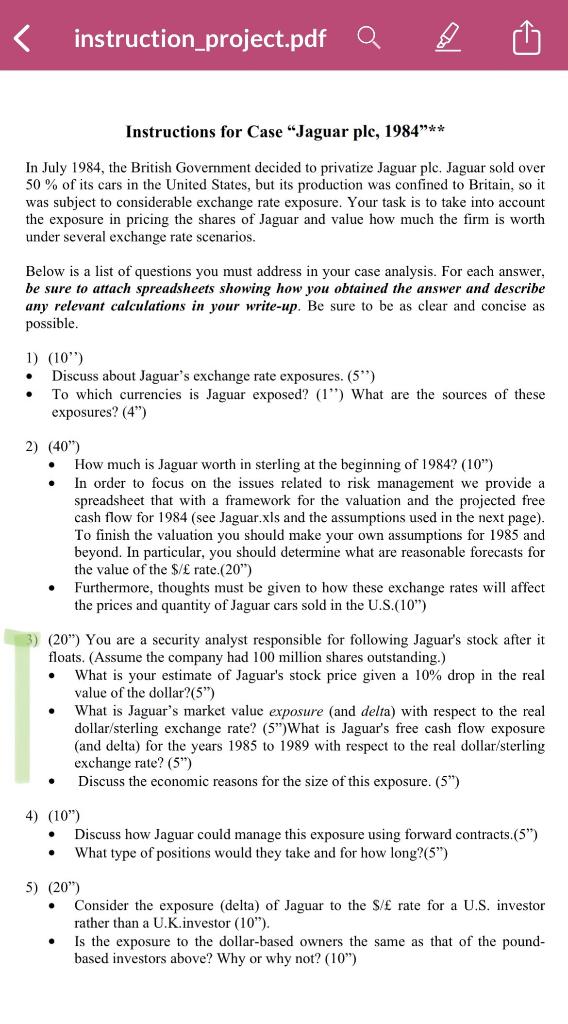
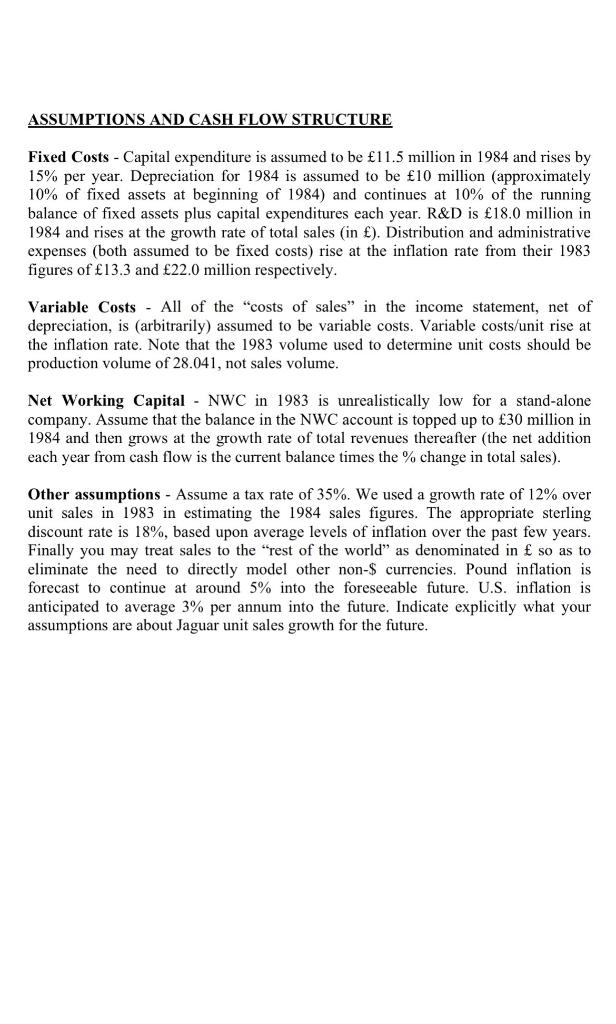
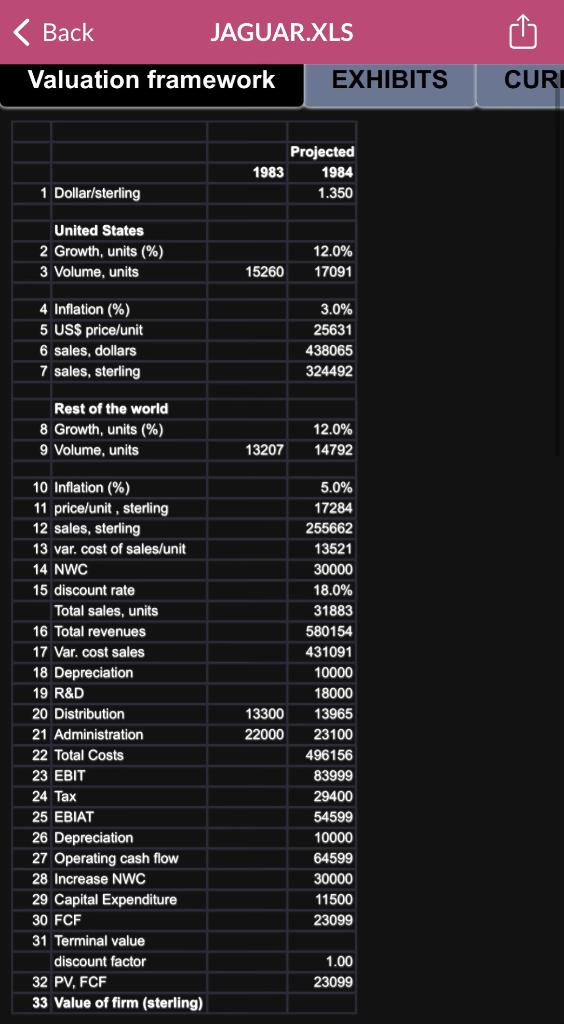
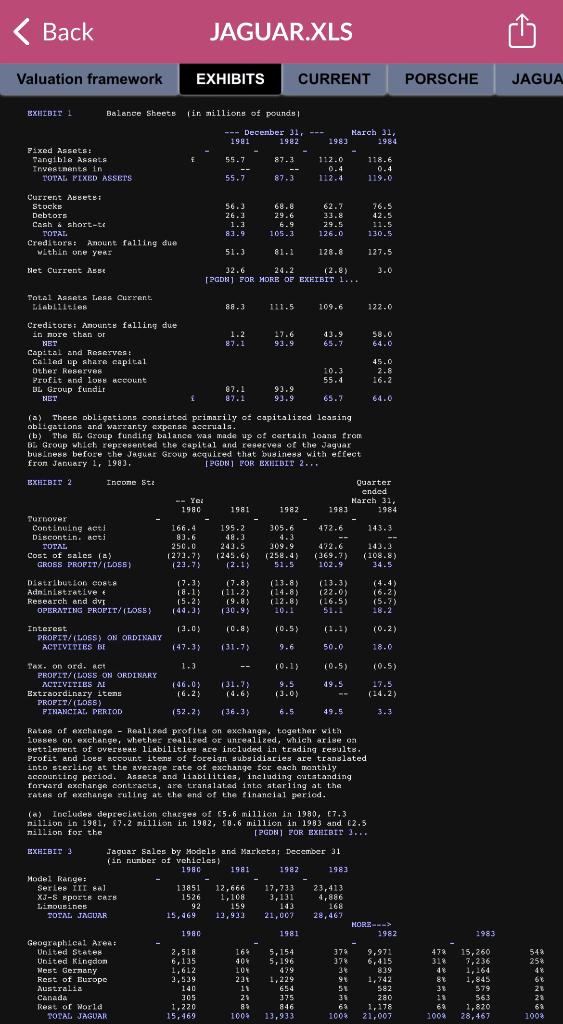
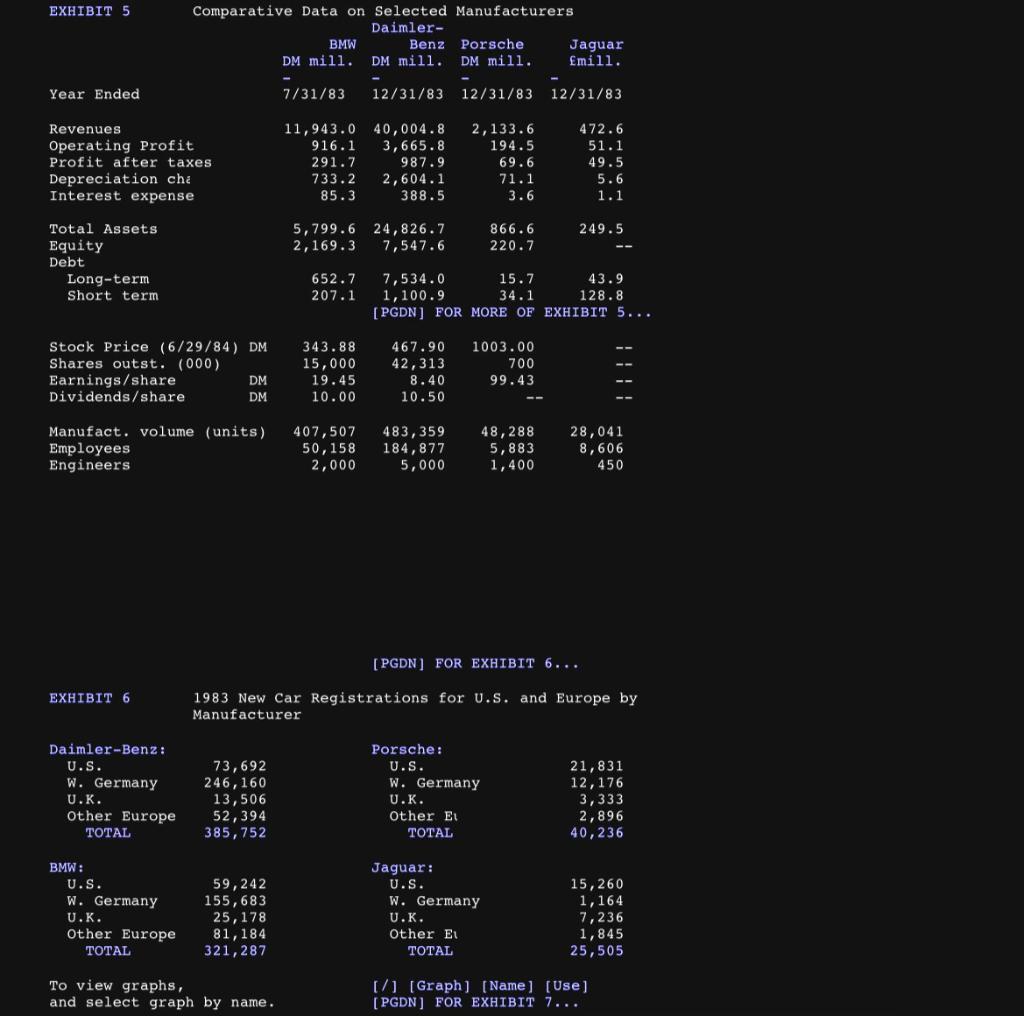
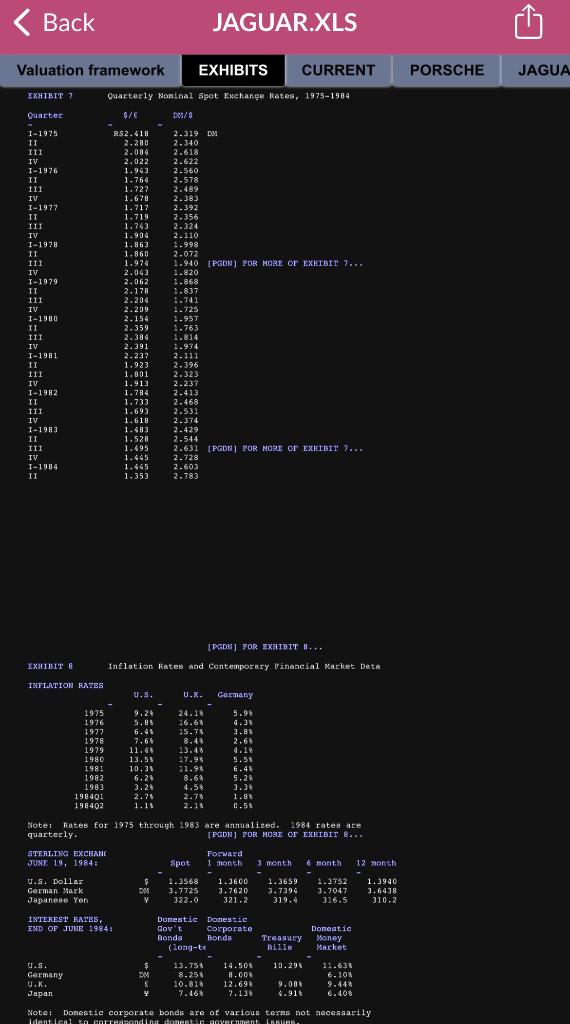
1) (10%) - Discuss about Jaguar's exchange rate exposures. (5") - To which currencies is Jaguar exposed? (1") What are the sources of these exposures? (4") 2) (40) - How much is Jaguar worth in sterling at the beginning of 1984 ? (10") - In order to focus on the issues related to risk management we provide a spreadsheet that with a framework for the valuation and the projected free cash flow for 1984 (see Jaguar.xls and the assumptions used in the next page). To finish the valuation you should make your own assumptions for 1985 and beyond. In particular, you should determine what are reasonable forecasts for the value of the $/ rate.(20") - Furthermore, thoughts must be given to how these exchange rates will affect the prices and quantity of Jaguar cars sold in the U.S.(10") 3) (20") You are a security analyst responsible for following Jaguar's stock after it floats. (Assume the company had 100 million shares outstanding.) - What is your estimate of Jaguar's stock price given a 10% drop in the real value of the dollar?(5") - What is Jaguar's market value exposure (and delta) with respect to the real dollar/sterling exchange rate? (5")What is Jaguar's free cash flow exposure (and delta) for the years 1985 to 1989 with respect to the real dollar/sterling exchange rate? (5") - Discuss the economic reasons for the size of this exposure. (5") 4) (10) - Discuss how Jaguar could manage this exposure using forward contracts.(5") - What type of positions would they take and for how long?(5") 5) (20) - Consider the exposure (delta) of Jaguar to the $/ rate for a U.S. investor rather than a U.K.investor (10"). - Is the exposure to the dollar-based owners the same as that of the poundbased investors above? Why or why not? (10") ASSUMPTIONS AND CASH FLOW STRUCTURE Fixed Costs - Capital expenditure is assumed to be 11.5 million in 1984 and rises by 15% per year. Depreciation for 1984 is assumed to be 10 million (approximately 10% of fixed assets at beginning of 1984) and continues at 10% of the running balance of fixed assets plus capital expenditures each year. R\&D is 18.0 million in 1984 and rises at the growth rate of total sales (in ). Distribution and administrative expenses (both assumed to be fixed costs) rise at the inflation rate from their 1983 figures of 13.3 and 22.0 million respectively. Variable Costs - All of the "costs of sales" in the income statement, net of depreciation, is (arbitrarily) assumed to be variable costs. Variable costs/unit rise at the inflation rate. Note that the 1983 volume used to determine unit costs should be production volume of 28.041, not sales volume. Net Working Capital - NWC in 1983 is unrealistically low for a stand-alone company. Assume that the balance in the NWC account is topped up to 30 million in 1984 and then grows at the growth rate of total revenues thereafter (the net addition each year from cash flow is the current balance times the % change in total sales). Other assumptions - Assume a tax rate of 35%. We used a growth rate of 12% over unit sales in 1983 in estimating the 1984 sales figures. The appropriate sterling discount rate is 18%, based upon average levels of inflation over the past few years. Finally you may treat sales to the "rest of the world" as denominated in so as to eliminate the need to directly model other non- $ currencies. Pound inflation is forecast to continue at around 5% into the foreseeable future. U.S. inflation is anticipated to average 3% per annum into the future. Indicate explicitly what your assumptions are about Jaguar unit sales growth for the future. [PGDN] FOR EXHIBIT 6... EXHIBIT6Manufacturer1983NewCarRegistrationsforU.S.andEuropeby Daimler-Benz:U.S.W.GermanyU.K.OtherEuropeTOTALBMW:U.S.W.GermanyU.K.OtherEuropeTOTAL73,692246,16013,50652,394385,75259,242155,68325,17881,184321,287 Porsche:U.S.W.GermanyU.K.OtherEtTOTALJaguar:U.S.W.GermanyU.K.OtherEtTOTAL21,83112,1763,3332,89640,23615,2601,1647,2361,84525,505 To view graphs, [/] [Graph] [Name] [Use] and select graph by name. [PGDN] FOR EXHIBIT 7 Valuation framework 1) (10%) - Discuss about Jaguar's exchange rate exposures. (5") - To which currencies is Jaguar exposed? (1") What are the sources of these exposures? (4") 2) (40) - How much is Jaguar worth in sterling at the beginning of 1984 ? (10") - In order to focus on the issues related to risk management we provide a spreadsheet that with a framework for the valuation and the projected free cash flow for 1984 (see Jaguar.xls and the assumptions used in the next page). To finish the valuation you should make your own assumptions for 1985 and beyond. In particular, you should determine what are reasonable forecasts for the value of the $/ rate.(20") - Furthermore, thoughts must be given to how these exchange rates will affect the prices and quantity of Jaguar cars sold in the U.S.(10") 3) (20") You are a security analyst responsible for following Jaguar's stock after it floats. (Assume the company had 100 million shares outstanding.) - What is your estimate of Jaguar's stock price given a 10% drop in the real value of the dollar?(5") - What is Jaguar's market value exposure (and delta) with respect to the real dollar/sterling exchange rate? (5")What is Jaguar's free cash flow exposure (and delta) for the years 1985 to 1989 with respect to the real dollar/sterling exchange rate? (5") - Discuss the economic reasons for the size of this exposure. (5") 4) (10) - Discuss how Jaguar could manage this exposure using forward contracts.(5") - What type of positions would they take and for how long?(5") 5) (20) - Consider the exposure (delta) of Jaguar to the $/ rate for a U.S. investor rather than a U.K.investor (10"). - Is the exposure to the dollar-based owners the same as that of the poundbased investors above? Why or why not? (10") ASSUMPTIONS AND CASH FLOW STRUCTURE Fixed Costs - Capital expenditure is assumed to be 11.5 million in 1984 and rises by 15% per year. Depreciation for 1984 is assumed to be 10 million (approximately 10% of fixed assets at beginning of 1984) and continues at 10% of the running balance of fixed assets plus capital expenditures each year. R\&D is 18.0 million in 1984 and rises at the growth rate of total sales (in ). Distribution and administrative expenses (both assumed to be fixed costs) rise at the inflation rate from their 1983 figures of 13.3 and 22.0 million respectively. Variable Costs - All of the "costs of sales" in the income statement, net of depreciation, is (arbitrarily) assumed to be variable costs. Variable costs/unit rise at the inflation rate. Note that the 1983 volume used to determine unit costs should be production volume of 28.041, not sales volume. Net Working Capital - NWC in 1983 is unrealistically low for a stand-alone company. Assume that the balance in the NWC account is topped up to 30 million in 1984 and then grows at the growth rate of total revenues thereafter (the net addition each year from cash flow is the current balance times the % change in total sales). Other assumptions - Assume a tax rate of 35%. We used a growth rate of 12% over unit sales in 1983 in estimating the 1984 sales figures. The appropriate sterling discount rate is 18%, based upon average levels of inflation over the past few years. Finally you may treat sales to the "rest of the world" as denominated in so as to eliminate the need to directly model other non- $ currencies. Pound inflation is forecast to continue at around 5% into the foreseeable future. U.S. inflation is anticipated to average 3% per annum into the future. Indicate explicitly what your assumptions are about Jaguar unit sales growth for the future. [PGDN] FOR EXHIBIT 6... EXHIBIT6Manufacturer1983NewCarRegistrationsforU.S.andEuropeby Daimler-Benz:U.S.W.GermanyU.K.OtherEuropeTOTALBMW:U.S.W.GermanyU.K.OtherEuropeTOTAL73,692246,16013,50652,394385,75259,242155,68325,17881,184321,287 Porsche:U.S.W.GermanyU.K.OtherEtTOTALJaguar:U.S.W.GermanyU.K.OtherEtTOTAL21,83112,1763,3332,89640,23615,2601,1647,2361,84525,505 To view graphs, [/] [Graph] [Name] [Use] and select graph by name. [PGDN] FOR EXHIBIT 7 Valuation framework
Step by Step Solution
There are 3 Steps involved in it

Get step-by-step solutions from verified subject matter experts
 Study Help