







Question: Answer question 4 Ward-to a. Asset A . Asset B c. No risky asset d. Can't tell from the data given an expected return of
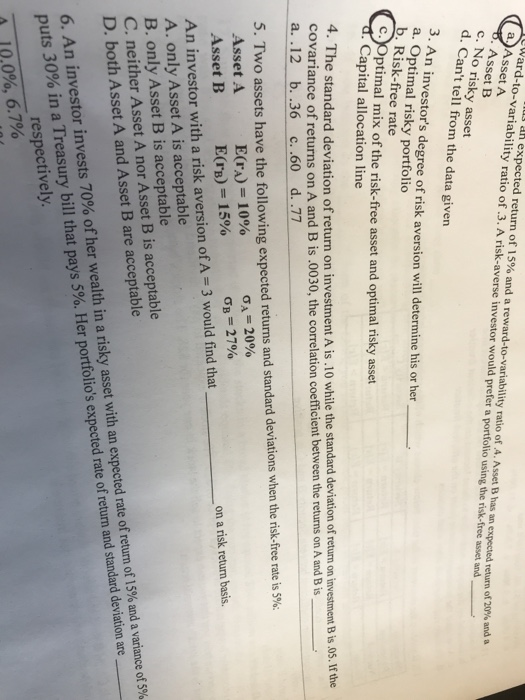
Ward-to a. Asset A . Asset B c. No risky asset d. Can't tell from the data given an expected return of 1 5% and a reward-to-variability ratio of .4 . Asset B has iability ratio of .3. A risk-averse investor would prefer a portfolio using the risk-free asset and an expected return of 20% and a 3. An investor's degree of risk aversion will determine his or her a Optimal risky portfolio b. Risk-free rate c.Optimal mix of the risk-free asset and optimal risky asset Capital allocation line 4. The standard deviation of return on investment A is.10 while the standard deviation of returm on investment B is 05. If the covariance of returns on A and B is 0030, the correlation coefficient between the returns on A and Bis a. .12 b. .36 c..60 d. .77 5. Two assets have the following expected returns and standard deviations when the risk-free rate is 5% E(rA)-10% E(I-B)-15% Asset A Asset B on a risk return basis An investor with a risk aversion of A-3 would find that A. only Asset A is acceptable B. only Asset B is acceptable C. neither Asset A nor Asset B is acceptable D. both Asset A and Asset B are acceptable 6. An investor invests 70% of her wealth in a risky asset with an expected rate of return of 15% and a variance of pu d standard deviation are ts 30% in a Treasury bill that pays 5%. Her portfolio's expected rate of return an respectively 10.0%, 6.7%
Step by Step Solution
There are 3 Steps involved in it

Get step-by-step solutions from verified subject matter experts
 Study Help