







Question: answer question keep it 1 paragraph max please. 10.2 Discussion: Negative or Unreasonable People This question refers to the article Think of a negative person

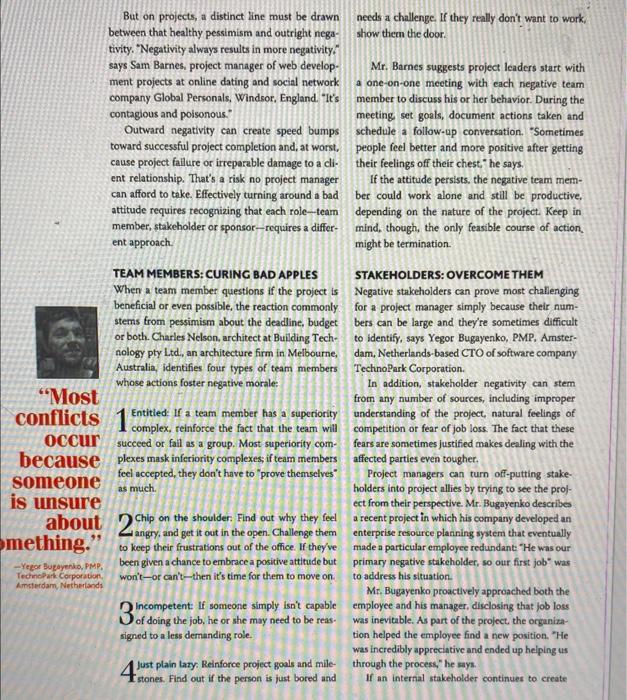
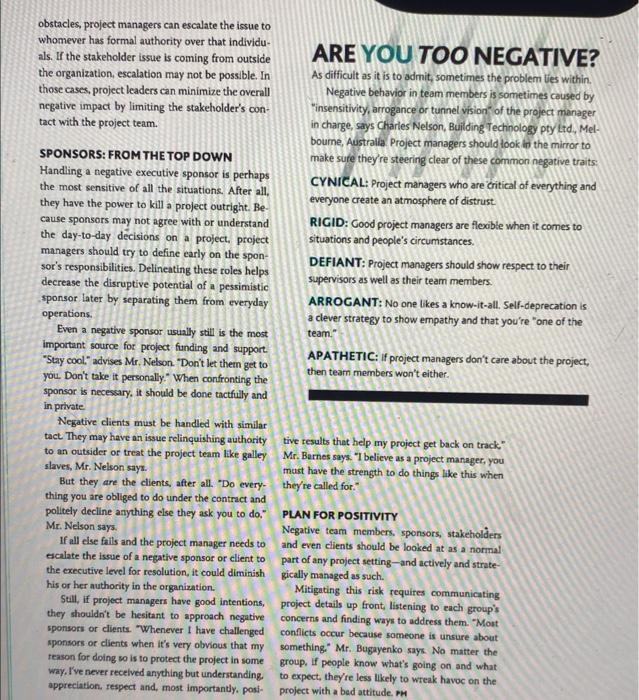
10.2 Discussion: Negative or Unreasonable People This question refers to the article Think of a negative person you know (no names!) Do the following: - Describe which of the four types in the article (Entitled, Chip, Incompetent or Lazy) they are. - Give examples of how they match that type - Describe which tactics (either in the chapter on page 436 or the article) would work best on them (and why) But on projects, a distinct line must be drawn needs a challenge. If they really don't want to work, between that healthy pessimism and outright nega- show them the door. tivity. "Negativity always results in more negativity," says Sam Barnes, project manager of web develop- Mr. Barnes suggests project leaders start with ment projects at online dating and social network a one-on-one meeting with each negative team company Global Personals. Windsor, England. "It's member to discuss his or her behavior. During the contagious and poisonous." meeting set goals, document actions taken and Outward negativity can create speed bumps schedule a follow-up conversation. "Sometimes toward successful project completion and, at worst, people feel better and more positive after getting cause project fallure or irreparable damage to a cli- their feelings off their chest, "he says. ent relationship. That's a risk no project manager If the attitude persists, the negative team memcan afford to take. Effectively turning around a bad ber could work alone and still be productive. attitude requires recognizing that each role-team depending on the nature of the project Keep in member, stakeholder or sponsor-requires a differ- mind, though, the only feasible course of action. ent approach. might be termination. TEAM MEMBERS: CURING BAD APPLES STAKEHOLDERS: OVERCOME THEM When a team member questions if the project is Negative stakeholders can prove most challenging beneficial or even possible, the reaction commonly for a project manager simply because their numstems from pessimism about the deadline, budget bers can be large and they're sometimes difficult or both. Charles Nelson, architect at Building Tech- to identify, says Yegor Bugayenko, PMP, Amsternology pty Ltd, an architecture firm in Melbourne, dam, Netherlands-based CTO of software company Australia, identifies four types of team members TechnoPark Corporation. whose actions foster negative morale: In addition, stakeholder negativity can stem 66Mosl from any number of sources, including improper CODfHCLS 1 Entitied If a team member has a superiority understanding of the project, natural feelings of OCCIIr complex, reinforce the fact that the team will competition or fear of job loss. The fact that these succeed or fail as a group. Most superiority com- fears are sometimes justified makes dealing with the DCCAIISB plexes mask inferiority complexes, if team members affected parties even tougher. QOII ODJo feel accepted, they don't have to "prove themselves" Project managers can turn off-putting stakeas much. holders into project allies by trying to see the projQh0U1. Chip on the shoulder. Find out why they feel a recent project in which his company developed an m athim os angry, and get it out in the open. Challenge them enterprise resource planning system that eventually to keep their frustrations out of the office. If they've made a particular employee redundant "He was our -Yegor sugayenio, PMP, been given a chance to embrace a positive attitude but primary negative stakeholder, so our first job" was Tecinclaik Conporation. won't-or can't-then it's time for them to move on. to address his situation. Amsterdam, Nethertand 1 Mr. Bugayenko proactively approached both the R incompetent: If someone simply isn't capable employee and his manager, disclosing that job loss of doing the job, he or she may need to be reas- was inevitable. As part of the project, the organizasigned to a less demanding role. tion helped the employee find a new position. "He was incredibly appreciative and ended up helping us 4 Just plain tary. Reinforce project gouls and mile- through the process, he says. obstacles, project managers can escalate the issue to whomever has formal authority over that individuals. If the stakeholder issue is coming from outside ARE YO TOOEATIVE? the organization, escalation may not be possible. In As difficult as it is to admit, sometimes the problem Ues within. those cases, project leaders can minimize the overall Negative behavior in team members is sometimes caused by negative impact by limiting the stakeholder's con- "insensitivity, arrogance or tunnel vision" of the project manager tact with the project team. in charge, says Charles Nelson, Buiding Technology pty Ltd, Melboume, Australle. Project managers should look ir the mirror to SPONSORS: FROMTHETOP DOWN make sure they re steering clear of these common negative traits: Handling a negative executive sponsor is perhaps the most sensitive of all the situations. After all. CYNICAL: Project managers who are critical of everything and they have the power to kill a project outright. Be. everyone create an atmosphere of distrust. cause sponsors may not agree with or understand RIGID: Cood project managers are flecible when it comes to the day-to-day decisions on a project, project situations and people's circumstances. managers should try to define early on the sponsor's responsibilities. Delineating these roles helps DEFIANT: Project managers should show respect to their decrease the disruptive potential of a pessimistic operations. Even a negative sponsor usually still is the most team." important source for project funding and support. "Stay cool," advises Mr, Nelson. "Don't let thein get to you. Don't take it personally. When confronting the sponsor is necessary, it should be done thctfully and in private Negative clients must be handled with similar tact. They may have an issue relinquishing authority tive results that help my project get back on track", to an outsider or treat the project team like galley Mr. Barnes says. "I believe as a project manager, you slaves, Mr. Nelson says. mast have the strength to do things like this when But they are the clients, after all. "Do every. they re called for." thing you are obliged to do under the contract and politely decline anything else they ask you to do." PLAN FOR POSITIVITY Mr. Nelson says. Negative team members, sponsors, stakeholders If all else fails and the project manager needs to and even clients should be looked at as a normal. escalate the issue of a negative sponsor or client to part of any project setting-and actively and stratethe executive level for resolution, it could diminish gically managed as such. his or her authority in the organization. Mitigating this risk requires communicating Still, if project managers have good intentions, project details up front, listening to each group's they shouldn't be hesitant to approach negative concerns and finding ways to address them. "Mout sponsors or clients. Whenever 1 have challenged conflicts occur because someone is unsure about sponsors or clients when it's very obvious that my something." Mr. Bugayenko says. No matter the reason for doing so is to protect the project in some group, if people know what's going on and what way, I've never recelved anything but understanding, to expect, they/re less likely to wreak havoc on the appreciation, respect and, most importantly, posf- project with a bed attitude. FH. 10.2 Discussion: Negative or Unreasonable People This question refers to the article Think of a negative person you know (no names!) Do the following: - Describe which of the four types in the article (Entitled, Chip, Incompetent or Lazy) they are. - Give examples of how they match that type - Describe which tactics (either in the chapter on page 436 or the article) would work best on them (and why) But on projects, a distinct line must be drawn needs a challenge. If they really don't want to work, between that healthy pessimism and outright nega- show them the door. tivity. "Negativity always results in more negativity," says Sam Barnes, project manager of web develop- Mr. Barnes suggests project leaders start with ment projects at online dating and social network a one-on-one meeting with each negative team company Global Personals. Windsor, England. "It's member to discuss his or her behavior. During the contagious and poisonous." meeting set goals, document actions taken and Outward negativity can create speed bumps schedule a follow-up conversation. "Sometimes toward successful project completion and, at worst, people feel better and more positive after getting cause project fallure or irreparable damage to a cli- their feelings off their chest, "he says. ent relationship. That's a risk no project manager If the attitude persists, the negative team memcan afford to take. Effectively turning around a bad ber could work alone and still be productive. attitude requires recognizing that each role-team depending on the nature of the project Keep in member, stakeholder or sponsor-requires a differ- mind, though, the only feasible course of action. ent approach. might be termination. TEAM MEMBERS: CURING BAD APPLES STAKEHOLDERS: OVERCOME THEM When a team member questions if the project is Negative stakeholders can prove most challenging beneficial or even possible, the reaction commonly for a project manager simply because their numstems from pessimism about the deadline, budget bers can be large and they're sometimes difficult or both. Charles Nelson, architect at Building Tech- to identify, says Yegor Bugayenko, PMP, Amsternology pty Ltd, an architecture firm in Melbourne, dam, Netherlands-based CTO of software company Australia, identifies four types of team members TechnoPark Corporation. whose actions foster negative morale: In addition, stakeholder negativity can stem 66Mosl from any number of sources, including improper CODfHCLS 1 Entitied If a team member has a superiority understanding of the project, natural feelings of OCCIIr complex, reinforce the fact that the team will competition or fear of job loss. The fact that these succeed or fail as a group. Most superiority com- fears are sometimes justified makes dealing with the DCCAIISB plexes mask inferiority complexes, if team members affected parties even tougher. QOII ODJo feel accepted, they don't have to "prove themselves" Project managers can turn off-putting stakeas much. holders into project allies by trying to see the projQh0U1. Chip on the shoulder. Find out why they feel a recent project in which his company developed an m athim os angry, and get it out in the open. Challenge them enterprise resource planning system that eventually to keep their frustrations out of the office. If they've made a particular employee redundant "He was our -Yegor sugayenio, PMP, been given a chance to embrace a positive attitude but primary negative stakeholder, so our first job" was Tecinclaik Conporation. won't-or can't-then it's time for them to move on. to address his situation. Amsterdam, Nethertand 1 Mr. Bugayenko proactively approached both the R incompetent: If someone simply isn't capable employee and his manager, disclosing that job loss of doing the job, he or she may need to be reas- was inevitable. As part of the project, the organizasigned to a less demanding role. tion helped the employee find a new position. "He was incredibly appreciative and ended up helping us 4 Just plain tary. Reinforce project gouls and mile- through the process, he says. obstacles, project managers can escalate the issue to whomever has formal authority over that individuals. If the stakeholder issue is coming from outside ARE YO TOOEATIVE? the organization, escalation may not be possible. In As difficult as it is to admit, sometimes the problem Ues within. those cases, project leaders can minimize the overall Negative behavior in team members is sometimes caused by negative impact by limiting the stakeholder's con- "insensitivity, arrogance or tunnel vision" of the project manager tact with the project team. in charge, says Charles Nelson, Buiding Technology pty Ltd, Melboume, Australle. Project managers should look ir the mirror to SPONSORS: FROMTHETOP DOWN make sure they re steering clear of these common negative traits: Handling a negative executive sponsor is perhaps the most sensitive of all the situations. After all. CYNICAL: Project managers who are critical of everything and they have the power to kill a project outright. Be. everyone create an atmosphere of distrust. cause sponsors may not agree with or understand RIGID: Cood project managers are flecible when it comes to the day-to-day decisions on a project, project situations and people's circumstances. managers should try to define early on the sponsor's responsibilities. Delineating these roles helps DEFIANT: Project managers should show respect to their decrease the disruptive potential of a pessimistic operations. Even a negative sponsor usually still is the most team." important source for project funding and support. "Stay cool," advises Mr, Nelson. "Don't let thein get to you. Don't take it personally. When confronting the sponsor is necessary, it should be done thctfully and in private Negative clients must be handled with similar tact. They may have an issue relinquishing authority tive results that help my project get back on track", to an outsider or treat the project team like galley Mr. Barnes says. "I believe as a project manager, you slaves, Mr. Nelson says. mast have the strength to do things like this when But they are the clients, after all. "Do every. they re called for." thing you are obliged to do under the contract and politely decline anything else they ask you to do." PLAN FOR POSITIVITY Mr. Nelson says. Negative team members, sponsors, stakeholders If all else fails and the project manager needs to and even clients should be looked at as a normal. escalate the issue of a negative sponsor or client to part of any project setting-and actively and stratethe executive level for resolution, it could diminish gically managed as such. his or her authority in the organization. Mitigating this risk requires communicating Still, if project managers have good intentions, project details up front, listening to each group's they shouldn't be hesitant to approach negative concerns and finding ways to address them. "Mout sponsors or clients. Whenever 1 have challenged conflicts occur because someone is unsure about sponsors or clients when it's very obvious that my something." Mr. Bugayenko says. No matter the reason for doing so is to protect the project in some group, if people know what's going on and what way, I've never recelved anything but understanding, to expect, they/re less likely to wreak havoc on the appreciation, respect and, most importantly, posf- project with a bed attitude. FH
Step by Step Solution
There are 3 Steps involved in it

Get step-by-step solutions from verified subject matter experts
 Study Help