Question: answer questions 1,2,3 ETHICS IN PRACTICE CASE Is the Fair Trade Movement Sustainable? The Fair Trade Move was one of the firs fair trade coffee
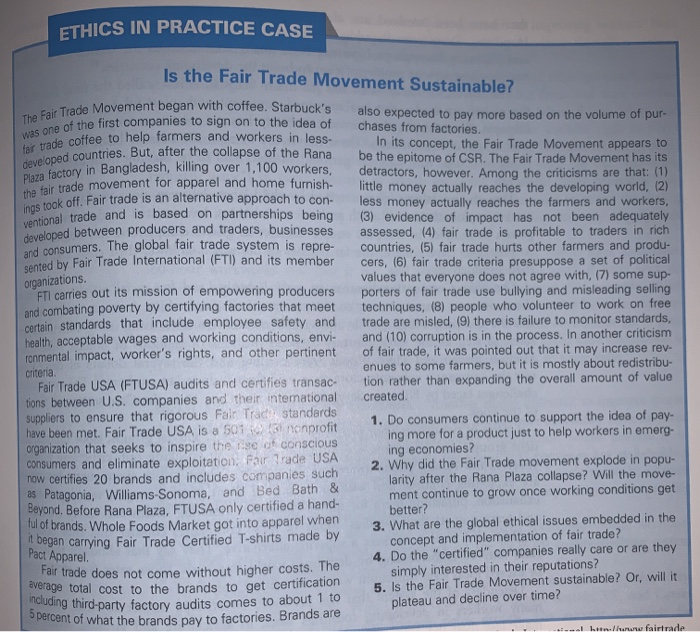
ETHICS IN PRACTICE CASE Is the Fair Trade Movement Sustainable? The Fair Trade Move was one of the firs fair trade coffee to 1. Movement began with coffee. Starbuck's of the first companies to sign on to the idea of e coffee to help farmers and workers in less- ned countries. But, after the collapse of the Rana Plaza factory factory in Bangladesh, killing over 1,100 workers the fair trag fair trade movement for apparel and home furnish ook off. Fair trade is an alternative approach to con- al trade and is based on partnerships being eloped between producers and traders, businesses onsumers. The global fair trade system is repre- cented by Fair Trade International (FTI) and its member organizations. FTI carries out its mission of empowering producers and combating poverty by certifying factories that meet certain standards that include employee safety and health, acceptable wages and working conditions, envi- ronmental impact, worker's rights, and other pertinent criteria. Fair Trade USA (FTUSA) audits and certifies transac- tions between U.S. companies and their international suppliers to ensure that rigorous Fair Trade standards have been met. Fair Trade USA is a 501 nonprofit organization that seeks to inspire the rise of conscious consumers and eliminate exploitation. Fair Trade USA now certifies 20 brands and includes companies such as Patagonia, Williams-Sonoma, and Bed Bath & Beyond. Before Rana Plaza, FTUSA only certified a hand- Tul of brands. Whole Foods Market got into apparel when began carrying Fair Trade Certified T-shirts made by also expected to nav mare based on the volume of pur chases from factories. In its concept, the Fair Trade Movement appears to be the epitome of CSR. The Fair Trade Movement has its detractors, however. Among the criticisms are that: (1) little money actually reaches the developing world, (2) less money actually reaches the farmers and workers, (3) evidence of impact has not been adequately assessed, (4) fair trade is profitable to traders in rich countries, (5) fair trade hurts other farmers and produ- cers, (6) fair trade criteria presuppose a set of political values that everyone does not agree with, (7) some sup. porters of fair trade use bullying and misleading selling techniques, (8) people who volunteer to work on free trade are misled, (9) there is failure to monitor standards, and (10) corruption is in the process. In another criticism of fair trade, it was pointed out that it may increase rev- onues to some farmers, but it is mostly about redistribu- tion rather than expanding the overall amount of value created 1. Do consumers continue to support the idea of pay- ing more for a product just to help workers in emerg. ing economies? 2. Why did the Fair Trade movement explode in popu- larity after the Rana Plaza collapse? Will the move- ment continue to grow once working conditions get better? 3. What are the global ethical issues embedded in the concept and implementation of fair trade? 4. Do the "certified" companies really care or are they simply interested in their reputations? 5. Is the Fair Trade Movement sustainable? Or, will it plateau and decline over time? Pact Apparel. including third-party 5 percent of Fair trade does not come without higher costs. The verage total cost to the brands to get certification ung third-party factory audits comes to about 1 to cent of what the brands pay to factories. Brands are h an fairtrade









 Study Help