



Question: Answer questions 46, 4, 16, and 22 please 46. 45-46 Use the definition of a derivative to find f'(x) and f(x). Then graph f, f',
Answer questions 46, 4, 16, and 22 please
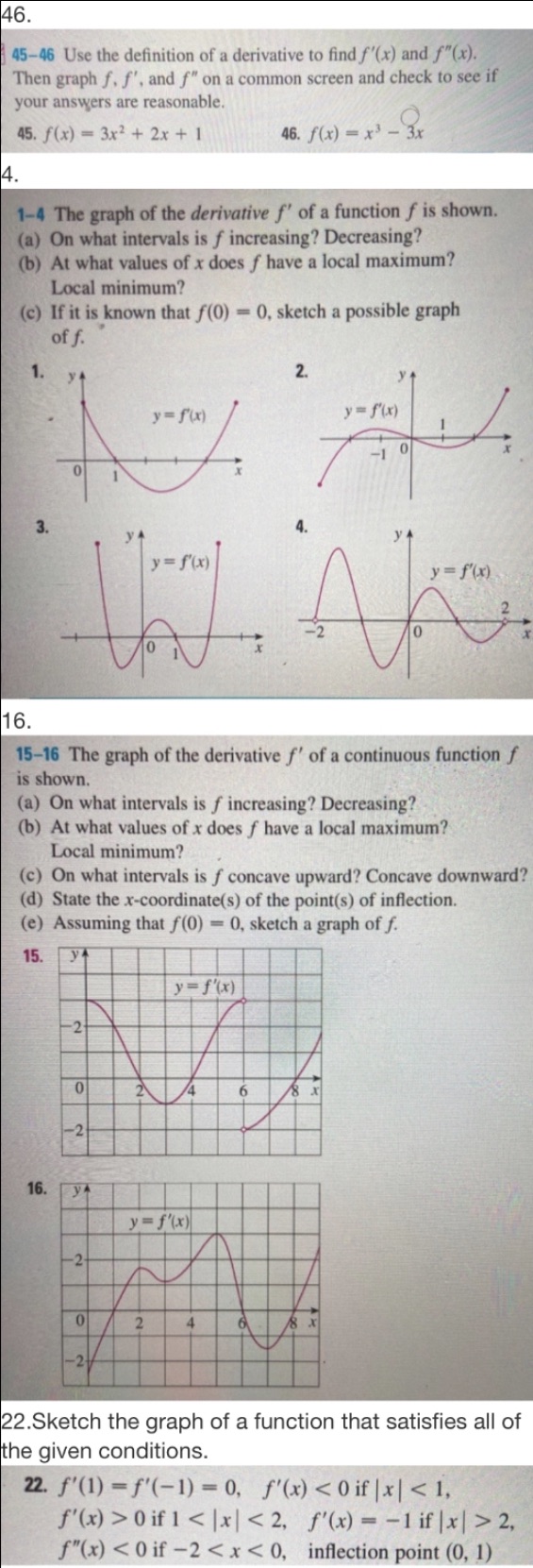
46. 45-46 Use the definition of a derivative to find f'(x) and f"(x). Then graph f, f', and f" on a common screen and check to see if your answers are reasonable. 45. f(x) = 3x2 + 2x + 1 46. f (x) = x3 - 3x 4. 1-4 The graph of the derivative f' of a function f is shown. (a) On what intervals is f increasing? Decreasing? (b) At what values of x does f have a local maximum? Local minimum? (c) If it is known that f(0) = 0, sketch a possible graph of f. 2. y = f(x) y = f'(x) y = f'(x ) 16. 15-16 The graph of the derivative f' of a continuous function f is shown. (a) On what intervals is f increasing? Decreasing? (b) At what values of x does f have a local maximum? Local minimum? (c) On what intervals is f concave upward? Concave downward? (d) State the x-coordinate(s) of the point(s) of inflection. (e) Assuming that f(0) - 0, sketch a graph of f. 15. y = f'(x ) 0 2 6 -2 16. y = f'(x) -2- 22.Sketch the graph of a function that satisfies all of the given conditions. 22. f' (1) = f' (-1) = 0, f'(x) 0if 1 2, f"(x)
Step by Step Solution
There are 3 Steps involved in it

Get step-by-step solutions from verified subject matter experts