



Question: Answer Questions on page 6. An originally neutral electroscope is briefly touched with a negatively charged glass rod. The electroscope A) remains neutral. B) becomes
Answer Questions on page
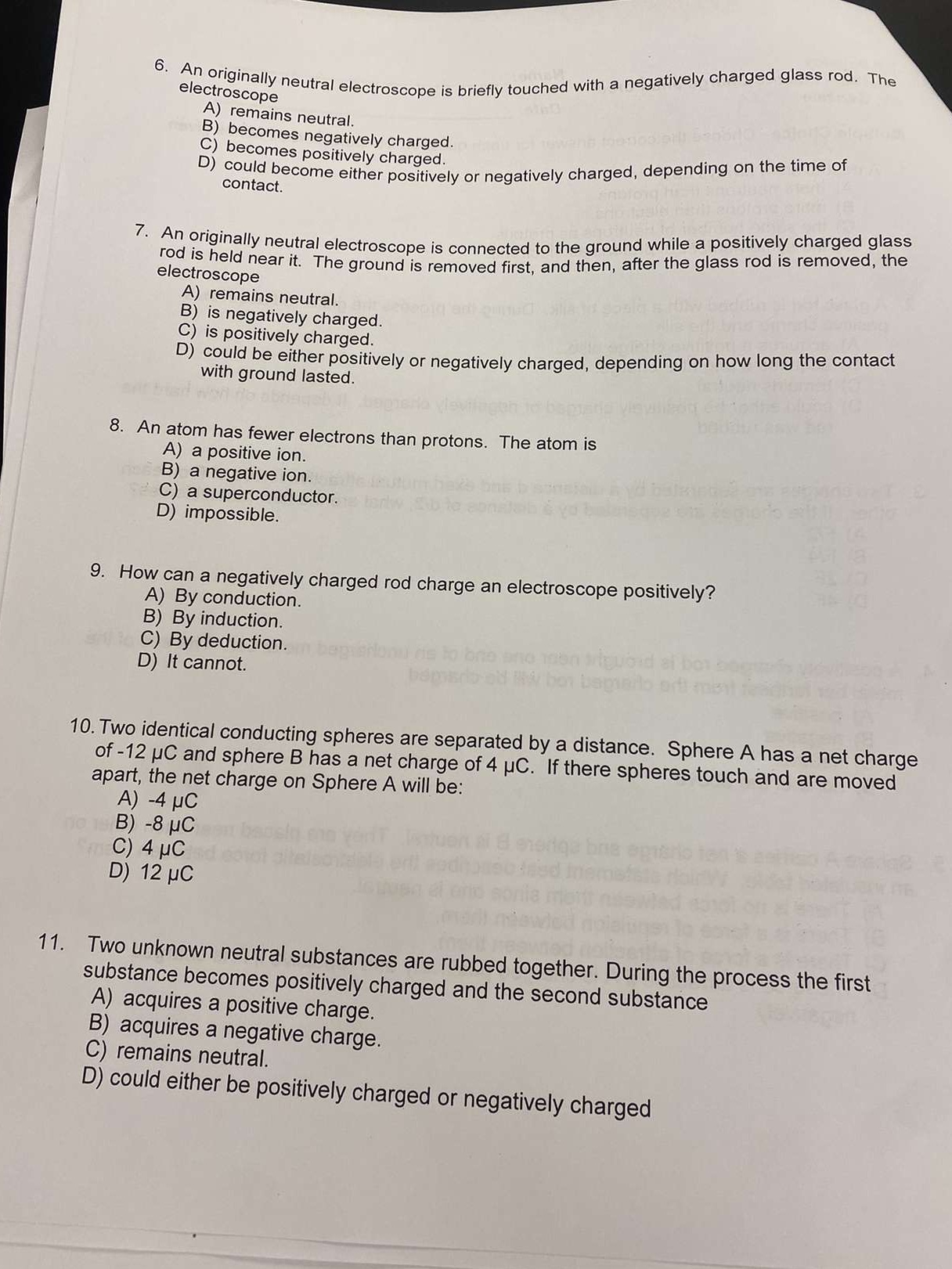
6. An originally neutral electroscope is briefly touched with a negatively charged glass rod. The electroscope A) remains neutral. B) becomes negatively charged. C) becomes positively charged. D) could become either positively or negatively charged, depending on the time of contact. 7. An originally neutral electroscope is connected to the ground while a positively charged glass rod is held near it. The ground is removed first, and then, after the glass rod is removed, the electroscope A) remains neutral. B) is negatively charged. C) is positively charged. D) could be either positively or negatively charged, depending on how long the contact with ground lasted. 8. An atom has fewer electrons than protons. The atom is A) a positive ion. B) a negative ion. C) a superconductor. Stanky D) impossible. 9. How can a negatively charged rod charge an electroscope positively? A) By conduction. B) By induction. C) By deduction. D) It cannot. 10. Two identical conducting spheres are separated by a distance. Sphere A has a net charge of -12 UC and sphere B has a net charge of 4 JC. If there spheres touch and are moved apart, the net charge on Sphere A will be: A) -4 UC B) -8 JC C) 4 HC corot all D) 12 HC 11. Two unknown neutral substances are rubbed together. During the process the first substance becomes positively charged and the second substance A) acquires a positive charge. B) acquires a negative charge. C) remains neutral. D) could either be positively charged or negatively charged
Step by Step Solution
There are 3 Steps involved in it

Get step-by-step solutions from verified subject matter experts