







Question: Physics 30 Unit 2: Electrostatic Charges team assignment Person B EVENS Learning outcomes addressed: B1-1k: explain electrical interactions in terms of the law of conservation
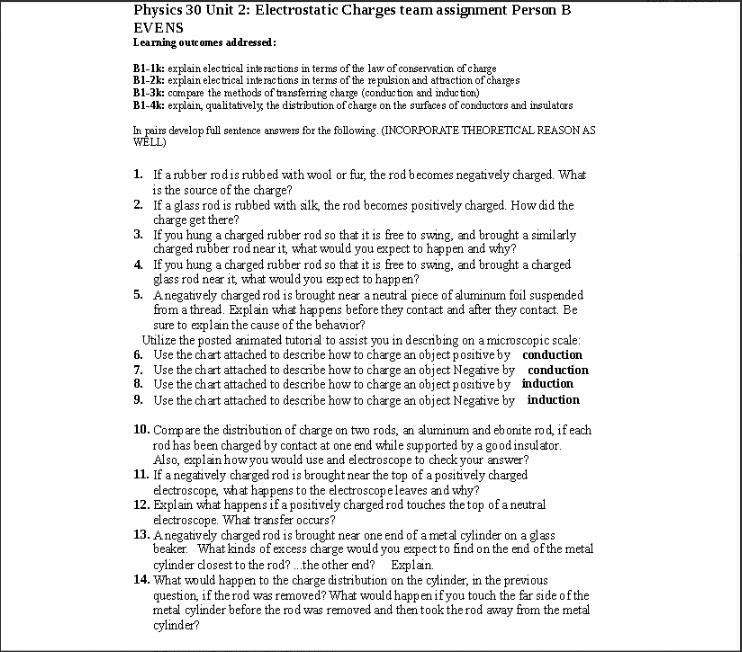
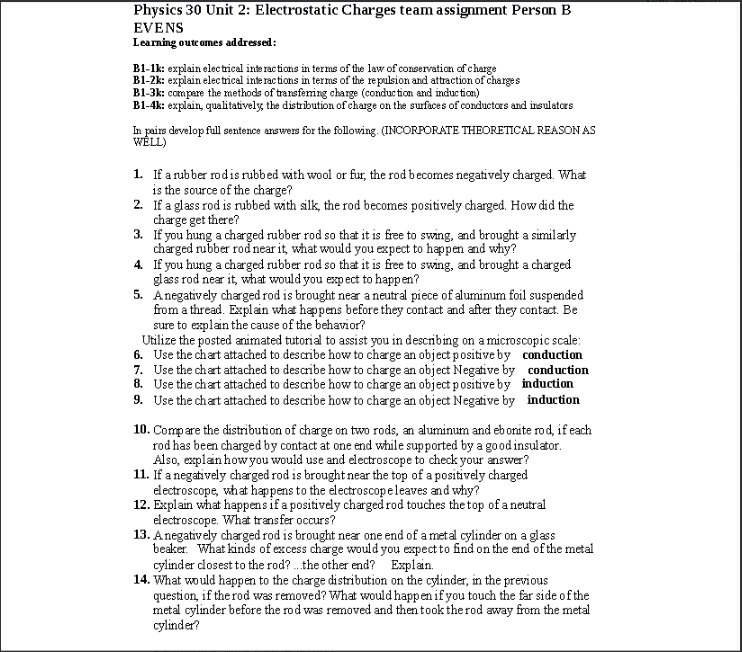
Physics 30 Unit 2: Electrostatic Charges team assignment Person B EVENS Learning outcomes addressed: B1-1k: explain electrical interactions in terms of the law of conservation of charge B1-2k: explain electrical interactions in terms of the repulsion and attraction of charges B1-3k: compare the methods of transferring charge (conduction and induction) B1-4k: explain, qualitatively, the distribution of charge on the surfaces of conductors and insulators In pairs develop full sentence answers for the following. (INCORPORATE THEORETICAL REASON AS WELL) 1. If a rubber rod is rubbed with wool or fur, the rod becomes negatively charged. What is the source of the charge? 2. If a glass rod is rubbed with silk, the rod becomes positively charged. How did the charge get there? 3. If you hung a charged rubber rod so that it is free to swing, and brought a similarly charged rubber rod near it, what would you expect to happen and why? 4. If you hung a charged rubber rod so that it is free to swing, and brought a charged glass rod near it, what would you expect to happen? 5. A negatively charged rod is brought near a neutral piece of aluminum foil suspended from a thread. Explain what happens before they contact and after they contact. Be sure to explain the cause of the behavior? Utilize the posted animated tutorial to assist you in describing on a microscopic scale 6. Use the chart attached to describe how to charge an object positive by conduction 7. Use the chart attached to describe how to charge an object Negative by conduction 8. Use the chart attached to describe how to charge an object positive by induction 9. Use the chart attached to describe how to charge an object Negative by induction 10. Compare the distribution of charge on two rods, an aluminum and ebonite rod, if each rod has been charged by contact at one end while supported by a good insulator. Also, explain how you would use and electroscope to check your answer? 11. If a negatively charged rod is brought near the top of a positively charged electroscope, what happens to the electroscope leaves and why? 12. Explain what happens if a positively charged rod touches the top of a neutral electroscope. What transfer occurs? 13. A negatively charged rod is brought near one end of a metal cylinder on a glass beaker. What kinds of excess charge would you expect to find on the end of the metal cylinder closest to the rod? .. the other end? Explain. 14. What would happen to the charge distribution on the cylinder, in the previous question, if the rod was removed? What would happen if you touch the far side of the metal cylinder before the rod was removed and then took the rod away from the metal cylinder
Step by Step Solution
There are 3 Steps involved in it

Get step-by-step solutions from verified subject matter experts
 Study Help