







Question: (a) Which of the following reactant concentrations could you use for experiment 3 in order to determine the rate law, assuming that the rate
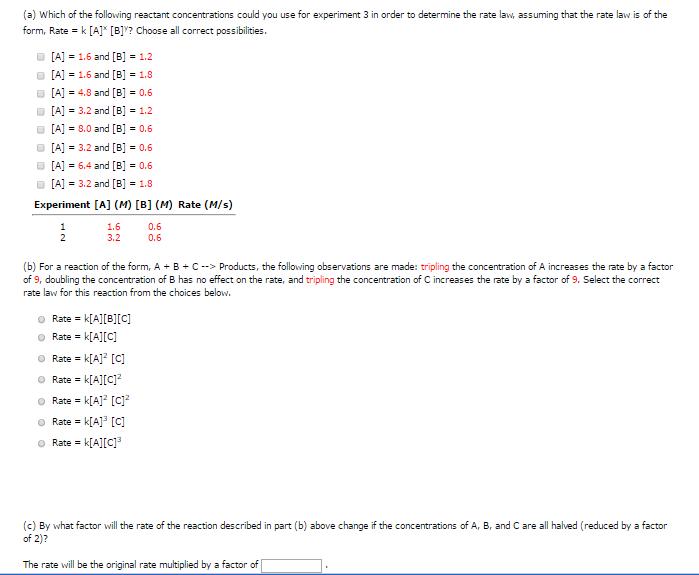
(a) Which of the following reactant concentrations could you use for experiment 3 in order to determine the rate law, assuming that the rate law is of the form, Rate = k [A]* [B]? Choose all correct possibilities. O [A] = 1.6 and [B] = 1.2 O [A] = 1.6 and [B] = 1.8 E [A] = 4.8 and [B] = 0.6 O [A] = 3.2 and [B] = 1.2 O [A] = 8.0 and [B] = 0.6 O [A] = 3.2 and [B] = 0.6 E [A] = 6,4 and [B] = 0.6 O [A] = 3.2 and [B] = 1.8 Experiment [A] (M) [B] (M) Rate (M/s) 1.6 0.6 3.2 0.6 (b) For a reaction of the form, A + B + C--> Products, the following observations are made: tripling the concentration of A increases the rate by a factor of 9, doubling the concentration of B has no effect on the rate, and tripling the concentration of C increases the rate by a factor of 9. Select the correct rate law for this reaction from the choices below. O Rate = k[A][B][C] O Rate = k[A][C] %3D O Rate = k[A]? [c] O Rate = k[A][C]? O Rate = k[A]" [C] O Rate = k[A] [C] O Rate = k[A][C] %3D (c) By what factor will the rate of the reaction described in part (b) above change if the concentrations of A, B, and C are all halved (reduced by a factor of 2)? The rate will be the original rate multiplied by a factor of
Step by Step Solution
3.46 Rating (156 Votes )
There are 3 Steps involved in it
a we will choose the reactant concentration combinations where the concentration of A will b... View full answer

Get step-by-step solutions from verified subject matter experts
 Study Help