







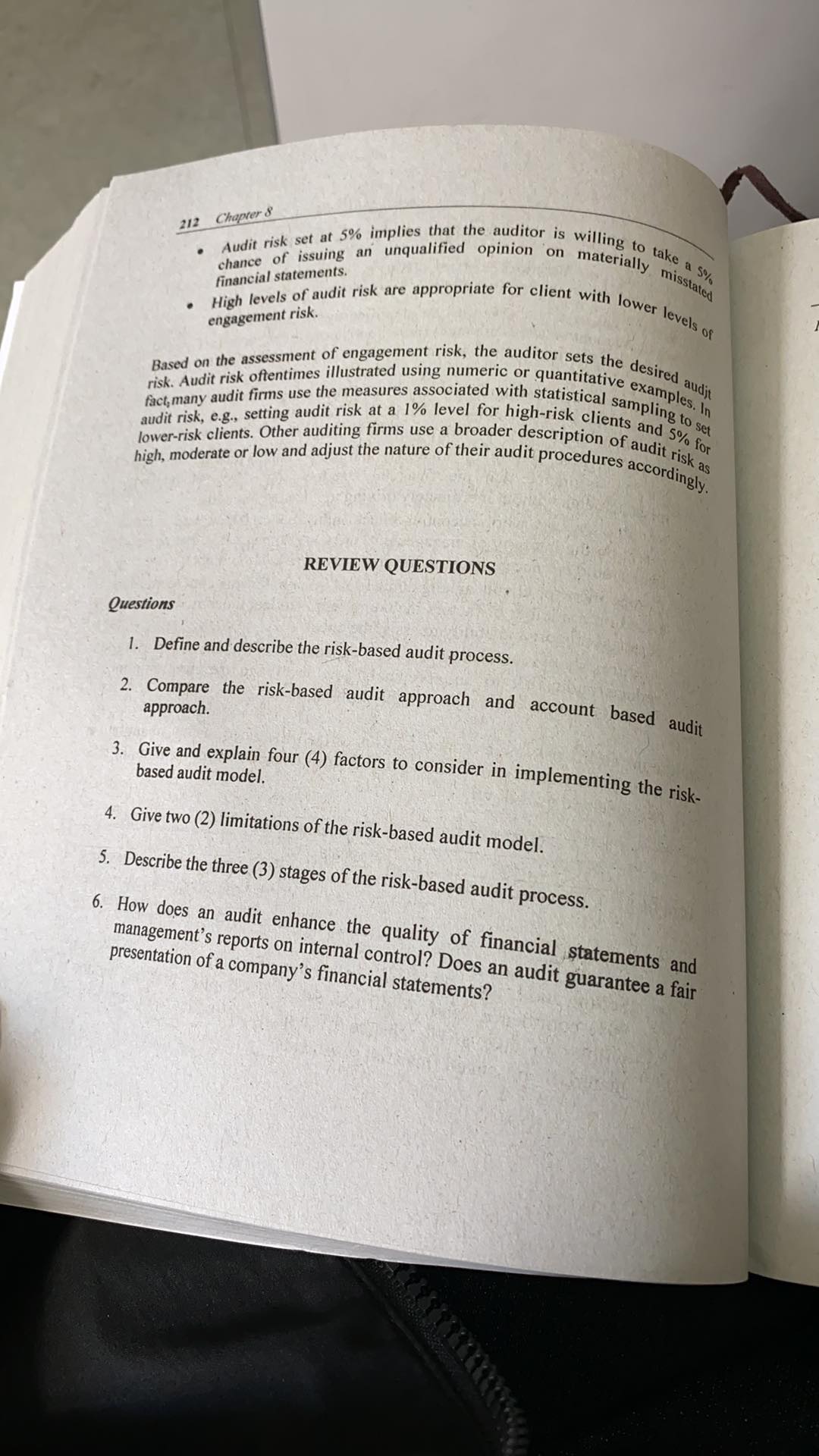
Question: answer review questions 212 Chapter & .Audit risk set at 5% implies that the auditor is willing to take a soy chance of issuing an
answer review questions
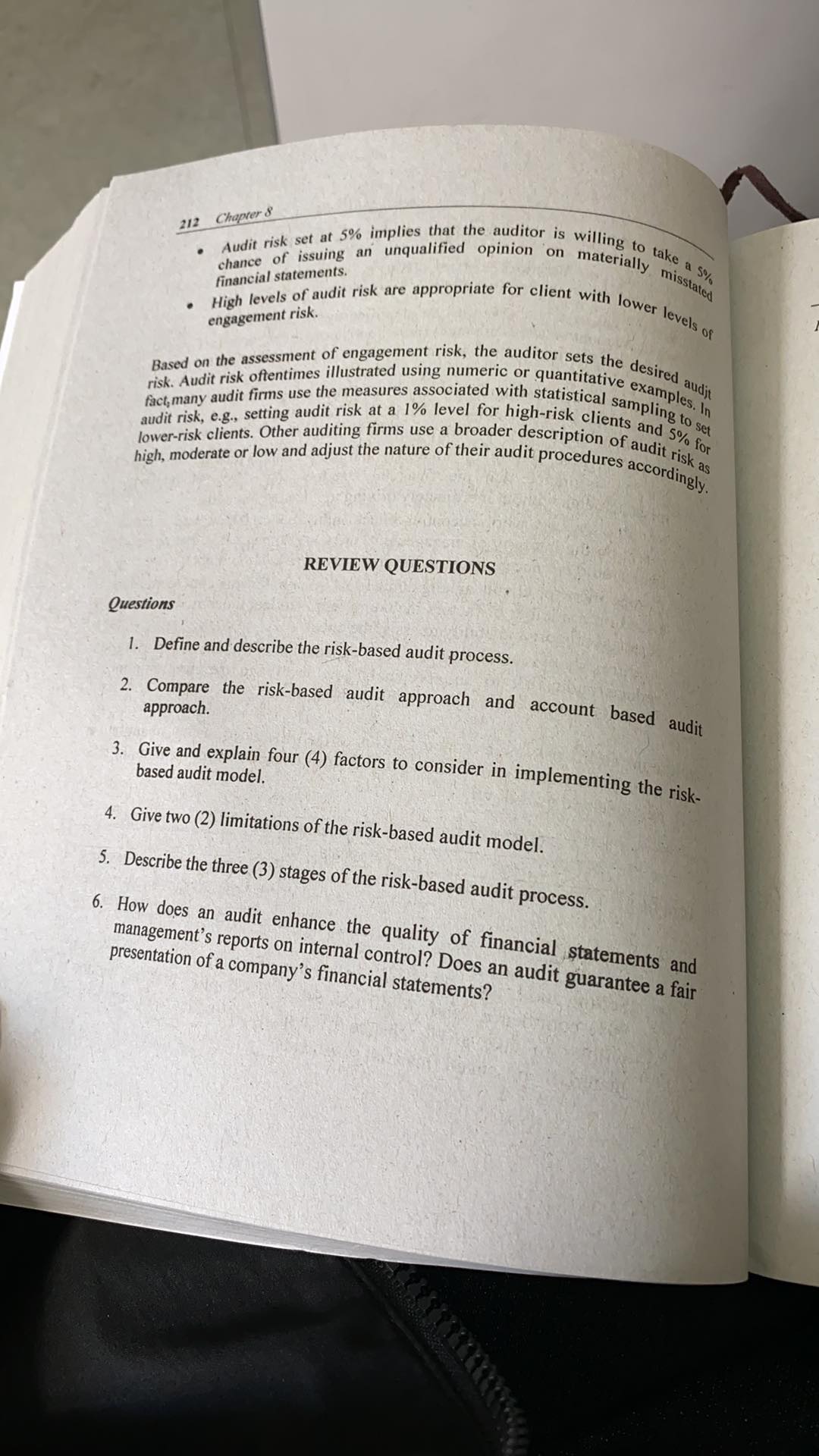
212 Chapter & .Audit risk set at 5% implies that the auditor is willing to take a soy chance of issuing an unqualified opinion on materially misstates financial statements. High levels of audit risk are appropriate for client with lower levels of engagement risk. Based on the assessment of engagement risk, the auditor sets the desired audit risk. Audit risk oftentimes illustrated using numeric or quantitative examples. In fact, many audit firms use the measures associated with statistical sampling to sey audit risk, e.g., setting audit risk at a 1% level for high-risk clients and 5% for lower-risk clients. Other auditing firms use a broader description of audit risk as high, moderate or low and adjust the nature of their audit procedures accordingly REVIEW QUESTIONS Questions 1. Define and describe the risk-based audit process. approach. 2. Compare the risk-based audit approach and account based audit 3. Give and explain four (4) factors to consider in implementing the risk- based audit model. 4. Give two (2) limitations of the risk-based audit model. 5. Describe the three (3) stages of the risk-based audit process. 6. How does an audit enhance the quality of financial statements and management's reports on internal control? Does an audit guarantee a fair presentation of a company's financial statements
Step by Step Solution
There are 3 Steps involved in it

Get step-by-step solutions from verified subject matter experts
 Study Help