







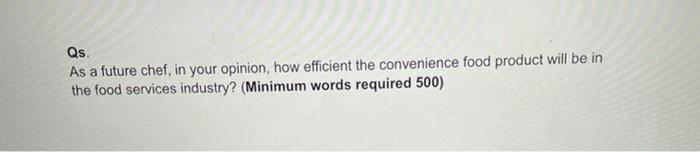
Question: Answer should realte this case study given below: (Question given in picture) A study of operations using convenience foods indicates that the successful ones do
A study of operations using convenience foods indicates that the successful ones do not rely exclusively on convenience foods. Instead, they have a menu that is made up totally of "convenient" foods; all kinds of foods that are easy to prepare. These types of operations use convenient, easy-toprepare foods exclusively, thus saving an immense amount of cooking time and labor. These foods may be fully prepared frozen foods. Also included are hamburgers, chops, steaks, corned beef, lobster tails, eggs, frozen foods, pancakes, spaghetti, roasts, ham, baconand even peanut butter. Together with salad ingredients, simple appetizers and desserts, these items comprise a menu of foods that do not require cooking and seasoning talent or much manipulation. Some operations have even virtually abandoned vegetables or a choice of salad.
Foods that are ordinarily hard to prepare, that require cooking skills or time, are called "made dishes" by old-fashioned dieticians. These foods, in sauces, are the major part of the new convenience foods. They are the ones that in a conventional manner might take the most time and the most skill to prepare.They are also the ones that are not ruined by slight overcooking and which hold up well in storage. The rest of the operating menu is made up of "convenient" foods. Thus, if a food product is neither easy to prepare nor available frozen, it is not on their menus. Successful operators know that a menu of only frozen foods, in sauce, doesn't sit well with the average customer. It is simply boring. Customers want plain, unsauced items along with the sauced ones. The plain unsauced items that have experienced the largest growth are the ones that require easily learned skills to prepare. So the broiler and the fryer come into their own.
Menus in convenience foods operations indicate that not more than 25 percent of the entree menu is made up of prepared, packaged, frozen foods in sauce. But this 25 percent of the menu required about 60 percent of the labor required for cooking. The main things that are being eliminated re a skilled chef, and a lot of man-hours. These operators are using trained help, but of a lesser degree. Operations which use convenience foods have specific savings in Labor, Space, Equipment ,Reduction of food waste. The savings occur when users of convenience foodsfollow a complete logic of convenience foods uses planning a simplified menu requiring few foods, planning the delivery and storage of these foods, reducin1 the number of variables in preparation, and therefore simplifying work and job descriptions.
Operations utilizing convenience foods do not use people who are conventionally skilled but use people which are trained to do their simplified jobs. These people are not given the old food service designations of chefs, but simply are called fry cook, pancake cook or pantry worker. During all of this, a new concept of providing a "flying squad" of capable workers in a kitchen was developed. These workers moved as a team from one workstation to another, getting timed jobs done. It has been shown that 20 percent of most kitchen jobs are preparation of the type that could be done in advance to good effect. The team could be taught to prepare food; that is, wash, peel, cut, portion, heat or re-heat in ovens or steam-cookers or fryers or broilers; and serve. All these tasks could be taught in a few weeks with a level of skill that is quite suitable for individual operations.
This has become a general rule in many food service operations. With new convenient foods there isn't as much work to do at any one station. The important thing to remember is that the work has to be planned out carefully. Management must take its role seriously. Through this type of thinking and development of teamwork, many desirable things happen: Fussiness about status diminishes. Anyone can do any job in the kitchen, cutting down on personnel emergencies. Idle time goes down. Labor costs are lower. All important things to consider and a major tool used to increase efficiency, profits, and customer satisfaction. Changes in Equipment Changes, overall, have not been as great as had been expected. Vegetable preparation equipment is gone for the most part. Meat cutting equipment is also gone overall. The objects that became major factors in kitchen equipment were the steam cooker, the steam-jacketed kettle, the convection oven, quartz ovens, microwave ovens, standard ovens, and deep fat fryers. These pieces of equipment are chosen after a particular operation considers what is needed in terms of the volume of food that must be prepared for service at one time.
This is distinctly dependent upon the number of persons who come to a place for food at one time. The basic concept about these new types of equipment is that the kitchen is work-station oriented. This means that holding refrigerators are located where reheating is done. All utensils are available at a workstationbecause employees do not have time to look for the piece of equipment, they need at any specific time. The operations use matching utensils and carts to avoid food transfers, and matching modules in refrigerator, carts, ovens, and serving units.Conveyors and other materials handling equipment are used to avoid having people running back and forth. Successful users of convenience foods are defined in two ways.
Individual restaurants and food service operations produced by one or two food processors who have gone in and worked and trained them and their people. These surveyors have worked out menus and systems for their customers. The chain systems, the large commercial or hospital or food organization that has spent an immense amount of time and money to research the problem.Handling the problem properly means, menu planning for a market, finding an acceptable and consistent quality of food.Developing a new kind of internal organization, establishing goals by top management, training people, and coordinating equipment and serving system and above all, time and executive confidence to work out problem. Few people have ever gone into convenience foods use quickly without pulling out just as quickly. Many food service managements used to, and still look for a simple. The food, the equipment, the system that meets all There simply is not any such formula.
Planning to use convenience foods in any organization involves doing the following by determine which segments of the institutional market his convenience food is for. Each segment has its own style in terms of food quality, facilities, customers, density of traffic, etc. These factors affect the formulation of product, the size of portions, the type of packaging, the method of reheating, etc. The market is highly segmented.
2) Price the product realistically, in terms of both food and labor costs. Standard markups are not useful any longer. Do detail relatively simple forms of unprocessed food into his menu, anddevelop plans for operations and use of equipment into a set of workable directions for personnel. Setting goals for the study.The organization of an actual study with decisions about food, criteria for setting up experiments in individual locations in different parts of the country, setting up experiments with cooperative personnel, designing menu plans for types of operations, outlining the duties of the location manager, providing actual operating advice and employee) Formulating forms for record-keeping and work charting and also ricing.
The next steps involve coordinating the groups of people involved, meeting with managers and supervisors to get theircooperation, leaving open the probability of changes to be madein the tentative set-up in accordance with their suggestions, providing for additional detail which included coordination of equipment and food supplies, the assurance of adequate refrigeration on the premises, the absolute necessity for planning garbage disposal. Working with employees directly. The usual actual test period for these above procedures involves six weeks in each location operating with a three-week cyclical menu.
This requires, Training before the test starts and during the first few days, written daily reports from the manager of forms provided, time and motion studies during the fourth week which would be a report of the first week's menu; and final reports. The final report, besides getting some over-all feelings from the managers and the employees and on customer response, requiresevaluation of the cost of serving the new menu. suggesting changes in labor patterns, suggesting changes in equipment, suggesting changes in pricing. There are no simple answers. Every company or organization making a success of convenience or ready foods must devote immense effort and study of the problem. Convenience foods are only part of the whole convenient food picture. A menu must include convenient foods.
Retrieved on 25th April 2021,
Trend in Food Services Industry : Convenience Food , John R.Adams
Step by Step Solution
There are 3 Steps involved in it

Get step-by-step solutions from verified subject matter experts
 Study Help