





Question: answer So far, we've figured out the angular momentum and torque on a single object. But what about for a system of objects? It turns

answer
answer So far, we've figured out the angular
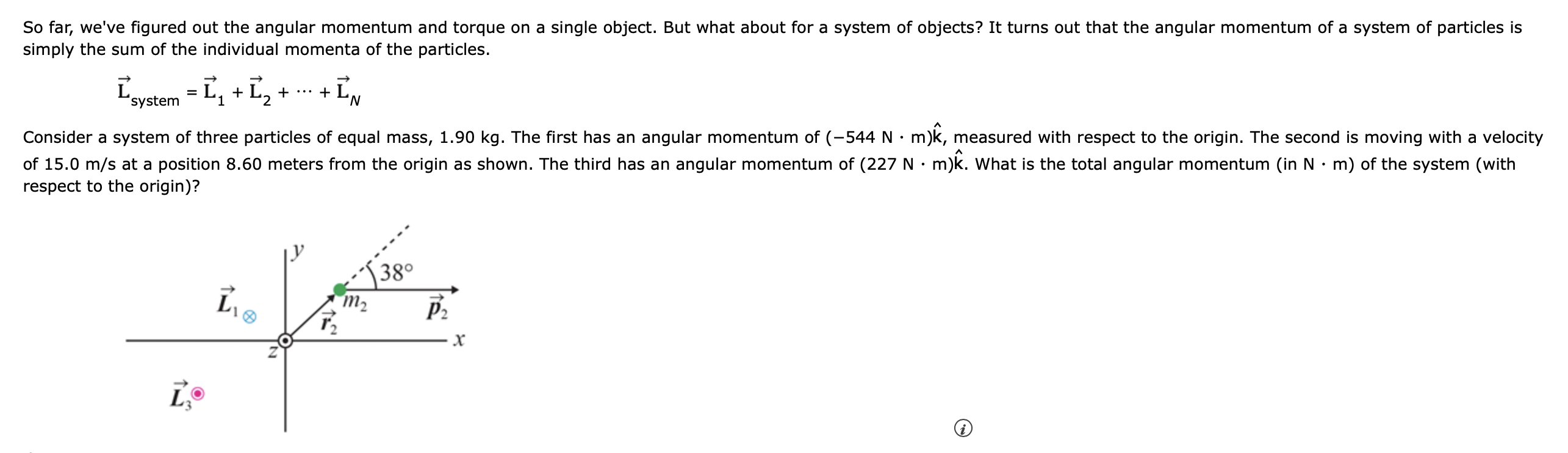
So far, we've figured out the angular momentum and torque on a single object. But what about for a system of objects? It turns out that the angular momentum of a system of particles is simply the sum of the individual momenta of the particles. - - - - Lsystem = Ll + LZ HER LN ~ Consider a system of three particles of equal mass, 1.90 kg. The first has an angular momentum of (544 N - m)k, measured with respect to the origin. The second is moving with a velocity of 15.0 m/s at a position 8.60 meters from the origin as shown. The third has an angular momentum of (227 N - m)lz. What is the total angular momentum (in N - m) of the system (with respect to the origin)

Step by Step Solution

There are 3 Steps involved in it

1 Expert Approved Answer
Step: 1 Unlock blur-text-image

Question Has Been Solved by an Expert!

Get step-by-step solutions from verified subject matter experts

Step: 2 Unlock
Step: 3 Unlock

Students Have Also Explored These Related Business Writing Questions!