Question: answer the 5 case point questions at the end please Coca-Cola Company In 2014, Coca-Cola celebrated its 128th anniver- special enclosure at the new interactive
answer the 5 case point questions at the end please
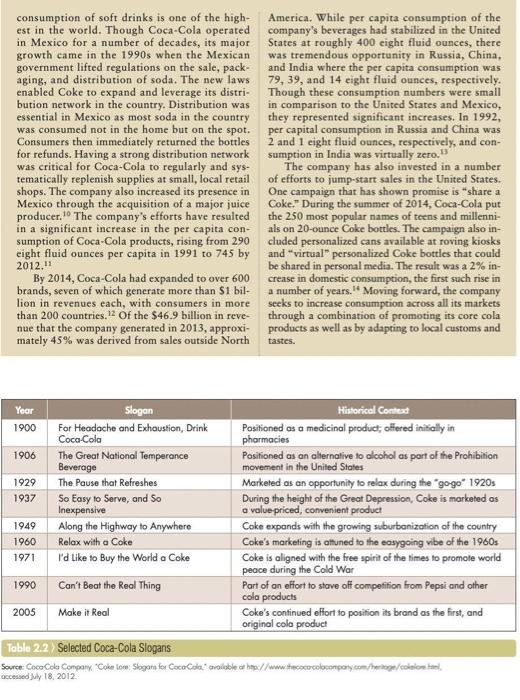
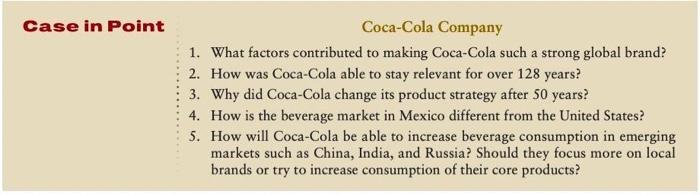
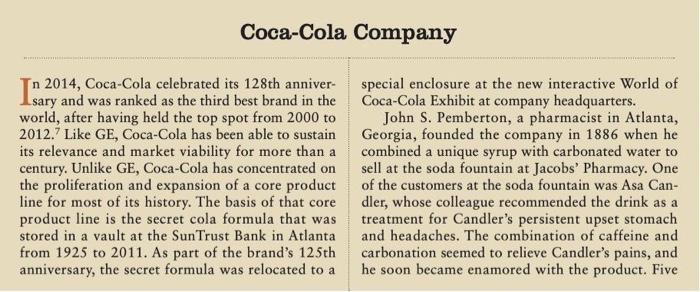
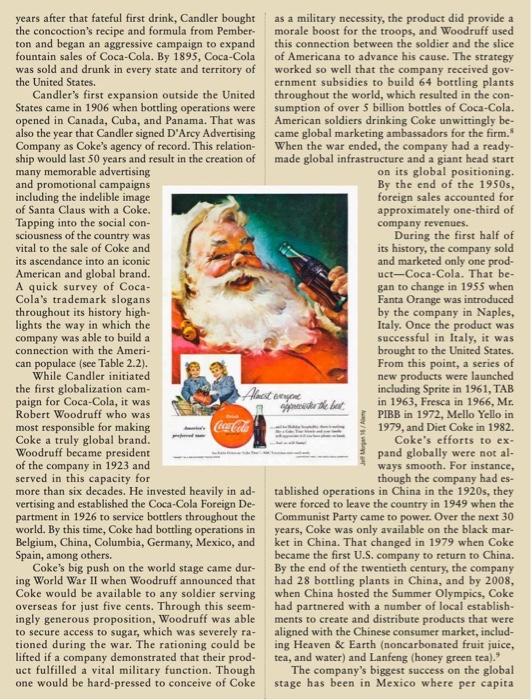
Coca-Cola Company In 2014, Coca-Cola celebrated its 128th anniver- special enclosure at the new interactive World of sary and was ranked as the third best brand in the Coca-Cola Exhibit at company headquarters. world, after having held the top spot from 2000 to John S. Pemberton, a pharmacist in Atlanta, 2012.7 Like GE, Coca-Cola has been able to sustain Georgia, founded the company in 1886 when he its relevance and market viability for more than a combined a unique syrup with carbonated water to century. Unlike GE, Coca-Cola has concentrated on sell at the soda fountain at Jacobs' Pharmacy. One the proliferation and expansion of a core product of the customers at the soda fountain was Asa Can- line for most of its history. The basis of that core dler, whose colleague recommended the drink as a product line is the secret cola formula that was treatment for Candler's persistent upset stomach stored in a vault at the Sun Trust Bank in Atlanta and headaches. The combination of caffeine and from 1925 to 2011. As part of the brand's 125th carbonation seemed to relieve Candler's pains, and anniversary, the secret formula was relocated to a he soon became enamored with the product. Five years after that fateful first drink, Candler bought as a military necessity, the product did provide a the concoction's recipe and formula from Pember morale boost for the troops, and Woodruff used ton and began an aggressive campaign to expand this connection between the soldier and the slice fountain sales of Coca-Cola. By 1895, Coca-Cola of Americana to advance his cause. The strategy was sold and drunk in every state and territory of worked so well that the company received gov- the United States. ernment subsidies to build 64 bottling plants Candler's first expansion outside the United throughout the world, which resulted in the con- States came in 1906 when bottling operations were sumption of over 5 billion bottles of Coca-Cola. opened in Canada, Cuba, and Panama. That was American soldiers drinking Coke unwittingly be- also the year that Candler signed D'Arcy Advertising came global marketing ambassadors for the firm. Company as Coke's agency of record. This relation- When the war ended, the company had a ready- ship would last 50 years and result in the creation of made global infrastructure and a giant head start many memorable advertising on its global positioning. and promotional campaigns By the end of the 1950s. including the indelible image foreign sales accounted for of Santa Claus with a Coke. approximately one-third of Tapping into the social con- company revenues. sciousness of the country was During the first half of vital to the sale of Coke and its history, the company sold its ascendance into an iconic and marketed only one prod- American and global brand. uct-Coca-Cola. That be- A quick survey of Coca- gan to change in 1955 when Cola's trademark slogans Fanta Orange was introduced throughout its history high- by the company in Naples, lights the way in which the Italy. Once the product was company was able to build a successful in Italy, it was connection with the Ameri- brought to the United States. can populace (see Table 2.2). From this point, a series of While Candler initiated new products were launched the first globalization cam- Aleest egent paign for Coca-Cola, it was including Sprite in 1961, TAB de bet in 1963, Fresca in 1966, Mr. Robert Woodruff who was PIBB in 1972, Mello Yello in most responsible for making erlede 1979, and Diet Coke in 1982. Coke a truly global brand. Coke's efforts to ex- Woodruff became president pand globally were not al- of the company in 1923 and ways smooth. For instance, served in this capacity for though the company had es- more than six decades. He invested heavily in ad- tablished operations in China in the 1920s, they vertising and established the Coca-Cola Foreign De were forced to leave the country in 1949 when the partment in 1926 to service bottlers throughout the Communist Party came to power. Over the next 30 world. By this time, Coke had bottling operations in years, Coke was only available on the black mar- Belgium, China, Columbia, Germany, Mexico, and ket in China. That changed in 1979 when Coke Spain, among others. became the first U.S. company to return to China. Coke's big push on the world stage came dur- By the end of the twentieth century, the company ing World War II when Woodruff announced that had 28 bottling plants in China, and by 2008, Coke would be available to any soldier serving when China hosted the Summer Olympics, Coke overseas for just five cents. Through this seem- had partnered with a number of local establish- ingly generous proposition, Woodruff was able ments to create and distribute products that were to secure access to sugar, which was severely ra- aligned with the Chinese consumer market, includ- tioned during the war. The rationing could be ing Heaven & Earth (noncarbonated fruit juice, lifted if a company demonstrated that their prod- tea, and water) and Lanfeng (honey green tea)." uct fulfilled a vital military function. Though The company's biggest success on the global one would be hard-pressed to conceive of Coke stage has been in Mexico where per capita consumption of soft drinks is one of the high- est in the world. Though Coca-Cola operated in Mexico for a number of decades, its major growth came in the 1990s when the Mexican government lifted regulations on the sale, pack- aging, and distribution of soda. The new laws enabled Coke to expand and leverage its distri- bution network in the country. Distribution was essential in Mexico as most soda in the country was consumed not in the home but on the spot. Consumers then immediately returned the bottles for refunds. Having a strong distribution network was critical for Coca-Cola to regularly and sys- tematically replenish supplies at small, local retail shops. The company also increased its presence in Mexico through the acquisition of a major juice producer. The company's efforts have resulted in a significant increase in the per capita con- sumption of Coca-Cola products, rising from 290 eight fluid ounces per capita in 1991 to 745 by 2012.11 By 2014, Coca-Cola had expanded to over 600 brands, seven of which generate more than $1 bil- lion in revenues each, with consumers in more than 200 countries. 12 Of the $46.9 billion in reve- nue that the company generated in 2013, approxi- mately 45% was derived from sales outside North America. While per capita consumption of the company's beverages had stabilized in the United States at roughly 400 cight fluid Ounces, there was tremendous opportunity in Russia, China, and India where the per capita consumption was 79, 39, and 14 eight fluid Ounces, respectively. Though these consumption numbers were small in comparison to the United States and Mexico, they represented significant increases. In 1992, per capital consumption in Russia and China was 2 and 1 eight fluid ounces, respectively, and con- sumption in India was virtually zero.13 The company has also invested in a number of efforts to jump-start sales in the United States. One campaign that has shown promise is "share a Coke." During the summer of 2014, Coca-Cola put the 250 most popular names of teens and millenni- als on 20-ounce Coke bottles. The campaign also in- cluded personalized cans available at roving kiosks and "virtual" personalized Coke bottles that could be shared in personal media. The result was a 2% in- crease in domestic consumption, the first such rise in a number of years. " Moving forward, the company seeks to increase consumption across all its markets through a combination of promoting its core cola products as well as by adapting to local customs and tastes. Year Slogan Historical Context 1900 For Headache and Exhaustion, Drink Positioned as a medicinal product, offered initially in Coca-Cola pharmacies 1906 The Great National Temperance Positioned as an alternative to alcohol as part of the Prohibition Beverage movement in the United States 1929 The Pause that Refreshes Marketed as an opportunity to relax during the gogo 1920s 1937 So Easy to Serve, and so During the height of the Great Depression, Coke is marketed as Inexpensive a value priced, convenient product 1949 Along the Highway to Anywhere Coke expands with the growing suburbanization of the country 1960 Relax with a Coke Coke's marketing is attuned to the easygoing vibe of the 1960s 1971 I'd like to Buy the World a Coke Coke is aligned with the free spirit of the times to promote world peace during the Cold War 1990 Can't Beat the Real Thing Part of an effort to stave off competition from Pepsi and other cola products 2005 Make it Real Coke's continued effort to position its brand as the first, and original cola product Table 2.2 Selected Coca-Cola Slogans Source: Coca Cola Company Coke low: Slogans for Coca Cola widoble at htp://www.ecococolocopory.com/herage/collo accessed July 18, 2012 a Case in Point Coca-Cola Company 1. What factors contributed to making Coca-Cola such a strong global brand? 2. How was Coca-Cola able to stay relevant for over 128 years? 3. Why did Coca-Cola change its product strategy after 50 years? 4. How is the beverage market in Mexico different from the United States? 5. How will Coca-Cola be able to increase beverage consumption in emerging markets such as China, India, and Russia? Should they focus more on local brands or try to increase consumption of their core products









 Study Help