







Question: answer the above 3 queations. answer the questions please CASE STUDY WJ-HAUL'S PERFORMANCE PROBLEM In Ontario, the Higheng Traffic Ad has in place tough sanctions
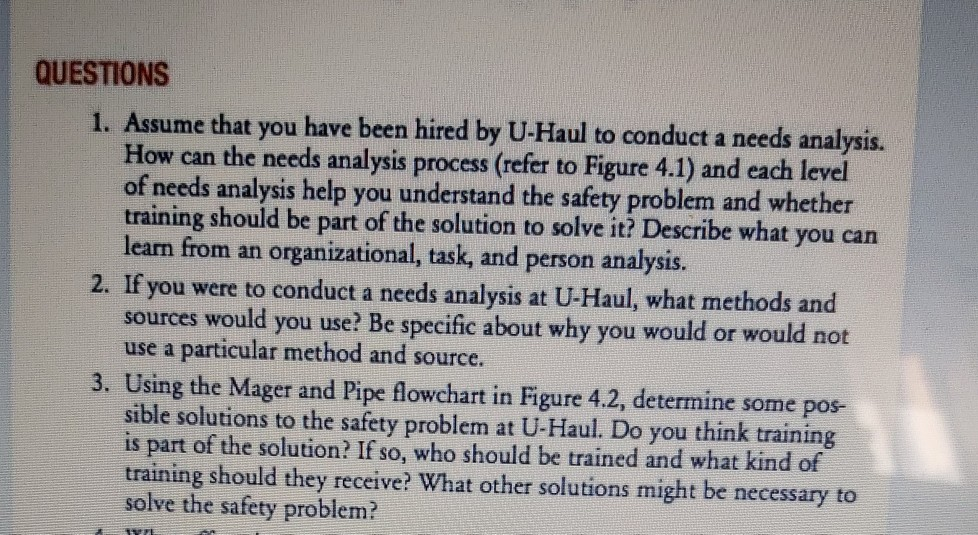
answer the above 3 queations.
answer the questions please
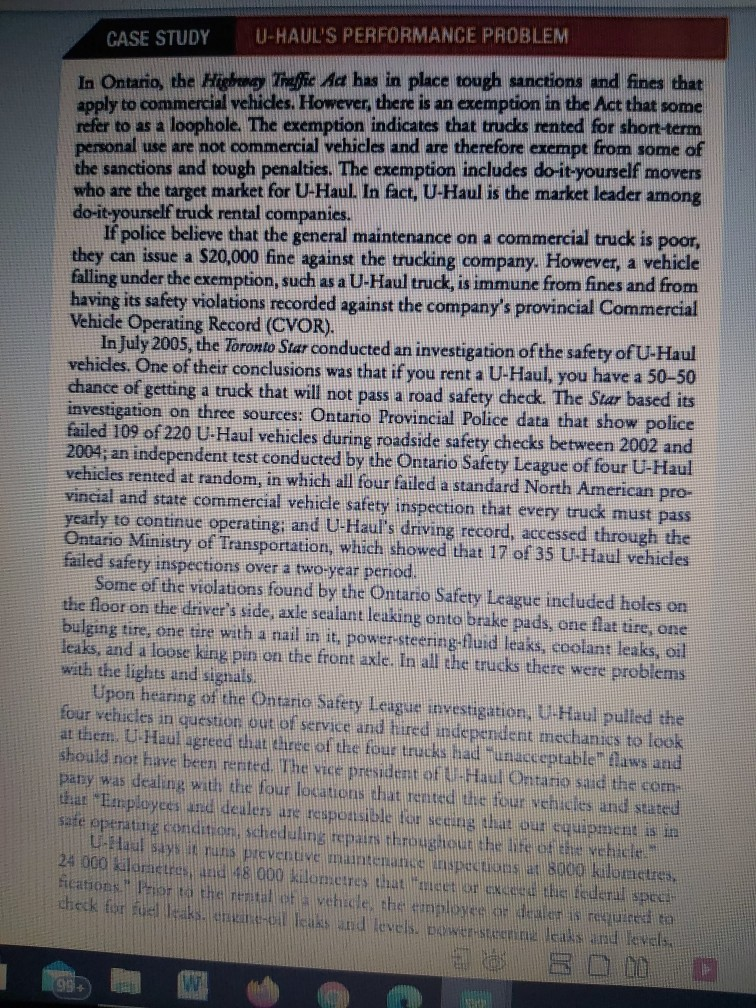
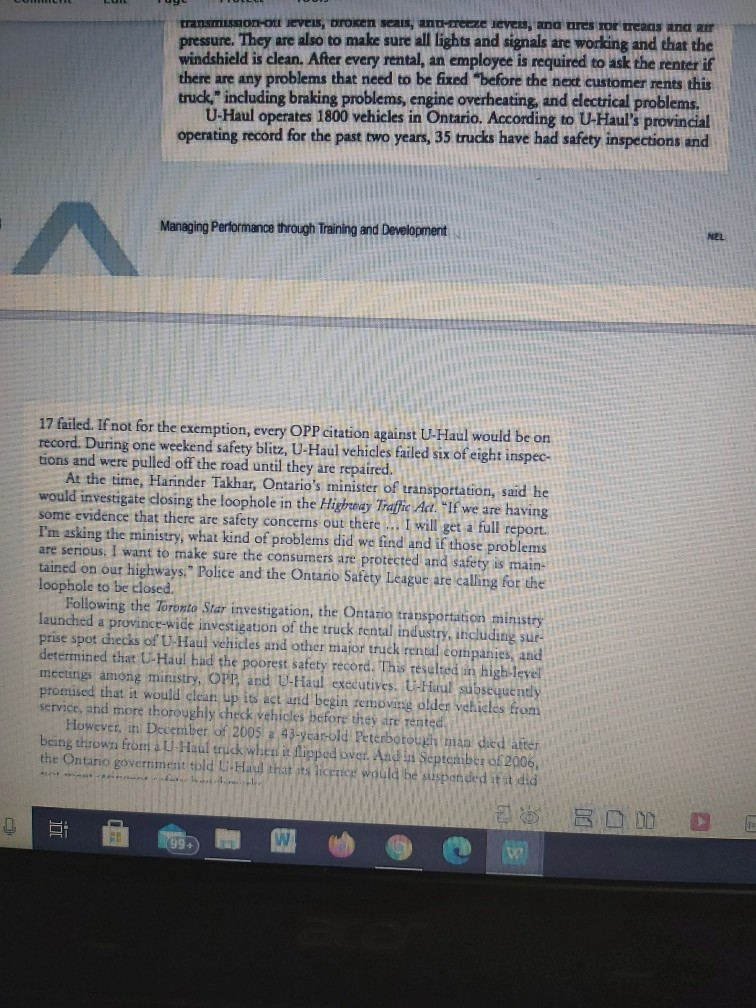
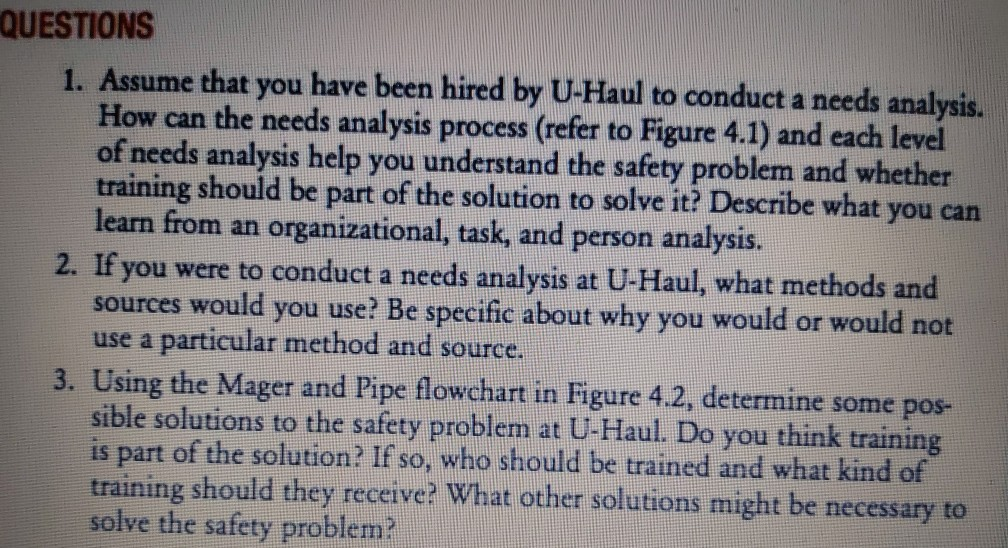
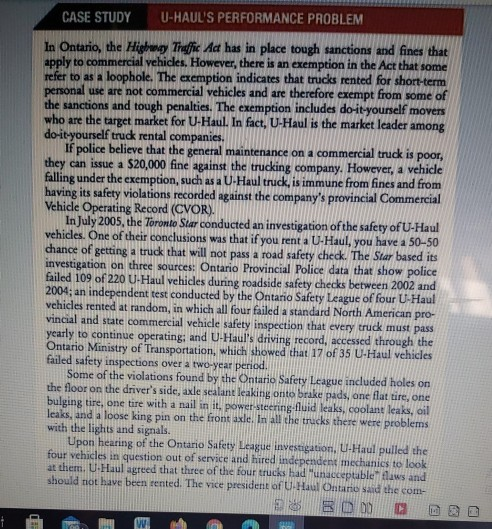
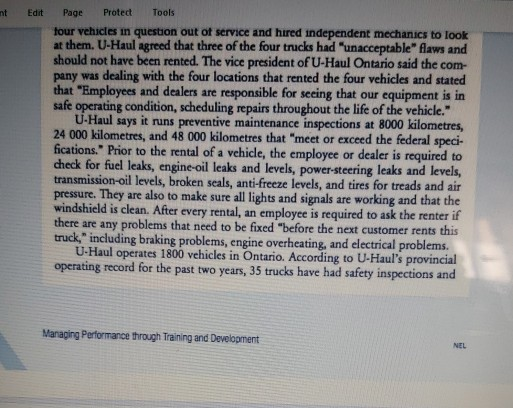
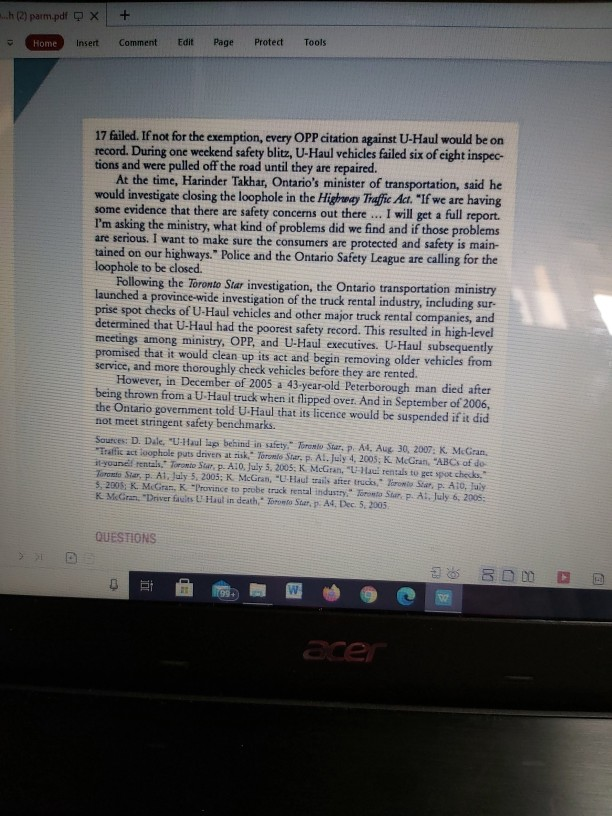
CASE STUDY WJ-HAUL'S PERFORMANCE PROBLEM In Ontario, the Higheng Traffic Ad has in place tough sanctions and fines that apply to commercial vehicles. However, there is an exemption in the Act that some refer to as a loophole. The exemption indicates that trucks rented for short-term personal use are not commercial vehicles and are therefore exempt from some of the sanctions and tough penalties. The exemption includes do-it-yourself movers who are the target market for U-Haul. In fact, U-Haul is the market leader among do-it-yourself truck rental companies. If police believe that the general maintenance on a commercial truck is poor, they can issue a $20,000 fine against the trucking company. However, a vehicle falling under the exemption, such as a U-Haul truck, is immune from fines and from having its safety violations recorded against the company's provincial Commercial Vehide Operating Record (CVOR). In July 2005, the Toronto Star conducted an investigation of the safety of U-Haul vehicles. One of their conclusions was that if you rent a U-Haul, you have a 50-50 chance of getting a truck that will not pass a road safety check. The Star based its investigation on three sources: Ontario Provincial Police data that show police failed 109 of 220 U-Haul vehicles during roadside safety checks between 2002 and 2004; an independent test conducted by the Ontario Safety League of four U-Haul vehicles rented at random, in which all four failed a standard North American pro- vincial and state commercial vehicle safety inspection that every truck must pass yearly to continue operating, and U-Haul's driving record, accessed through the Ontario Ministry of Transportation, which showed that 17 of 35 U-Haul vehicles failed safety inspections over a two-year period. Some of the violations found by the Ontario Safety League included holes on the floor on the driver's side, axle sealant leaking onto brake pads, one flat tire, one bulging tire, one tire with a nail in it, power steering-fluid leaks, coolant leaks, oil leaks, and a loose kang pin on the front axle. In all the trucks there were problems with the lights and signals. Upon heanng of the Ontario Safety League investigation, U-Haul pulled the four vehicles in question out of service and hired independent mechanics to look at them.. U-Haul agreed that three of the four trucks had unacceptable flaws and should not have been rented. The vice president of U-Haul Ontario said the com- pany was dealing with the four locations that rented the four vehicles and stated thar "Employees and dealers are responsible for seeing that our equipment is in Sate operating condition, scheduling repairs throughout the life of the vehicle U-Haul says it runs preventive maintenance Inspections at 8000 kilousties 24 000 kilometres, and 48 000 kilometres that meet or excee the federal spect fications. Prior to the mentalite vehide, the apoyo de las em check for fuel leaks. en ek and levels were incals and levels 99 w transmiTOCHT levels, broken seals, and ecze levens, and res for treads and a pressure. They are also to make sure all lights and signals are working and that the windshield is clean. After every rental, an employee is required to ask the renter if there are any problems that need to be fixed "before the next customer rents this truck," including braking problems, engine overheating, and electrical problems. U-Haul operates 1800 vehicles in Ontario. According to U-Haul's provincial operating record for the past two years, 35 trucks have had safety inspections and A Managing Performance through Training and Development 17 failed. If not for the exemption, every OPP citation against U-Haul would be on record. During one weekend safety blitz, U-Haul vehicles failed six of eight inspec- tions and were pulled off the road until they are repaired. At the time, Harinder Takhar, Ontario's minister of transportation, said he would investigate closing the loophole in the Highroay Traffic Ad. "If we are having some evidence that there are safety concerns out there... I will get a full report. I'm asking the ministry, what kind of problems did we find and if those problems are serious. I want to make sure the consumers are protected and safety is main- tained on our highways." Police and the Ontario Safety League are calling for the loophole to be closed. Following the Toronto Star investigation, the Ontario transportation ministry launched a province-wide investigation of the truck rental industry, including sur- prise spot checks of U-Haul vehicles and other major truck rental companies, and determined that U-Haul had the poorest safety record. This resulted in high-level meetings among ministry, OPP, and U-Haul executives. U-Haul subsequently promised that it would clean up is act and begin removing older vehicles from service, and more thoroughly check vehicles before they are rented However, in December of 2005 2 43-year-old Peterborough man died after being thrown from a U-Haul truck when it flipped over. And in September of 2006, the Ontario government told C Haul that its licence would be suspended it it did ---- BD DD 1994 QUESTIONS 1. Assume that you have been hired by U-Haul to conduct a needs analysis. How can the needs analysis process (refer to Figure 4.1) and each level of needs analysis help you understand the safety problem and whether training should be part of the solution to solve it? Describe what you can learn from an organizational, task, and person analysis. 2. If you were to conduct a needs analysis at U-Haul, what methods and sources would you use? Be specific about why you would or would not use a particular method and source. 3. Using the Mager and Pipe flowchart in Figure 4.2, determine some pos- sible solutions to the safety problem at U-Haul. Do you think training is part of the solution? If so, who should be trained and what kind of training should they receive? What other solutions might be necessary to solve the safety problem? CASE STUDY U-HAUL'S PERFORMANCE PROBLEM In Ontario, the Highway Traffic Ad has in place tough sanctions and fines that apply to commercial vehicles. However, there is an exemption in the Act that some refer to as a loophole. The exemption indicates that trucks rented for short-term personal use are not commercial vehicles and are therefore exempt from some of the sanctions and tough penalties. The exemption includes do-it-yourself movers who are the target market for U-Haul. In fact, U-Haul is the market leader among do-it-yourself truck rental companies. If police believe that the general maintenance on a commercial truck is poor, they can issue a $20,000 fine against the trucking company. However, a vehicle falling under the exemption, such as a U-Haul truck, is immune from fines and from having its safety violations recorded against the company's provincial Commercial Vehicle Operating Record (CVOR). In July 2005, the Toronto Star conducted an investigation of the safety of U-Haul vehicles. One of their conclusions was that if you rent a U-Haul, you have a 50-50 chance of getting a truck that will not pass a road safety check. The Star based its investigation on three sources: Ontario Provincial Police data that show police failed 109 of 220 U-Haul vehicles during roadside safety checks between 2002 and 2004; an independent test conducted by the Ontario Safety League of four U-Haul vehicles rented at random, in which all four failed a standard North American pro- vincial and state commercial vehicle safety inspection that every truck must pass yearly to continue operating, and U-Haul's driving record, accessed through the Ontario Ministry of Transportation, which showed that 17 of 35 U-Haul vehicles failed safety inspections over a two-year period. Some of the violations found by the Ontario Safety League included holes on the floor on the driver's side, axle sealant leaking onto brake pads, one flat tire, one bulging tire, one tire with a nail in it, power-steering-fluid leaks, coolant leaks, oil leaks, and a loose king pin on the front axle. In all the trucks there were problems with the lights and signals. Upon hearing of the Ontario Safety League investigation, U-Haul pulled the four vehicles in question out of service and hired independent mechanics to look at them. U-Haul agreed that three of the four trucks had unacceptable flaws and should not have been rented. The vice president of U-Haul Ontare said the com- 98 8 000 nt Edit Page Protect Tools tour vehicles in question out of service and hired independent mechanics to look at them. U-Haul agreed that three of the four trucks had "unacceptable" flaws and should not have been rented. The vice president of U-Haul Ontario said the com- pany was dealing with the four locations that rented the four vehicles and stated that "Employees and dealers are responsible for seeing that our equipment is in safe operating condition, scheduling repairs throughout the life of the vehicle." U-Haul says runs preventive maintenance inspections at 8000 kilometres, 24 000 kilometres, and 48 000 kilometres that meet or exceed the federal speci- fications." Prior to the rental of a vehicle, the employee or dealer is required to check for fuel leaks, engine oil leaks and levels, power steering leaks and levels, transmission-oil levels, broken seals, anti-freeze levels, and tires for treads and air pressure. They are also to make sure all lights and signals are working and that the windshield is clean. After every rental, an employee is required to ask the renter if there are any problems that need to be fixed "before the next customer rents this truck," including braking problems, engine overheating, and electrical problems. U-Haul operates 1800 vehicles in Ontario. According to U-Haul's provincial operating record for the past two years, 35 trucks have had safety inspections and Managing Performance through Training and Development NEL ...h (2) parm.pdf X + Home Insert Comment Edit Page Protect Tools 17 failed. If not for the exemption, every OPP citation against U-Haul would be on record. During one weekend safety blitz, U-Haul vehicles failed six of eight inspec- tions and were pulled off the road until they are repaired. At the time, Harinder Takhar, Ontario's minister of transportation, said he would investigate closing the loophole in the Highway Traffic Act. "If we are having some evidence that there are safety concerns out there ... I will get a full report. I'm asking the ministry, what kind of problems did we find and if those problems are serious. I want to make sure the consumers are protected and safety is main- tained on our highways." Police and the Ontario Safety League are calling for the loophole to be closed. Following the Toronto Star investigation, the Ontario transportation ministry launched a province-wide investigation of the truck rental industry, including sur- prise spot checks of U-Haul vehicles and other major truck rental companies, and determined that U-Haul had the poorest safety record. This resulted in high-level meetings among ministry, OPP, and U-Haul executives. U-Haul subsequently promised that it would clean up its act and begin removing older vehicles from service, and more thoroughly check vehicles before they are rented. However, in December of 2005 a 43-year-old Peterborough man died after being thrown from a U-Haul truck when it flipped over. And in September of 2006, the Ontario government told U-Haul that its licence would be suspended if it did not meet stringent safety benchmarks. Sources: D. Dale. "U-Haul lap behind in safety. To Star, PAL Aug 30, 2007: K McGran Traffic act loophole puts drivers at risk. Toronto Star, p. Al. July 4, 2005. K. McGran, "ABCs of do it-younei rentals, Toronto Sorp. ALO, July 3, 2005: K MeGran, "La rentals to get spot checks Jordito Scarp. A1, Jaly 5, 2005: K. McGran. "U-Haul trails after tracks, Irom Star, p. 10, las 3. 2005: K. McGras, K Province to probe track rental industry. Toto Surpat, July 6, 2005 K MeGran, "Driver faits Haut in death, Tom Star, A4, Dec. 5.2005 QUESTIONS 0 if w acer QUESTIONS 1. Assume that you have been hired by U-Haul to conduct a needs analysis. How can the needs analysis process (refer to Figure 4.1) and each level of needs analysis help you understand the safety problem and whether training should be part of the solution to solve it? Describe what you can learn from an organizational, task, and person analysis. 2. If you were to conduct a needs analysis at U-Haul, what methods and sources would you use? Be specific about why you would or would not use a particular method and source. 3. Using the Mager and Pipe flowchart in Figure 4.2, determine some pos- sible solutions to the safety problem at U-Haul. Do you think training is part of the solution? If so, who should be trained and what kind of training should they receive? What other solutions might be necessary to solve the safety problem? TE CASE STUDY WJ-HAUL'S PERFORMANCE PROBLEM In Ontario, the Higheng Traffic Ad has in place tough sanctions and fines that apply to commercial vehicles. However, there is an exemption in the Act that some refer to as a loophole. The exemption indicates that trucks rented for short-term personal use are not commercial vehicles and are therefore exempt from some of the sanctions and tough penalties. The exemption includes do-it-yourself movers who are the target market for U-Haul. In fact, U-Haul is the market leader among do-it-yourself truck rental companies. If police believe that the general maintenance on a commercial truck is poor, they can issue a $20,000 fine against the trucking company. However, a vehicle falling under the exemption, such as a U-Haul truck, is immune from fines and from having its safety violations recorded against the company's provincial Commercial Vehide Operating Record (CVOR). In July 2005, the Toronto Star conducted an investigation of the safety of U-Haul vehicles. One of their conclusions was that if you rent a U-Haul, you have a 50-50 chance of getting a truck that will not pass a road safety check. The Star based its investigation on three sources: Ontario Provincial Police data that show police failed 109 of 220 U-Haul vehicles during roadside safety checks between 2002 and 2004; an independent test conducted by the Ontario Safety League of four U-Haul vehicles rented at random, in which all four failed a standard North American pro- vincial and state commercial vehicle safety inspection that every truck must pass yearly to continue operating, and U-Haul's driving record, accessed through the Ontario Ministry of Transportation, which showed that 17 of 35 U-Haul vehicles failed safety inspections over a two-year period. Some of the violations found by the Ontario Safety League included holes on the floor on the driver's side, axle sealant leaking onto brake pads, one flat tire, one bulging tire, one tire with a nail in it, power steering-fluid leaks, coolant leaks, oil leaks, and a loose kang pin on the front axle. In all the trucks there were problems with the lights and signals. Upon heanng of the Ontario Safety League investigation, U-Haul pulled the four vehicles in question out of service and hired independent mechanics to look at them.. U-Haul agreed that three of the four trucks had unacceptable flaws and should not have been rented. The vice president of U-Haul Ontario said the com- pany was dealing with the four locations that rented the four vehicles and stated thar "Employees and dealers are responsible for seeing that our equipment is in Sate operating condition, scheduling repairs throughout the life of the vehicle U-Haul says it runs preventive maintenance Inspections at 8000 kilousties 24 000 kilometres, and 48 000 kilometres that meet or excee the federal spect fications. Prior to the mentalite vehide, the apoyo de las em check for fuel leaks. en ek and levels were incals and levels 99 w transmiTOCHT levels, broken seals, and ecze levens, and res for treads and a pressure. They are also to make sure all lights and signals are working and that the windshield is clean. After every rental, an employee is required to ask the renter if there are any problems that need to be fixed "before the next customer rents this truck," including braking problems, engine overheating, and electrical problems. U-Haul operates 1800 vehicles in Ontario. According to U-Haul's provincial operating record for the past two years, 35 trucks have had safety inspections and A Managing Performance through Training and Development 17 failed. If not for the exemption, every OPP citation against U-Haul would be on record. During one weekend safety blitz, U-Haul vehicles failed six of eight inspec- tions and were pulled off the road until they are repaired. At the time, Harinder Takhar, Ontario's minister of transportation, said he would investigate closing the loophole in the Highroay Traffic Ad. "If we are having some evidence that there are safety concerns out there... I will get a full report. I'm asking the ministry, what kind of problems did we find and if those problems are serious. I want to make sure the consumers are protected and safety is main- tained on our highways." Police and the Ontario Safety League are calling for the loophole to be closed. Following the Toronto Star investigation, the Ontario transportation ministry launched a province-wide investigation of the truck rental industry, including sur- prise spot checks of U-Haul vehicles and other major truck rental companies, and determined that U-Haul had the poorest safety record. This resulted in high-level meetings among ministry, OPP, and U-Haul executives. U-Haul subsequently promised that it would clean up is act and begin removing older vehicles from service, and more thoroughly check vehicles before they are rented However, in December of 2005 2 43-year-old Peterborough man died after being thrown from a U-Haul truck when it flipped over. And in September of 2006, the Ontario government told C Haul that its licence would be suspended it it did ---- BD DD 1994 QUESTIONS 1. Assume that you have been hired by U-Haul to conduct a needs analysis. How can the needs analysis process (refer to Figure 4.1) and each level of needs analysis help you understand the safety problem and whether training should be part of the solution to solve it? Describe what you can learn from an organizational, task, and person analysis. 2. If you were to conduct a needs analysis at U-Haul, what methods and sources would you use? Be specific about why you would or would not use a particular method and source. 3. Using the Mager and Pipe flowchart in Figure 4.2, determine some pos- sible solutions to the safety problem at U-Haul. Do you think training is part of the solution? If so, who should be trained and what kind of training should they receive? What other solutions might be necessary to solve the safety problem? CASE STUDY U-HAUL'S PERFORMANCE PROBLEM In Ontario, the Highway Traffic Ad has in place tough sanctions and fines that apply to commercial vehicles. However, there is an exemption in the Act that some refer to as a loophole. The exemption indicates that trucks rented for short-term personal use are not commercial vehicles and are therefore exempt from some of the sanctions and tough penalties. The exemption includes do-it-yourself movers who are the target market for U-Haul. In fact, U-Haul is the market leader among do-it-yourself truck rental companies. If police believe that the general maintenance on a commercial truck is poor, they can issue a $20,000 fine against the trucking company. However, a vehicle falling under the exemption, such as a U-Haul truck, is immune from fines and from having its safety violations recorded against the company's provincial Commercial Vehicle Operating Record (CVOR). In July 2005, the Toronto Star conducted an investigation of the safety of U-Haul vehicles. One of their conclusions was that if you rent a U-Haul, you have a 50-50 chance of getting a truck that will not pass a road safety check. The Star based its investigation on three sources: Ontario Provincial Police data that show police failed 109 of 220 U-Haul vehicles during roadside safety checks between 2002 and 2004; an independent test conducted by the Ontario Safety League of four U-Haul vehicles rented at random, in which all four failed a standard North American pro- vincial and state commercial vehicle safety inspection that every truck must pass yearly to continue operating, and U-Haul's driving record, accessed through the Ontario Ministry of Transportation, which showed that 17 of 35 U-Haul vehicles failed safety inspections over a two-year period. Some of the violations found by the Ontario Safety League included holes on the floor on the driver's side, axle sealant leaking onto brake pads, one flat tire, one bulging tire, one tire with a nail in it, power-steering-fluid leaks, coolant leaks, oil leaks, and a loose king pin on the front axle. In all the trucks there were problems with the lights and signals. Upon hearing of the Ontario Safety League investigation, U-Haul pulled the four vehicles in question out of service and hired independent mechanics to look at them. U-Haul agreed that three of the four trucks had unacceptable flaws and should not have been rented. The vice president of U-Haul Ontare said the com- 98 8 000 nt Edit Page Protect Tools tour vehicles in question out of service and hired independent mechanics to look at them. U-Haul agreed that three of the four trucks had "unacceptable" flaws and should not have been rented. The vice president of U-Haul Ontario said the com- pany was dealing with the four locations that rented the four vehicles and stated that "Employees and dealers are responsible for seeing that our equipment is in safe operating condition, scheduling repairs throughout the life of the vehicle." U-Haul says runs preventive maintenance inspections at 8000 kilometres, 24 000 kilometres, and 48 000 kilometres that meet or exceed the federal speci- fications." Prior to the rental of a vehicle, the employee or dealer is required to check for fuel leaks, engine oil leaks and levels, power steering leaks and levels, transmission-oil levels, broken seals, anti-freeze levels, and tires for treads and air pressure. They are also to make sure all lights and signals are working and that the windshield is clean. After every rental, an employee is required to ask the renter if there are any problems that need to be fixed "before the next customer rents this truck," including braking problems, engine overheating, and electrical problems. U-Haul operates 1800 vehicles in Ontario. According to U-Haul's provincial operating record for the past two years, 35 trucks have had safety inspections and Managing Performance through Training and Development NEL ...h (2) parm.pdf X + Home Insert Comment Edit Page Protect Tools 17 failed. If not for the exemption, every OPP citation against U-Haul would be on record. During one weekend safety blitz, U-Haul vehicles failed six of eight inspec- tions and were pulled off the road until they are repaired. At the time, Harinder Takhar, Ontario's minister of transportation, said he would investigate closing the loophole in the Highway Traffic Act. "If we are having some evidence that there are safety concerns out there ... I will get a full report. I'm asking the ministry, what kind of problems did we find and if those problems are serious. I want to make sure the consumers are protected and safety is main- tained on our highways." Police and the Ontario Safety League are calling for the loophole to be closed. Following the Toronto Star investigation, the Ontario transportation ministry launched a province-wide investigation of the truck rental industry, including sur- prise spot checks of U-Haul vehicles and other major truck rental companies, and determined that U-Haul had the poorest safety record. This resulted in high-level meetings among ministry, OPP, and U-Haul executives. U-Haul subsequently promised that it would clean up its act and begin removing older vehicles from service, and more thoroughly check vehicles before they are rented. However, in December of 2005 a 43-year-old Peterborough man died after being thrown from a U-Haul truck when it flipped over. And in September of 2006, the Ontario government told U-Haul that its licence would be suspended if it did not meet stringent safety benchmarks. Sources: D. Dale. "U-Haul lap behind in safety. To Star, PAL Aug 30, 2007: K McGran Traffic act loophole puts drivers at risk. Toronto Star, p. Al. July 4, 2005. K. McGran, "ABCs of do it-younei rentals, Toronto Sorp. ALO, July 3, 2005: K MeGran, "La rentals to get spot checks Jordito Scarp. A1, Jaly 5, 2005: K. McGran. "U-Haul trails after tracks, Irom Star, p. 10, las 3. 2005: K. McGras, K Province to probe track rental industry. Toto Surpat, July 6, 2005 K MeGran, "Driver faits Haut in death, Tom Star, A4, Dec. 5.2005 QUESTIONS 0 if w acer QUESTIONS 1. Assume that you have been hired by U-Haul to conduct a needs analysis. How can the needs analysis process (refer to Figure 4.1) and each level of needs analysis help you understand the safety problem and whether training should be part of the solution to solve it? Describe what you can learn from an organizational, task, and person analysis. 2. If you were to conduct a needs analysis at U-Haul, what methods and sources would you use? Be specific about why you would or would not use a particular method and source. 3. Using the Mager and Pipe flowchart in Figure 4.2, determine some pos- sible solutions to the safety problem at U-Haul. Do you think training is part of the solution? If so, who should be trained and what kind of training should they receive? What other solutions might be necessary to solve the safety problem? TEStep by Step Solution
There are 3 Steps involved in it
1 Expert Approved Answer
Step: 1 Unlock

Question Has Been Solved by an Expert!
Get step-by-step solutions from verified subject matter experts
Step: 2 Unlock
Step: 3 Unlock
 Study Help