







Question: Answer the Case question and add more information in each question. Part 2 Closing Cases Twenty-First Century Pirates Most economists would agree that intellectual property
Answer the Case question and add more information in each question.
 |
 |
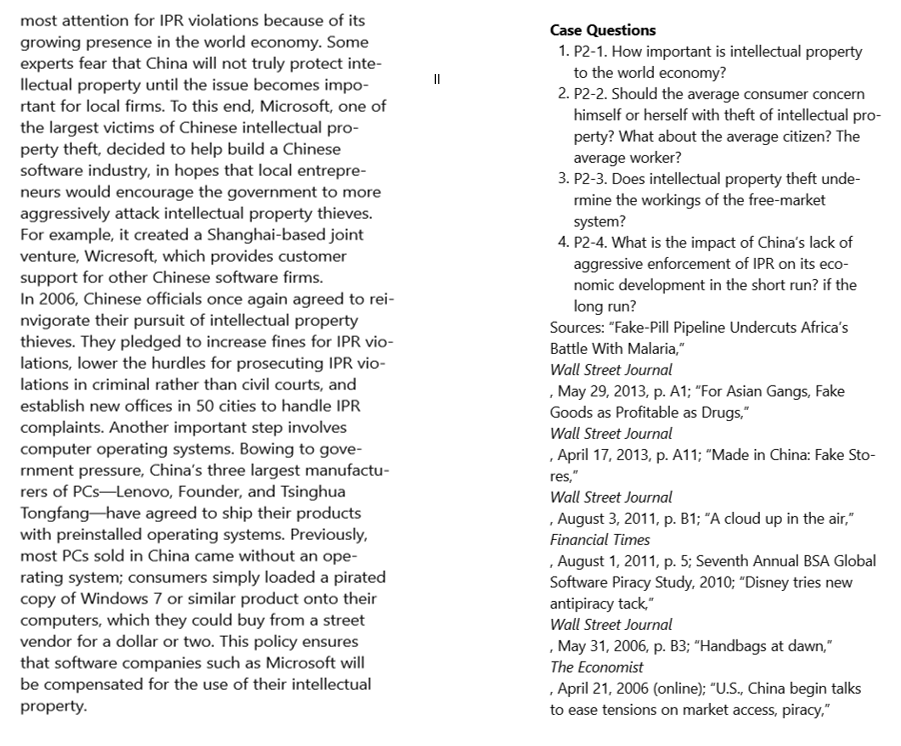 |
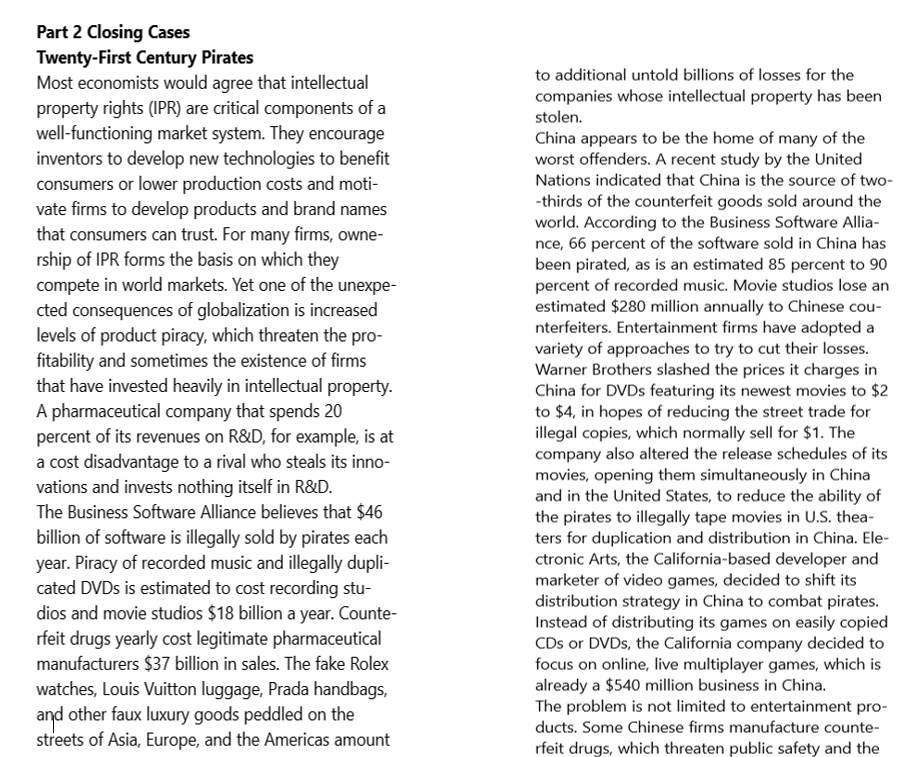
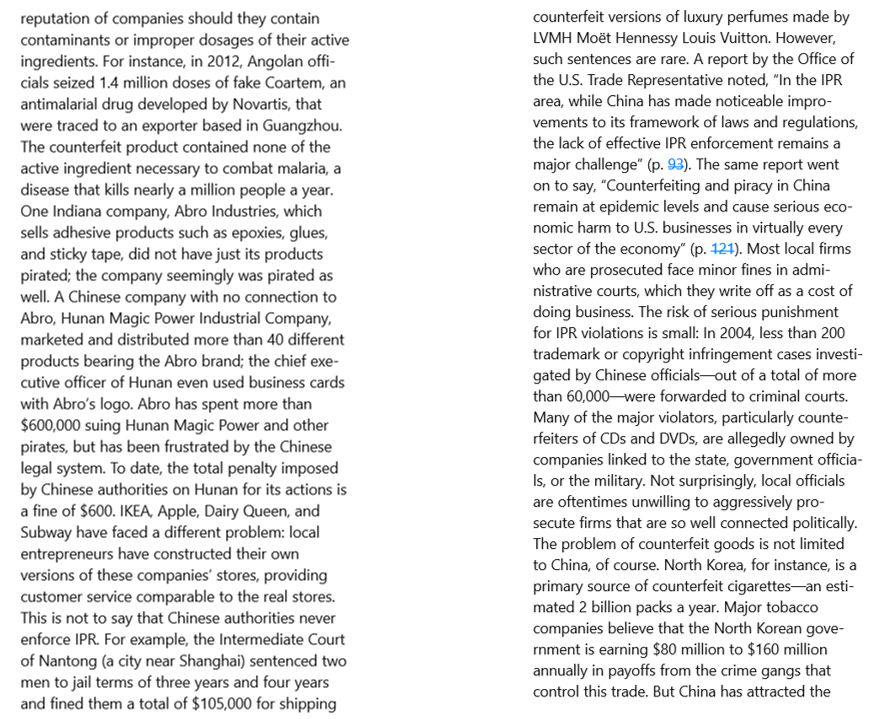
Part 2 Closing Cases Twenty-First Century Pirates Most economists would agree that intellectual property rights (IPR) are critical components of a well-functioning market system. They encourage inventors to develop new technologies to benefit consumers or lower production costs and moti- vate firms to develop products and brand names that consumers can trust. For many firms, owne- rship of IPR forms the basis on which they compete in world markets. Yet one of the unexpe- cted consequences of globalization is increased levels of product piracy, which threaten the pro- fitability and sometimes the existence of firms that have invested heavily in intellectual property. A pharmaceutical company that spends 20 percent of its revenues on R&D, for example, is at a cost disadvantage to a rival who steals its inno- vations and invests nothing itself in R&D. The Business Software Alliance believes that $46 billion of software is illegally sold by pirates each year. Piracy of recorded music and illegally dupli- cated DVDs is estimated to cost recording stu- dios and movie studios $18 billion a year. Counte- rfeit drugs yearly cost legitimate pharmaceutical manufacturers $37 billion in sales. The fake Rolex watches, Louis Vuitton luggage, Prada handbags, and other faux luxury goods peddled on the streets of Asia, Europe, and the Americas amount to additional untold billions of losses for the companies whose intellectual property has been stolen. China appears to be the home of many of the worst offenders. A recent study by the United Nations indicated that China is the source of two- -thirds of the counterfeit goods sold around the world. According to the Business Software Allia- nce, 66 percent of the software sold in China has been pirated, as is an estimated 85 percent to 90 percent of recorded music. Movie studios lose an estimated $280 million annually to Chinese cou- nterfeiters. Entertainment firms have adopted a variety of approaches to try to cut their losses. Warner Brothers slashed the prices it charges in China for DVDs featuring its newest movies to $2 to $4, in hopes of reducing the street trade for illegal copies, which normally sell for $1. The company also altered the release schedules of its movies, opening them simultaneously in China and in the United States, to reduce the ability of the pirates to illegally tape movies in U.S. thea- ters for duplication and distribution in China. Ele- ctronic Arts, the California-based developer and marketer of video games, decided to shift its distribution strategy in China to combat pirates. Instead of distributing its games on easily copied CDs or DVDs, the California company decided to focus on online, live multiplayer games, which is already a $540 million business in China. The problem is not limited to entertainment pro- ducts. Some Chinese firms manufacture counte- rfeit drugs, which threaten public safety and the reputation of companies should they contain contaminants or improper dosages of their active ingredients. For instance, in 2012, Angolan offi- cials seized 1.4 million doses of fake Coartem, an antimalarial drug developed by Novartis, that were traced to an exporter based in Guangzhou. The counterfeit product contained none of the active ingredient necessary to combat malaria, a disease that kills nearly a million people a year. One Indiana company, Abro Industries, which sells adhesive products such as epoxies, glues, and sticky tape, did not have just its products pirated; the company seemingly was pirated as well. A Chinese company with no connection to Abro, Hunan Magic Power Industrial Company, marketed and distributed more than 40 different products bearing the Abro brand; the chief exe- cutive officer of Hunan even used business cards with Abro's logo. Abro has spent more than $600,000 suing Hunan Magic Power and other pirates, but has been frustrated by the Chinese legal system. To date, the total penalty imposed by Chinese authorities on Hunan for its actions is a fine of $600. IKEA, Apple, Dairy Queen, and Subway have faced a different problem: local entrepreneurs have constructed their own versions of these companies' stores, providing customer service comparable to the real stores. This is not to say that Chinese authorities never enforce IPR. For example, the Intermediate Court of Nantong (a city near Shanghai) sentenced two men to jail terms of three years and four years and fined them a total of $105,000 for shipping counterfeit versions of luxury perfumes made by LVMH Mot Hennessy Louis Vuitton. However, such sentences are rare. A report by the Office of the U.S. Trade Representative noted, "In the IPR area, while China has made noticeable impro- vements to its framework of laws and regulations, the lack of effective IPR enforcement remains a major challenge" (p. 93). The same report went on to say, "Counterfeiting and piracy in China remain at epidemic levels and cause serious eco- nomic harm to U.S. businesses in virtually every sector of the economy" (p. 124). Most local firms who are prosecuted face minor fines in admi- nistrative courts, which they write off as a cost of doing business. The risk of serious punishment for IPR violations is small: In 2004, less than 200 trademark or copyright infringement cases investi- gated by Chinese officials-out of a total of more than 60,000were forwarded to criminal courts. Many of the major violators, particularly counte- rfeiters of CDs and DVDs, are allegedly owned by companies linked to the state government officia- Is, or the military. Not surprisingly, local officials are oftentimes unwilling to aggressively pro- secute firms that are so well connected politically. The problem of counterfeit goods is not limited to China, of course. North Korea, for instance, is a primary source of counterfeit cigarettesan esti- mated 2 billion packs a year. Major tobacco companies believe that the North Korean gove- rnment is earning $80 million to $160 million annually in payoffs from the crime gangs that control this trade. But China has attracted the II most attention for IPR violations because of its growing presence in the world economy. Some experts fear that China will not truly protect inte- llectual property until the issue becomes impo- rtant for local firms. To this end, Microsoft, one of the largest victims of Chinese intellectual pro- perty theft, decided to help build a Chinese software industry, in hopes that local entrepre- neurs would encourage the government to more aggressively attack intellectual property thieves. For example, it created a Shanghai-based joint venture, Wicresoft, which provides customer support for other Chinese software firms. In 2006, Chinese officials once again agreed to rei- nvigorate their pursuit of intellectual property thieves. They pledged to increase fines for IPR vio- lations, lower the hurdles for prosecuting IPR vio- lations in criminal rather than civil courts, and establish new offices in 50 cities to handle IPR complaints. Another important step involves computer operating systems. Bowing to gove- rnment pressure, China's three largest manufactu- rers of PCsLenovo, Founder, and Tsinghua Tongfang-have agreed to ship their products with preinstalled operating systems. Previously, most PCs sold in China came without an ope- rating system; consumers simply loaded a pirated copy of Windows 7 or similar product onto their computers, which they could buy from a street vendor for a dollar or two. This policy ensures that software companies such as Microsoft will be compensated for the use of their intellectual property. Case Questions 1. P2-1. How important is intellectual property to the world economy? 2. P2-2. Should the average consumer concern himself or herself with theft of intellectual pro- perty? What about the average citizen? The average worker? 3. P2-3. Does intellectual property theft unde- rmine the workings of the free-market system? 4. P2-4. What is the impact of China's lack of aggressive enforcement of IPR on its eco- nomic development in the short run? if the long run? Sources: "Fake-Pill Pipeline Undercuts Africa's Battle With Malaria," Wall Street Journal May 29, 2013, p. A1; "For Asian Gangs, Fake Goods as Profitable as Drugs," Wall Street Journal April 17, 2013, p. A11; "Made in China: Fake Sto- res," Wall Street Journal August 3, 2011, p. B1; "A cloud up in the air," Financial Times August 1, 2011, p. 5; Seventh Annual BSA Global Software Piracy Study, 2010; "Disney tries new antipiracy tack," Wall Street Journal , May 31, 2006, p. B3; "Handbags at dawn," The Economist April 21, 2006 (online); U.S., China begin talks to ease tensions on market access, piracy
Step by Step Solution
There are 3 Steps involved in it
1 Expert Approved Answer
Step: 1 Unlock

Question Has Been Solved by an Expert!
Get step-by-step solutions from verified subject matter experts
Step: 2 Unlock
Step: 3 Unlock
 Study Help