



Question: answer the critical thinking question CASE 21-1 MEYER v. CHRISTIE U.S. Court of Appeals for the Tenth Circuit 634 F. 3D 1152 (2011) FACTS: In
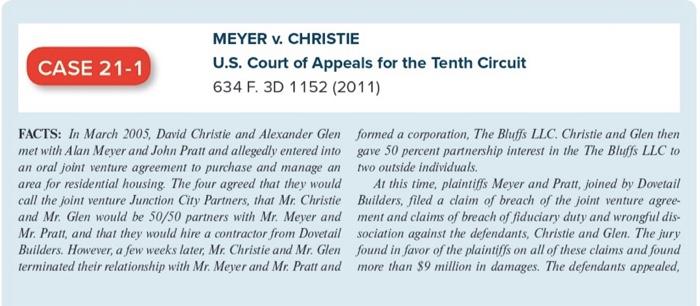
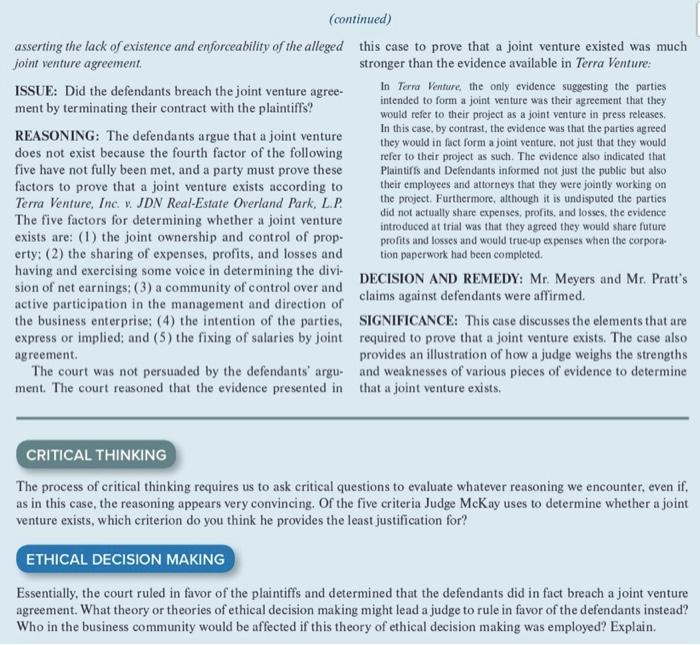
CASE 21-1 MEYER v. CHRISTIE U.S. Court of Appeals for the Tenth Circuit 634 F. 3D 1152 (2011) FACTS: In March 2005, David Christie and Alexander Glen formed a corporation, The Bluffs LLC. Christie and Glen then met with Alan Meyer and John Prant and allegedly entered into gave 50 percent partnership interest in the The Bluffs LLC to an oral joint venture agreement to purchase and manage an two outside individuals. area for residential housing. The four agreed that they would At this time, plaintiffs Meyer and Pratt, joined by Dovetail call the joint venture Junction City Partners, that Mr. Christie Builders, filed a daim of breach of the joint venture agree- and Mr. Glen would be 50/50 partners with Mr. Meyer and ment and claims of breach of fiduciary duty and wrongful dis- Mr. Pratt, and that they would hire a contractor from Dovetail sociation against the defendants, Christie and Glen. The jury Builders. However, a few weeks later, Mr. Christie and Mr. Glen found in favor of the plaintiffs on all of these claims and found terminated their relationship with Mr. Meyer and Mr. Pratt and more than $9 million in damages. The defendants appealed, (continued) asserting the lack of existence and enforceability of the alleged this case to prove that a joint venture existed was much joint venture agreement. stronger than the evidence available in Terra Venture: ISSUE: Did the defendants breach the joint venture agree- In Terra Venture the only evidence suggesting the parties ment by terminating their contract with the plaintiffs? intended to form a joint venture was their agreement that they would refer to their project as a joint venture in press releases. REASONING: The defendants argue that a joint venture In this case, by contrast, the evidence was that the parties agreed they would in fact form a joint venture, not just that they would does not exist because the fourth factor of the following refer to their project as such. The evidence also indicated that five have not fully been met, and a party must prove these Plaintiffs and Defendants informed not just the public but also factors to prove that a joint venture exists according to their employees and attorneys that they were jointly working on Terra Venture, Inc. . JDN Real-Estate Overland Park, L.P. the project. Furthermore, although it is undisputed the parties did not actually share expenses, profits, and losses, the evidence The five factors for determining whether a joint venture introduced at trial was that they agreed they would share future exists are: (1) the joint ownership and control of prop- profits and losses and would true-up expenses when the corporal erty: (2) the sharing of expenses, profits, and losses and tion paperwork had been completed. having and exercising some voice in determining the divi- DECISION AND REMEDY: Mr. Meyers and Mr. Pratt's sion of net earnings: (3) a community of control over and active participation in the management and direction of claims against defendants were affirmed. the business enterprise: (4) the intention of the parties. SIGNIFICANCE: This case discusses the elements that are express or implied, and (5) the fixing of salaries by joint required to prove that a joint venture exists. The case also agreement. provides an illustration of how a judge weighs the strengths The court was not persuaded by the defendants' argu- and weaknesses of various pieces of evidence to determine ment. The court reasoned that the evidence presented in that a joint venture exists. CRITICAL THINKING The process of critical thinking requires us to ask critical questions to evaluate whatever reasoning we encounter, even if as in this case, the reasoning appears very convincing. Of the five criteria Judge McKay uses to determine whether a joint venture exists, which criterion do you think he provides the least justification for? ETHICAL DECISION MAKING Essentially, the court ruled in favor of the plaintiffs and determined that the defendants did in fact breach a joint venture agreement. What theory or theories of ethical decision making might lead a judge to rule in favor of the defendants instead? Who in the business community would be affected if this theory of ethical decision making was employed? Explain
Step by Step Solution
There are 3 Steps involved in it

Get step-by-step solutions from verified subject matter experts