Question: answer the followig questions ,Labor force is normalized to 1 and there are 2 types of workers. A worker of type i = fL;Hg enjoys
answer the followig questions
,Labor force is normalized to 1 and there are 2 types of workers. A worker of type i = fL;Hg enjoys a benet zi while unemployed, and zL 0 per unit of time, i.e., p does not depend on the worker's type and p > zi, for all i. a)Write down the value functions for a rm and a worker of each type in all possible states. b) Exploiting the free entry condition of rms, derive the analogue of the job creation (JC) curve for this economy. c) Using the same methodology as in the lectures (adjusted to accommodate the dierences in the new environment), derive the wage curve (WC) for this economy. d) Combine the JC curve and the WC curve determined in the previous parts in order to provide an equation that (implicitly) determines the equilibrium . Compare with the analogous equilibrium condition from the lectures. For the remainder of this question, we will make an important change in the environment. We will assume that the total production of a lled job is given by px, where x is the match-specic (idiosyncratic) productivity. (But we will maintain the assumption that there are two types of workers and they enjoy a dierent unemployment benet.) As in the theory of \endogenous job destruction" (Chapter 2 of Pissarides' book), we will assume that existing matches get hit by a productivity shock at rate ; when that happens the random variable x attains a new value drawn from the cdf G(x). This distribution is iid over time and has support in the interval [0; 1]. 2 New jobs are always created at x = 1. Assume that every time a match obtains a new value x, the rm and the worker decide whether it is worth keeping the match alive and, if yes, they renegotiate over the wage. To answer the following questions make a conjecture about the equilibrium form, similar to the one we made in class in the endogenous job destruction theory. e) In this new environment what is the unemployment rate of workers of type i = L and H? Is it the same? f) Write down the value functions for a rm in all possible states. g) Write down the value functions for a worker of each type in all possible states. h) Without characterizing equilibrium (just using the economic intuition y
Assume you are managing a manufacturing line consisting of two workstations: Decambering and Hemming. The mean effective process time of the first machine is 15 minutes and its coefficient of variation is 1 (i.e., exponential distribution). The second machine has the same coefficient of variation, but this machine takes 14 minutes to process a part. (a) If there is an infinite buffer between the machines, compute the expected WIP, CT, and TH. (15 Points) WIP: ______ TH: ______ CT________
(b) Now assume that there is enough space for only 3 parts between the machines (Hint: the buffer size, b, is 3.) Recompute the expected WIP, CT, and TH. Compare with Part a. (15 Points) WIP: ______ TH: ______ CT: ______
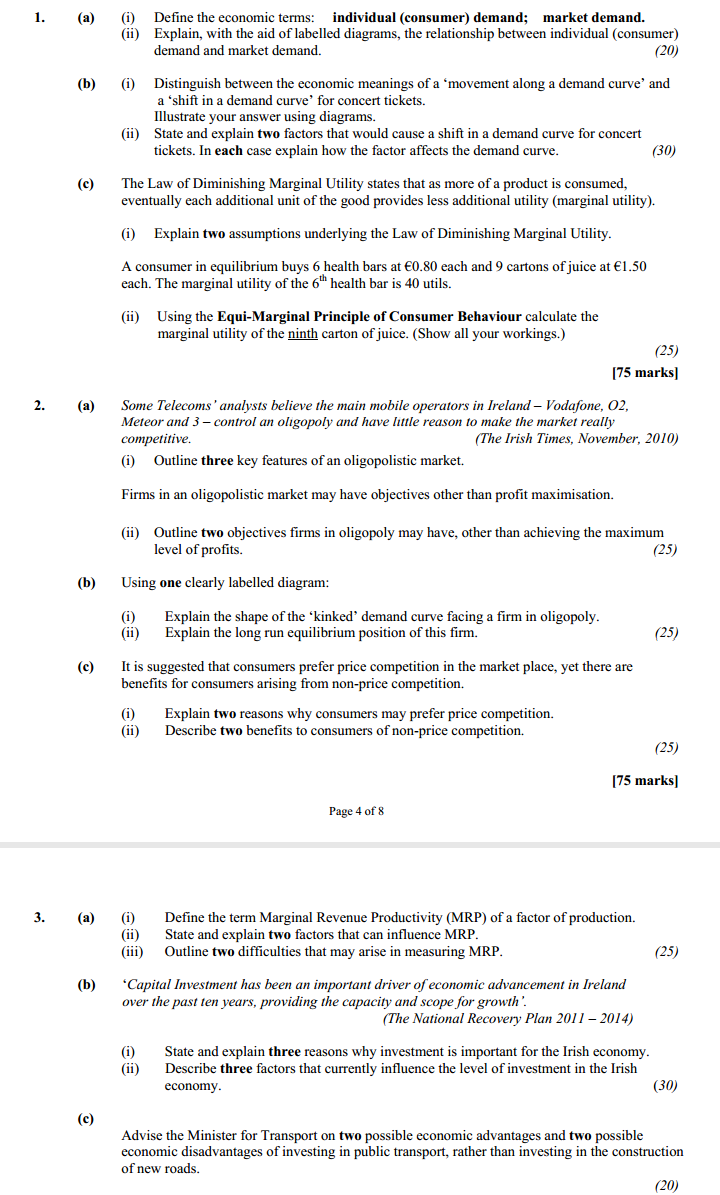
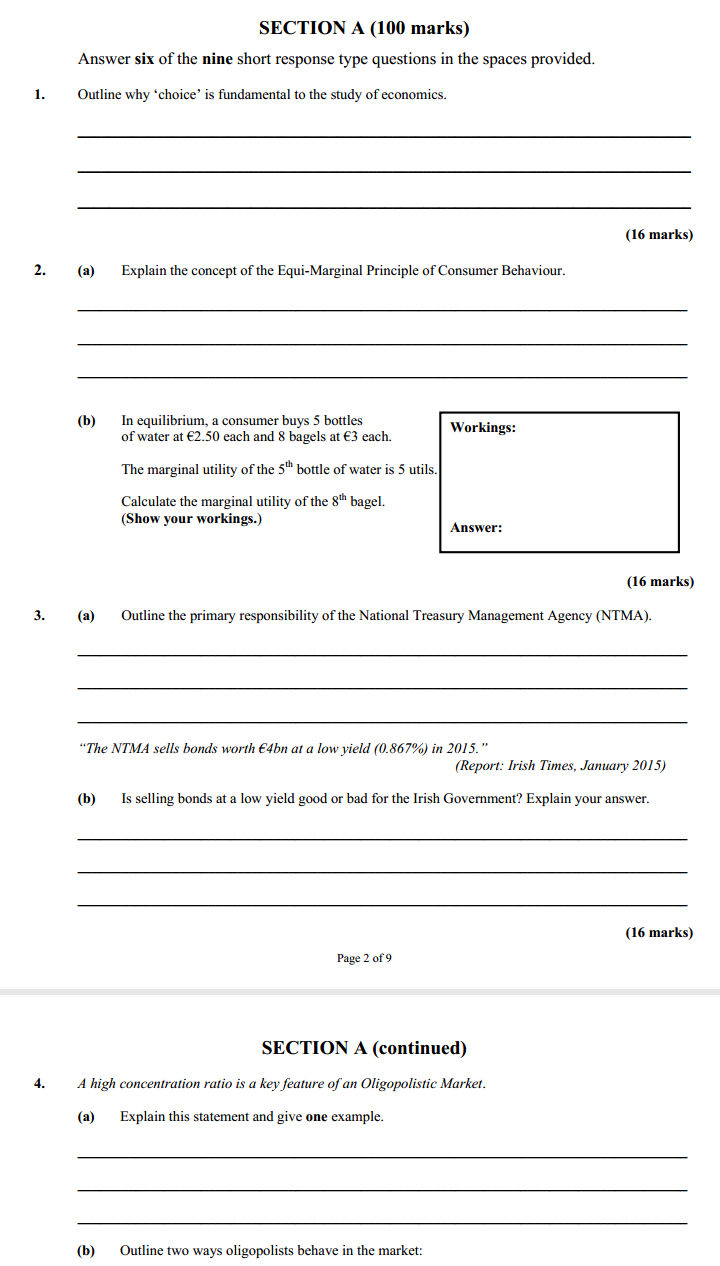
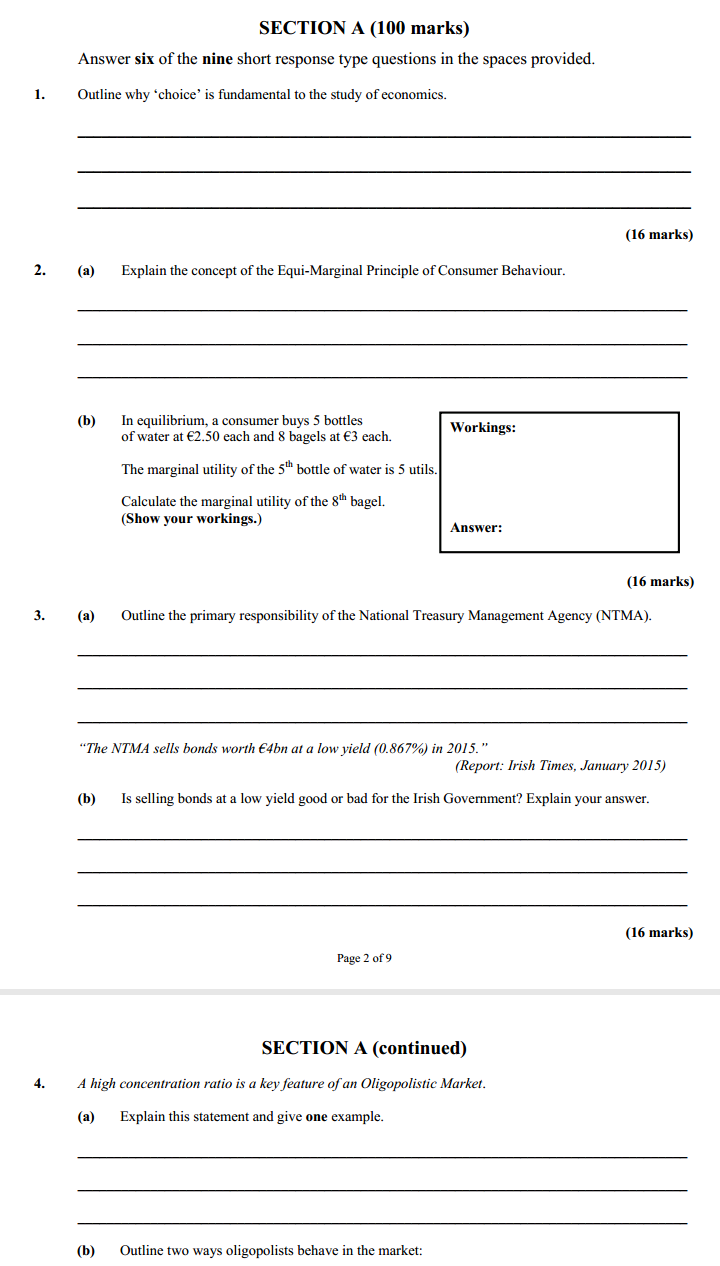
1. (a) (1) Define the economic terms: individual (consumer) demand; market demand. (ii) Explain, with the aid of labelled diagrams, the relationship between individual (consumer) demand and market demand. (20) (b) (i) Distinguish between the economic meanings of a 'movement along a demand curve' and a 'shift in a demand curve' for concert tickets. Illustrate your answer using diagrams. (ii) State and explain two factors that would cause a shift in a demand curve for concert tickets. In each case explain how the factor affects the demand curve. (30) (c) The Law of Diminishing Marginal Utility states that as more of a product is consumed, eventually each additional unit of the good provides less additional utility (marginal utility). (i) Explain two assumptions underlying the Law of Diminishing Marginal Utility. A consumer in equilibrium buys 6 health bars at 60.80 each and 9 cartons of juice at 61.50 each. The marginal utility of the 6" health bar is 40 utils. (ii) Using the Equi-Marginal Principle of Consumer Behaviour calculate the marginal utility of the ninth carton of juice. (Show all your workings.) (25) [75 marks] 2. (a) Some Telecoms' analysts believe the main mobile operators in Ireland - Vodafone, 02, Meteor and 3 - control an oligopoly and have little reason to make the market really competitive. (The Irish Times, November, 2010) (i) Outline three key features of an oligopolistic market. Firms in an oligopolistic market may have objectives other than profit maximisation. (ii) Outline two objectives firms in oligopoly may have, other than achieving the maximum level of profits. (25) (b) Using one clearly labelled diagram: (ii) Explain the shape of the 'kinked' demand curve facing a firm in oligopoly. Explain the long run equilibrium position of this firm. (25) (c) It is suggested that consumers prefer price competition in the market place, yet there are benefits for consumers arising from non-price competition. Explain two reasons why consumers may prefer price competition. (ii) Describe two benefits to consumers of non-price competition. (25) [75 marks] Page 4 of 8 3. (a) (i) Define the term Marginal Revenue Productivity (MRP) of a factor of production. (ii) State and explain two factors that can influence MRP. (iii) Outline two difficulties that may arise in measuring MRP. (25) (b) Capital Investment has been an important driver of economic advancement in Ireland over the past ten years, providing the capacity and scope for growth'. (The National Recovery Plan 201 1 - 2014) (i) State and explain three reasons why investment is important for the Irish economy. (ii) Describe three factors that currently influence the level of investment in the Irish economy. (30) (c) Advise the Minister for Transport on two possible economic advantages and two possible economic disadvantages of investing in public transport, rather than investing in the construction of new roads. (20)SECTION A (100 marks) Answer six of the nine short response type questions in the spaces provided. 1 . Outline why 'choice' is fundamental to the study of economics. (16 marks) 2. (a) Explain the concept of the Equi-Marginal Principle of Consumer Behaviour. (b) In equilibrium, a consumer buys 5 bottles of water at (2.50 each and 8 bagels at 63 each. Workings: The marginal utility of the 5" bottle of water is 5 utils. Calculate the marginal utility of the 8" bagel. (Show your workings.) Answer: (16 marks) 3. (a) Outline the primary responsibility of the National Treasury Management Agency (NTMA). "The NTMA sells bonds worth 64bn at a low yield (0.867%) in 2015." (Report: Irish Times, January 2015) (b) Is selling bonds at a low yield good or bad for the Irish Government? Explain your answer. (16 marks) Page 2 of 9 SECTION A (continued) 4. A high concentration ratio is a key feature of an Oligopolistic Market. (a) Explain this statement and give one example. (b) Outline two ways oligopolists behave in the market:SECTION A (100 marks) Answer six of the nine short response type questions in the spaces provided. 1 . Outline why 'choice' is fundamental to the study of economics. (16 marks) 2. (a) Explain the concept of the Equi-Marginal Principle of Consumer Behaviour. (b) In equilibrium, a consumer buys 5 bottles of water at (2.50 each and 8 bagels at 63 each. Workings: The marginal utility of the 5" bottle of water is 5 utils. Calculate the marginal utility of the 8" bagel. (Show your workings.) Answer: (16 marks) 3. (a) Outline the primary responsibility of the National Treasury Management Agency (NTMA). "The NTMA sells bonds worth 64bn at a low yield (0.867%) in 2015." (Report: Irish Times, January 2015) (b) Is selling bonds at a low yield good or bad for the Irish Government? Explain your answer. (16 marks) Page 2 of 9 SECTION A (continued) 4. A high concentration ratio is a key feature of an Oligopolistic Market. (a) Explain this statement and give one example. (b) Outline two ways oligopolists behave in the market
Step by Step Solution
There are 3 Steps involved in it
1 Expert Approved Answer
Step: 1 Unlock
Question Has Been Solved by an Expert!
Get step-by-step solutions from verified subject matter experts
Step: 2 Unlock
Step: 3 Unlock
Students Have Also Explored These Related General Management Questions!