Question: Answer the following case study. Explain the answer with minimum 10 sentences each . Do not plagiarized. Do not forget to cite using APA 7th
Answer the following case study. Explain the answer with minimum 10 sentences each. Do not plagiarized. Do not forget to cite using APA 7th Edition and give the links of references.
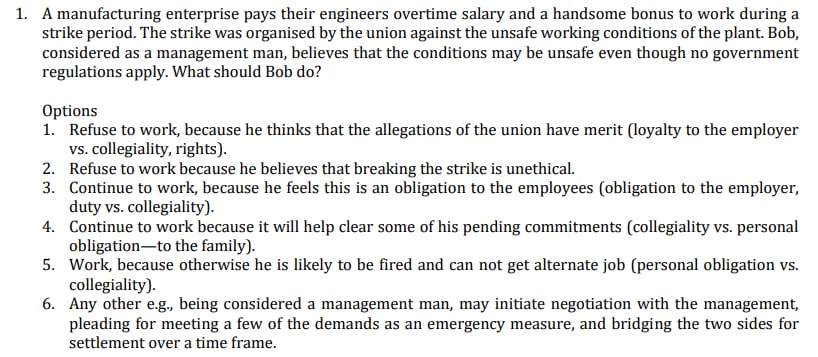
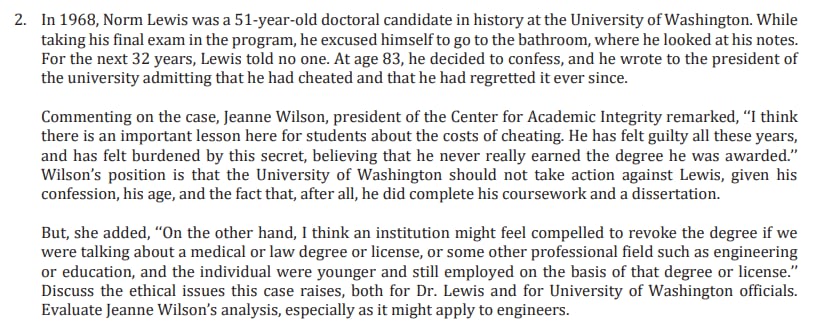
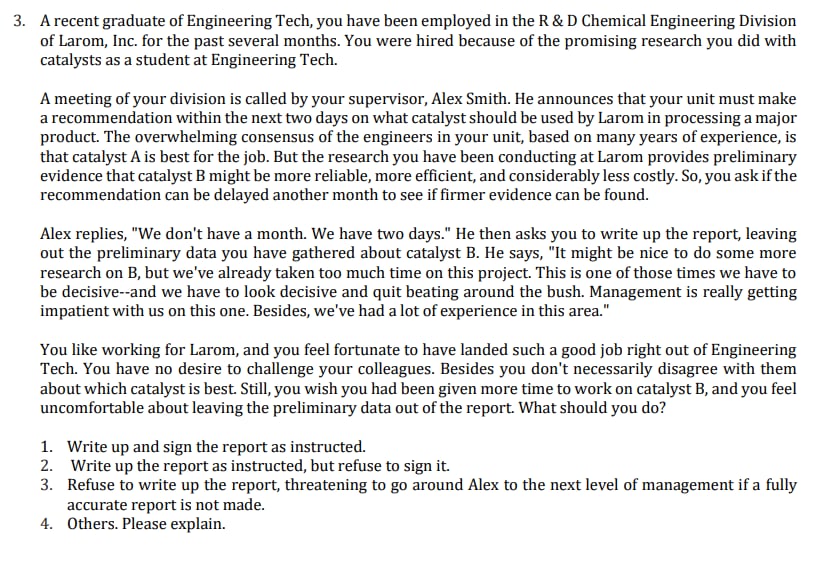
1. A manufacturing enterprise pays their engineers overtime salary and a handsome bonus to work during a strike period. The strike was organised by the union against the unsafe working conditions of the plant. Bob, considered as a management man, believes that the conditions may be unsafe even though no government regulations apply. What should Bob do? Options 1. Refuse to work, because he thinks that the allegations of the union have merit (loyalty to the employer vs. collegiality, rights). 2. Refuse to work because he believes that breaking the strike is unethical. 3. Continue to work, because he feels this is an obligation to the employees (obligation to the employer, duty vs. collegiality). 4. Continue to work because it will help clear some of his pending commitments (collegiality vs. personal obligationto the family). 5. Work, because otherwise he is likely to be fired and can not get alternate job (personal obligation vs. collegiality). 6. Any other e.g., being considered a management man, may initiate negotiation with the management, pleading for meeting a few of the demands as an emergency measure, and bridging the two sides for settlement over a time frame. 2. In 1968, Norm Lewis was a 51-year-old doctoral candidate in history at the University of Washington. While taking his final exam in the program, he excused himself to go to the bathroom, where he looked at his notes. For the next 32 years, Lewis told no one. At age 83, he decided to confess, and he wrote to the president of the university admitting that he had cheated and that he had regretted it ever since. Commenting on the case, Jeanne Wilson, president of the Center for Academic Integrity remarked, \"I think there is an important lesson here for students about the costs of cheating. He has felt guilty all these years, and has felt burdened by this secret, believing that he never really earned the degree he was awarded.\" Wilson's position is that the University of Washington should not take action against Lewis, given his confession, his age, and the fact that, after all, he did complete his coursework and a dissertation. But, she added, \"On the other hand, I think an institution might feel compelled to revoke the degree if we were talking about a medical or law degree or license, or some other professional field such as engineering or education, and the individual were younger and still employed on the basis of that degree or license.\" Discuss the ethical issues this case raises, both for Dr. Lewis and for University of Washington officials. Evaluate Jeanne Wilson's analysis, especially as it might apply to engineers. A recent graduate of Engineering Tech, you have been employed in the R & D Chemical Engineering Division of Larom, Inc. for the past several months. You were hired because of the promising research you did with catalysts as a student at Engineering Tech. A meeting of your division is called by your supervisor, Alex Smith. He announces that your unit must make a recommendation within the next two days on what catalyst should be used by Larom in processing a major product. The overwhelming consensus of the engineers in your unit, based on many years of experience, is that catalyst A is best for the job. But the research you have been conducting at Larom provides preliminary evidence that catalyst B might be more reliable, more efficient, and considerably less costly. So, you ask if the recommendation can be delayed another month to see if firmer evidence can be found. Alex replies, "We don't have a month. We have two days.\" He then asks you to write up the report, leaving out the preliminary data you have gathered about catalyst B. He says, "It might be nice to do some more research on B, but we've already taken too much time on this project. This is one of those times we have to be decisive--and we have to look decisive and quit beating around the bush. Management is really getting impatient with us on this one. Besides, we've had a lot of experience in this area." You like working for Larom, and you feel fortunate to have landed such a good job right out of Engineering Tech. You have no desire to challenge your colleagues. Besides you don't necessarily disagree with them about which catalyst is best. Still, you wish you had been given more time to work on catalyst B, and you feel uncomfortable about leaving the preliminary data out of the report. What should you do? 1. Write up and sign the report as instructed. 2. Write up the report as instructed, but refuse to sign it. 3. Refuse to write up the report, threatening to go around Alex to the next level of management if a fully accurate report is not made. 4. Others. Please explain
Step by Step Solution
There are 3 Steps involved in it
1 Expert Approved Answer
Step: 1 Unlock
Question Has Been Solved by an Expert!
Get step-by-step solutions from verified subject matter experts
Step: 2 Unlock
Step: 3 Unlock
Students Have Also Explored These Related General Management Questions!









 Study Help