







Question: Answer the following questions: 1. Describe the basic issue between Meshal, and Bander. 2. Considering the effect of conflict on creativity, how can the conflict
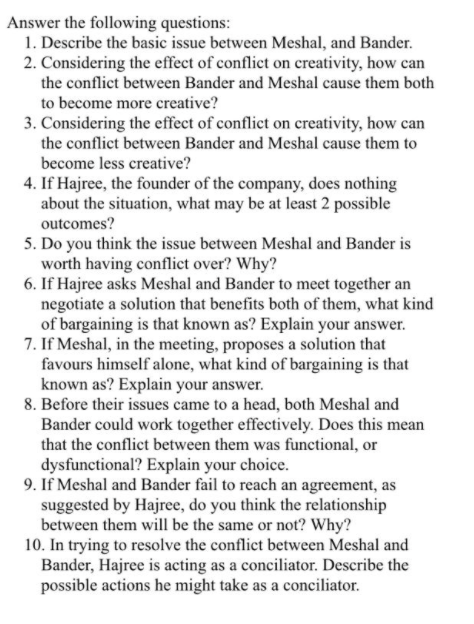
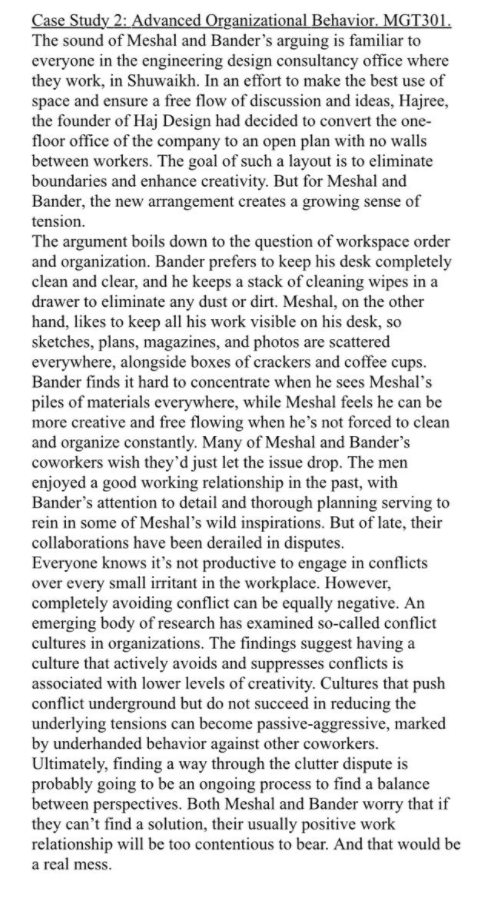
Answer the following questions: 1. Describe the basic issue between Meshal, and Bander. 2. Considering the effect of conflict on creativity, how can the conflict between Bander and Meshal cause them both to become more creative? 3. Considering the effect of conflict on creativity, how can the conflict between Bander and Meshal cause them to become less creative? 4. If Hajree, the founder of the company, does nothing about the situation, what may be at least 2 possible outcomes? 5. Do you think the issue between Meshal and Bander is worth having conflict over? Why? 6. If Hajree asks Meshal and Bander to meet together an negotiate a solution that benefits both of them, what kind of bargaining is that known as? Explain your answer. 7. If Meshal, in the meeting, proposes a solution that favours himself alone, what kind of bargaining is that known as? Explain your answer. 8. Before their issues came to a head, both Meshal and Bander could work together effectively. Does this mean that the conflict between them was functional, or dysfunctional? Explain your choice. 9. If Meshal and Bander fail to reach an agreement, as suggested by Hajree, do you think the relationship between them will be the same or not? Why? 10. In trying to resolve the conflict between Meshal and Bander, Hajree is acting as a conciliator. Describe the possible actions he might take as a conciliator. Case Study 2: Advanced Organizational Behavior. MGT301. The sound of Meshal and Bander's arguing is familiar to everyone in the engineering design consultancy office where they work, in Shuwaikh. In an effort to make the best use of space and ensure a free flow of discussion and ideas, Hajree, the founder of Haj Design had decided to convert the onefloor office of the company to an open plan with no walls between workers. The goal of such a layout is to eliminate boundaries and enhance creativity. But for Meshal and Bander, the new arrangement creates a growing sense of tension. The argument boils down to the question of workspace order and organization. Bander prefers to keep his desk completely clean and clear, and he keeps a stack of cleaning wipes in a drawer to eliminate any dust or dirt. Meshal, on the other hand, likes to keep all his work visible on his desk, so sketches, plans, magazines, and photos are scattered everywhere, alongside boxes of crackers and coffee cups. Bander finds it hard to concentrate when he sees Meshal's piles of materials everywhere, while Meshal feels he can be more creative and free flowing when he's not forced to clean and organize constantly. Many of Meshal and Bander's coworkers wish they'd just let the issue drop. The men enjoyed a good working relationship in the past, with Bander's attention to detail and thorough planning serving to rein in some of Meshal's wild inspirations. But of late, their collaborations have been derailed in disputes. Everyone knows it's not productive to engage in conflicts over every small irritant in the workplace. However, completely avoiding conflict can be equally negative. An emerging body of research has examined so-called conflict cultures in organizations. The findings suggest having a culture that actively avoids and suppresses conflicts is associated with lower levels of creativity. Cultures that push conflict underground but do not succeed in reducing the underlying tensions can become passive-aggressive, marked by underhanded behavior against other coworkers. Ultimately, finding a way through the clutter dispute is probably going to be an ongoing process to find a balance between perspectives. Both Meshal and Bander worry that if they can't find a solution, their usually positive work relationship will be too contentious to bear. And that would be a real mess. Answer the following questions: 1. Describe the basic issue between Meshal, and Bander. 2. Considering the effect of conflict on creativity, how can the conflict between Bander and Meshal cause them both to become more creative? 3. Considering the effect of conflict on creativity, how can the conflict between Bander and Meshal cause them to become less creative? 4. If Hajree, the founder of the company, does nothing about the situation, what may be at least 2 possible outcomes? 5. Do you think the issue between Meshal and Bander is worth having conflict over? Why? 6. If Hajree asks Meshal and Bander to meet together an negotiate a solution that benefits both of them, what kind of bargaining is that known as? Explain your answer. 7. If Meshal, in the meeting, proposes a solution that favours himself alone, what kind of bargaining is that known as? Explain your answer. 8. Before their issues came to a head, both Meshal and Bander could work together effectively. Does this mean that the conflict between them was functional, or dysfunctional? Explain your choice. 9. If Meshal and Bander fail to reach an agreement, as suggested by Hajree, do you think the relationship between them will be the same or not? Why? 10. In trying to resolve the conflict between Meshal and Bander, Hajree is acting as a conciliator. Describe the possible actions he might take as a conciliator. Case Study 2: Advanced Organizational Behavior. MGT301. The sound of Meshal and Bander's arguing is familiar to everyone in the engineering design consultancy office where they work, in Shuwaikh. In an effort to make the best use of space and ensure a free flow of discussion and ideas, Hajree, the founder of Haj Design had decided to convert the onefloor office of the company to an open plan with no walls between workers. The goal of such a layout is to eliminate boundaries and enhance creativity. But for Meshal and Bander, the new arrangement creates a growing sense of tension. The argument boils down to the question of workspace order and organization. Bander prefers to keep his desk completely clean and clear, and he keeps a stack of cleaning wipes in a drawer to eliminate any dust or dirt. Meshal, on the other hand, likes to keep all his work visible on his desk, so sketches, plans, magazines, and photos are scattered everywhere, alongside boxes of crackers and coffee cups. Bander finds it hard to concentrate when he sees Meshal's piles of materials everywhere, while Meshal feels he can be more creative and free flowing when he's not forced to clean and organize constantly. Many of Meshal and Bander's coworkers wish they'd just let the issue drop. The men enjoyed a good working relationship in the past, with Bander's attention to detail and thorough planning serving to rein in some of Meshal's wild inspirations. But of late, their collaborations have been derailed in disputes. Everyone knows it's not productive to engage in conflicts over every small irritant in the workplace. However, completely avoiding conflict can be equally negative. An emerging body of research has examined so-called conflict cultures in organizations. The findings suggest having a culture that actively avoids and suppresses conflicts is associated with lower levels of creativity. Cultures that push conflict underground but do not succeed in reducing the underlying tensions can become passive-aggressive, marked by underhanded behavior against other coworkers. Ultimately, finding a way through the clutter dispute is probably going to be an ongoing process to find a balance between perspectives. Both Meshal and Bander worry that if they can't find a solution, their usually positive work relationship will be too contentious to bear. And that would be a real mess
Step by Step Solution
There are 3 Steps involved in it

Get step-by-step solutions from verified subject matter experts
 Study Help