







Question: Answer the following questions about the function 4 E f($)=z,:25 Instructions: - If you are asked for a function, enter a function. - If you
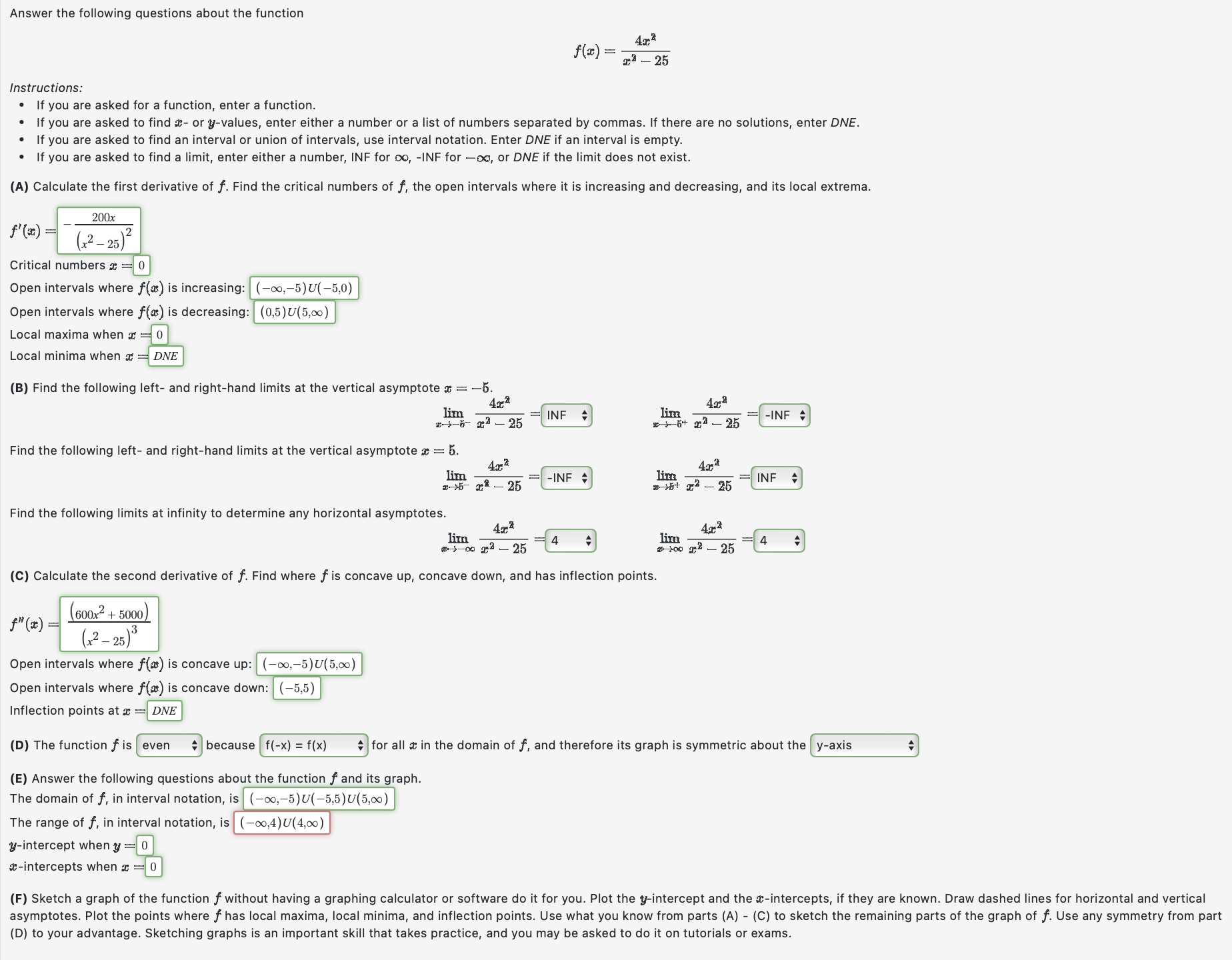
Answer the following questions about the function 4 E f($)=z,:25 Instructions: - If you are asked for a function, enter a function. - If you are asked to find a: or y-values, enter either a number or a list of numbers separated by commas. If there are no solutions, enter DNE. - If you are asked to find an interval or union of intervals, use interval notation. Enter DNE if an interval is empty. - If you are asked to find a limit, enter either a number, INF for no, |NF for oo, or DNE if the limit does not exist. (A) Calculate the first derivative of f. Find the critical numbers of f, the open intervals where it is increasing and decreasing, and its local extrema. f'lw) = Critical numbers .1: = Open intervals where x) is increasing: (700:5)Uli) Open intervals where at) is decreasing: Local maxima when x Local minima when x (B) Find the following left- and right-hand limits at the vertical asymptote z = 5. 4:2 lim zki' :3 _ 25 Find the following left- and righthand limits at the vertical asymptote :1,- = 5. 4:2 lim :-)' 2' 25 _ 43" 3351+ :3 25 Find the following limits at infinity to determine any horizontal asymptotes. 2 42,2 .327 -25 A's.245 =- (c) Calculate the second derivative of f. Find where f is concave up, concave down, and has inflection points. \"(1) = (60(le + won! (1:2 , 25)d Open intervals where n) is concave up: Open intervals where n) is concave down: Inflection points at :1: (D) The function f is because fl-x] = f(x) 3 for all 1 in the domain of f, and therefore its graph is symmetric about the m (E) Answer the following questions about the function f and its graph. The domain off, in interval notation, is (m,5)U(5.5)Ul5,oo) The range of f, in interval notation, is yintercept when 3; {c-intercepts when a: (F) Sketch a graph of the function f without having a graphing calculator or software do it for you. Plot the yintercept and the 1-intercepts, if they are known. Draw dashed lines for horizontal and vertical asymptotes. Plot the points where f has local maxima, local minima, and inflection points. Use what you know from parts (A) - (C) to sketch the remaining parts of the graph of f Use any symmetry from part (B) to your advantage. Sketching graphs is an important skill that takes practice, and you may be asked to do it on tutorials or exams
Step by Step Solution
There are 3 Steps involved in it

Get step-by-step solutions from verified subject matter experts
 Study Help