Question: Answer the following questions according to the given case study. 1. Explain the purpose of an organisation implementing an e-CRM system and how this relates
Answer the following questions according to the given case study.
1. Explain the purpose of an organisation implementing an e-CRM system and how this relates to the changes made by Cisco, within the case study section on Customer Service. 2. Discuss why allowing Cisco B2B customers to complete online orders would also be a benefit to other business entities. Also, what could be potential disadvantages or risks to a business.
3. Identity at least 3 cost saving benefits that Cisco has achieved from the implementation of their online connection system, and why they are justified.
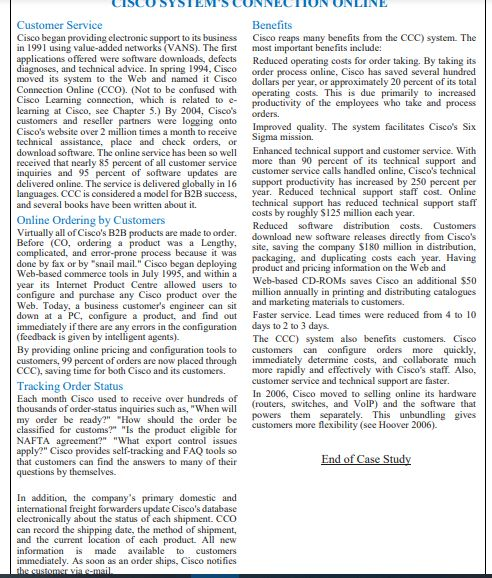
Customer Service Cisco began providing electronic support to its business in 1991 using value-added networks (VANS). The first applications offered were software downloads, defects diagnoses, and technical advice. In spring 1994, Cisco moved its system to the Web and named it Cisco Connection Online (CCO). (Not to be confused with Cisco Learning connection, which is related to c- learning at Cisco, see Chapter 5.) By 2004, Cisco's customers and reseller partners were logging onto Cisco's website over 2 million times a month to receive technical assistance, place and check orders, or download software. The online service has been so well received that nearly 85 percent of all customer service inquiries and 95 percent of software updates are delivered online. The service is delivered globally in 16 languages. CCC is considered a model for B2B success, and several books have been written about it. Online Ordering by Customers Virtually all of Cisco's B2B products are made to order. Before (CO, ordering a product was a Lengthy, complicated, and error-prone process because it was done by fax or by "snail mail." Cisco began deploying Web-based commerce tools in July 1995, and within a year its Internet Product Centre allowed users to configure and purchase any Cisco product over the Web. Today, a business customer's engineer can sit down at a PC, configure a product, and find out immediately if there are any errors in the configuration (feedback is given by intelligent agents). By providing online pricing and configuration tools to customers, 99 percent of orders are now placed through CCC), saving time for both Cisco and its customers. Tracking Order Status Each month Cisco used to receive over hundreds of thousands of order-status inquiries such as, "When will my order be ready?" "How should the order be classified for customs?" "Is the product eligible for NAFTA agreement?" "What export control issues apply?" Cisco provides self-tracking and FAQ tools so that customers can find the answers to many of their questions by themselves. Benefits Cisco reaps many benefits from the CCC) system. The most important benefits include: Reduced operating costs for order taking. By taking its order process online, Cisco has saved several hundred dollars per year, or approximately 20 percent of its total operating costs. This is due primarily to increased productivity of the employees who take and process orders. Improved quality. The system facilitates Cisco's Six Sigma mission. Enhanced technical support and customer service. With more than 90 percent of its technical support and customer service calls handled online, Cisco's technical support productivity has increased by 250 percent per year. Reduced technical support staff cost. Online technical support has reduced technical support staff costs by roughly S125 million each year. Reduced software distribution costs. Customers download new software releases directly from Cisco's site, saving the company $180 million in distribution. packaging, and duplicating costs each year. Having product and pricing information on the Web and Web-based CD-ROMs saves Cisco an additional $50 million annually in printing and distributing catalogues and marketing materials to customers. Faster service. Lead times were reduced from 4 to 10 days to 2 to 3 days The CCC) system also benefits customers. Cisco customers can configure orders more quickly, immediately determine costs, and collaborate much more rapidly and effectively with Cisco's staff. Also, customer service and technical support are faster. In 2006, Cisco moved to selling online its hardware (routers, switches, and VoIP) and the software that powers them separately. This unbundling gives customers more flexibility (see Hoover 2006). End of Case Study In addition, the company's primary domestic and international freight forwarders update Cisco's database electronically about the status of each shipment. CCO can record the shipping date, the method of shipment, and the current location of each product. All new information is made available to customers immediately. As soon as an order ships, Cisco notifies the customer wicemsil









 Study Help