Question: Answer the questions 1. In Document 25, how does Nathan Cole describe the scene and style of George Whitefields preaching? Why would established religious leaders
Answer the questions
1. In Document 25, how does Nathan Cole describe the scene and style of George Whitefields preaching? Why would established religious leaders be alarmed by Whitefields appearance in the American colonies?
2. In Document 26, what elements of Indian life does Neolincriticize most strongly according to Pontiac?
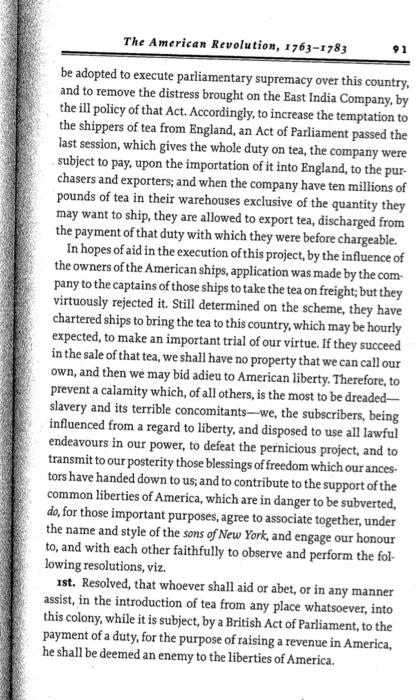
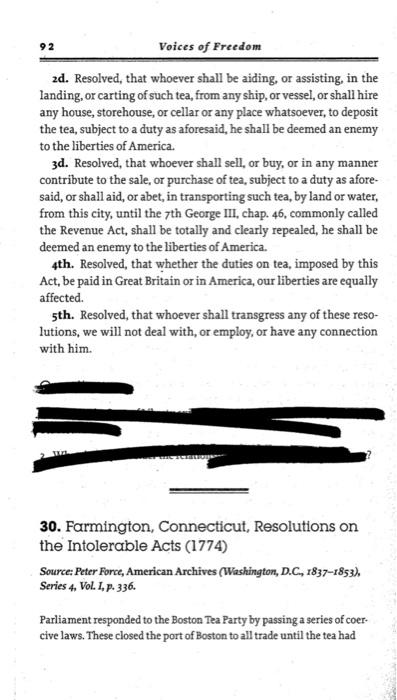
3. In Document 29, how do the Sons of Liberty explain Britains motivations for passing the Tea Act?
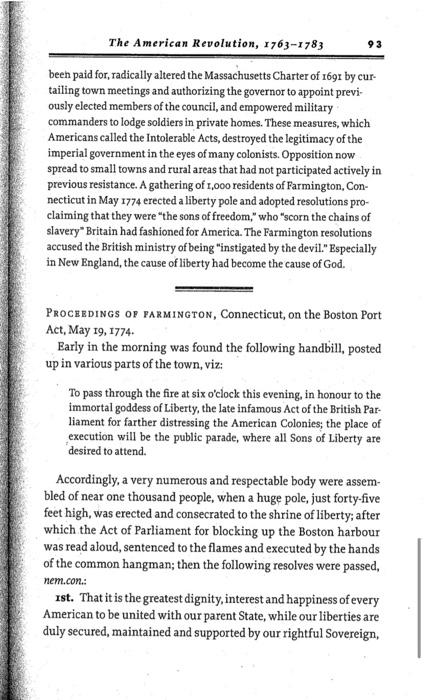
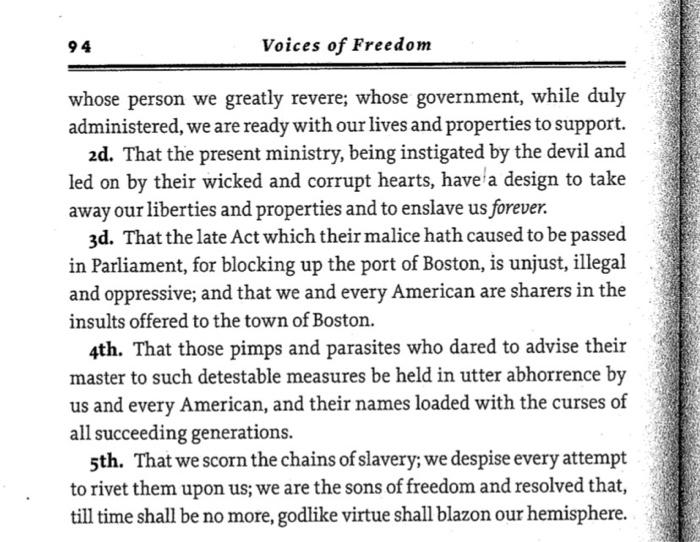
4. In Document 30, how does the language of the resolutions suggest that feelings toward Great Britain have hardened or deteriorated in the colonies?
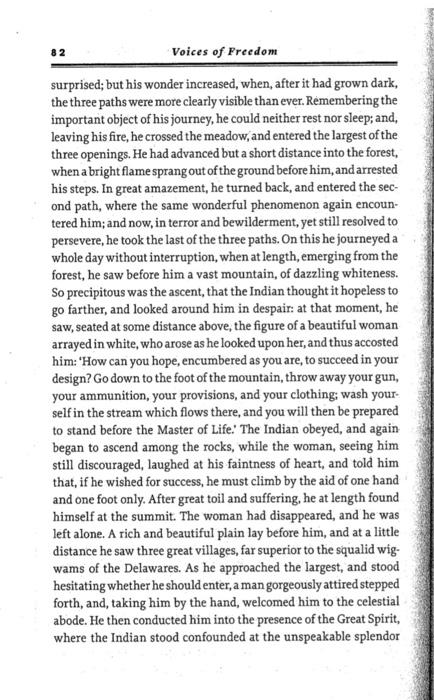
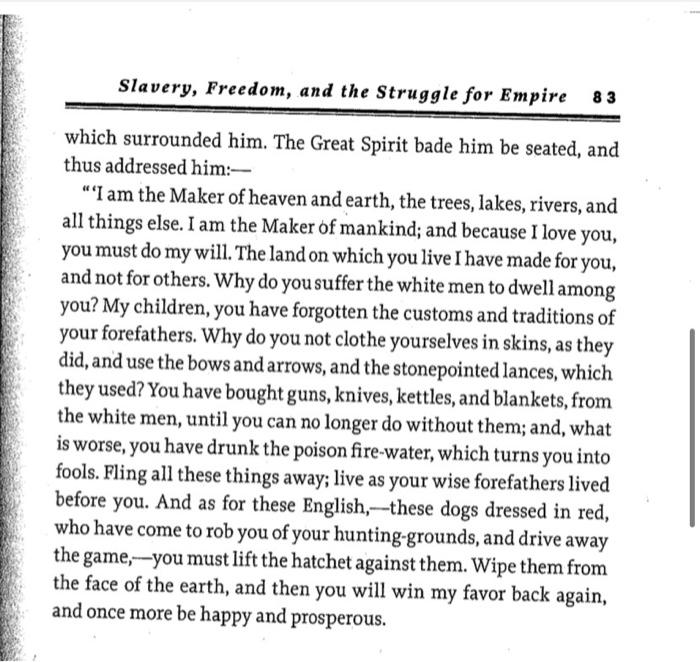
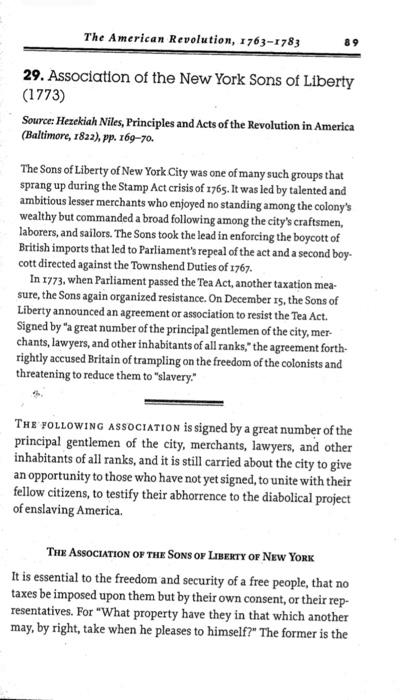
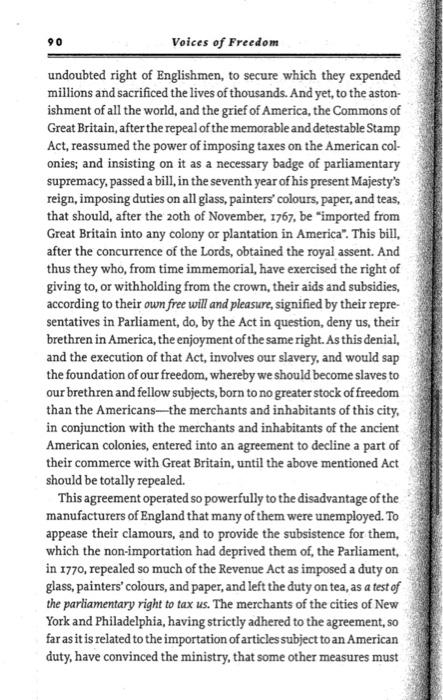
78 Voices of Freedom transatlantic movement. More than any other individual, the English minister George Whitefield, who declared the whole world his parish." sparked the Great Awakening. For two years after his arrival in America in 1739. Whitefield brought his highly emotional brand of preaching to colonies from Georgia to New England. A Connecticut farmer, Nathan Cole, in a 200-page autobiographical man- uscript, offered a vivid account of the impact of Whitefield's preaching and how ordinary colonists responded to its spiritual message. People, Cole wrote, traveled from far and wide to hear Whitefield because of a concern for their soul. When he heard that Whitefield was nearby, Cole stopped his work, ran to get his wife, and immediately took off on horseback. Cole would later go on to form his own church, illustrating how the Great Awak ening inspired ordinary people to think for themselves in religious matters. NOW IT PLEASED GOD to send Mr. Whitefield into this land, and my hearing of his preaching at Philadelphia, like one of the Old apos- tles, and many thousands flocking to hear him preach the Gospel, and great numbers were converted to Christ; I felt the Spirit of God drawing me by conviction, longed to see and hear him, and wished he would come this way. And I soon heard he was come to New York and the Jerseys and great multitudes flocking after him under great concern for their Souls and many converted which brought on my concern more and more hoping soon to see him but next I heard he was at Long Island, then at Boston, and next at Northampton. Then one morning all on a Sudden, about 8 or 9 o'clock there came a messenger and said Mr. Whitefield preached at Hartford and Weathersfield yesterday and is to preach at Middletown this morn- ing (October 23, 1740) at ten of the Clock. I was in my field at work. I dropped my tool that I had in my hand and ran home and run through my house and bade my wife get ready quick to go and hear Mr. Whitefield preach at Middletown, and run to my pasture for my horse with all my might fearing that I should be too late to hear him. I brought my horse home and soon mounted and took my wife up and went forward as fast as I thought the horse could bear, and Slavery, Freedom, and the struggle for Empire 79 when my horse began to be out of breath, I would get down and put my wife on the saddle and bid her ride as fast as she could and not stop or slack for me except I bade her, and so I would run until I was much out of breath, and then mount my horse again, and so I did several times to favor my horse, we improved every moment to get along as if we were fleeing for our lives, all the while fearing we should be too late to hear the Sermon, for we had twelve miles to ride double in little more than an hour.... And when we came within about half a mile of the road that comes down from Hartford, Weathersfield and Stepney to Middletown; on high land I saw before me a cloud or fog rising. I first thought it came from the great river (Connecticut River), but as I came nearer the road, I heard a noise something like a low rumbling thunder and pres- ently found it was the noise of horses' feet coming down the road and this cloud was a cloud of dust made by the horses' feet.... As I drew nearer it seemed like a steady stream of horses and their riders, scarcely a horse more than his length behind another, all of a lather and foam with sweat, their breath rolling out of their nostrils in the cloud of dust every jump; every horse seemed to go with all his might to carry his rider to hear news from heaven for the saving of Souls. It made me tremble to see the sight, how the world was in a struggle. I found a space between two horses to slip in my horse; and my wife said...our clothes will be all spoiled see how they look, for they were so covered with dust, that they looked almost all of a color coats, hats, and shirts and horses. We went down in the stream: I heard no man speak a word all the way three miles but every one pressing forward in great haste and when we got to the old meeting house there was a great multitude; it was said to be 3 or 4,000 of people assembled together, we got off from our horses and shook off the dust, and the ministers were then coming to the meeting house. I turned and looked towards the great river and saw the ferry boats running swift forward... bringing over loads of people, the oars rowed nimble and quick, everything men horses and boats seemed to be struggling for life, the land and banks 80 Voices of Freedom over the river looked black with people and horses all along the 12 miles. I saw no man at work in his field, but all seemed to be gone. When I saw Mr. Whitefield come upon the scaffold he looked almost angelical, a young, slim slender youth before some thousands of people with a bold undaunted countenance, and my hearing how God was with him everywhere as he came along it solemnized my mind, and put me into a trembling fear before he began to preach; for he looked as if he was clothed with authority from the Great God, and a sweet solemn solemnity sat upon his brow. And my hearing him preach gave me a heart wound; by God's blessing my old foundation was broken up, and I saw that my righteousness would not save me then I was convinced of the doctrine of Election and went right to quarreling with God about it, because all that I could do would not save me, and he had decreed from Eternity who should be saved and who not. preacht the American 26. Pontiac, Two Speeches (1762 and 1763) Source: Alexander Henry, Travels and Adventures in Canada and the Indian Territories between the Years 1760 and 1776 [1809) (Toronto, 1901), p.44; and Francis Parkman, The Conspiracy of Pontiac and the Indian Wars after the Conquest of Canada (6th ed., Boston, 1874), Vol. 1, pp. 205-07. Victory in the Seven Years' War, confirmed in the Treaty of Paris of 1763. established British preeminence in North America east of the Mississippi River. To Indians, it was clear that the abrupt departure of the French Slavery, Freedom, and the Struggle for Empire 81 from Canada and the Mississippi and Ohio valleys, and the continued expansion of the British settler population, posed a dire threat. In 1763, Indians of the Ohio Valley and Great Lakes launched a revolt against British rule. Although known as Pontiac's Rebellion, after an Ottawa war leader, the rebellion owed much to the teachings of Neolin, a Delaware religious prophet. Neolin and Pontiac promoted a pan Indian identity among members of different tribes, urging all Indians to fight to regain their lost independence. In 1763, Indians seized several British forts and killed hundreds of white settlers who had intruded onto Indian lands. British forces soon launched a counterattack, and one by one the tribes made peace. But the uprising laid the groundwork for future resis- tance. ENGLISHMAN, ALTHOUGH You have conquered the French, you have not yet conquered us! We are not your slaves. These lakes, these woods and mountains, were left to us by our ancestors. They are our inheritance, and we will part with them to none. Your nation sup- poses that we, like the white people, cannot live without bread--and pork--and beef! But, you ought to know, that He, the Great Spirit and Master of Life, has provided food for us, in these spacious lakes, and on these woody mountains... "A Delaware Indian (Neolin)" said Pontiac, "conceived an eager desire to learn wisdom from the Master of Life; but, being ignorant where to find him, he had recourse to fasting, dreaming, and magical incantations. By these means it was revealed to him, that, by mov- ing forward in a straight, undeviating course, he would reach the abode of the Great Spirit. He told his purpose to no one, and having provided the equipments of a hunter-gun, powder-horn, ammu- nition, and a kettle for preparing his food.-he set out on his errand. For some time he journeyed on in high hope and confidence. On the evening of the eighth day, he stopped by the side of a brook at the edge of a meadow, where he began to make ready his evening meal, when, looking up, he saw three large openings in the woods before him, and three well-beaten paths which entered them. He was much 82 Voices of Freedom surprised; but his wonder increased, when, after it had grown dark, the three paths were more clearly visible than ever. Remembering the important object of his journey, he could neither rest nor sleep; and, leaving his fire, he crossed the meadow, and entered the largest of the three openings. He had advanced but a short distance into the forest, when a bright flame sprang out of the ground before him, and arrested his steps. In great amazement, he turned back, and entered the sec- ond path, where the same wonderful phenomenon again encoun tered him; and now, in terror and bewilderment, yet still resolved to persevere, he took the last of the three paths. On this he journeyed a whole day without interruption, when at length, emerging from the forest, he saw before him a vast mountain, of dazzling whiteness. So precipitous was the ascent, that the Indian thought it hopeless to go farther, and looked around him in despair: at that moment, he saw, seated at some distance above, the figure of a beautiful woman arrayed in white, who arose as he looked upon her, and thus accosted him: "How can you hope, encumbered as you are, to succeed in your design? Go down to the foot of the mountain, throw away your gun, your ammunition, your provisions, and your clothing wash your self in the stream which flows there, and you will then be prepared to stand before the Master of Life! The Indian obeyed, and again began to ascend among the rocks, while the woman, seeing him still discouraged, laughed at his faintness of heart, and told him that, if he wished for success, he must climb by the aid of one hand and one foot only. After great toil and suffering, he at length found himself at the summit. The woman had disappeared, and he was left alone. A rich and beautiful plain lay before him, and at a little distance he saw three great villages, far superior to the squalid wig- wams of the Delawares. As he approached the largest, and stood hesitating whether he should enter, a man gorgeously attired stepped forth, and, taking him by the hand, welcomed him to the celestial abode. He then conducted him into the presence of the Great Spirit, where the Indian stood confounded at the unspeakable splendor Slavery, Freedom, and the Struggle for Empire which surrounded him. The Great Spirit bade him be seated, and thus addressed him: "'I am the Maker of heaven and earth, the trees, lakes, rivers, and all things else. I am the Maker of mankind; and because I love you, you must do my will. The land on which you live I have made for you, and not for others. Why do you suffer the white men to dwell among you? My children, you have forgotten the customs and traditions of your forefathers. Why do you not clothe yourselves in skins, as they did, and use the bows and arrows, and the stonepointed lances, which they used? You have bought guns, knives, kettles, and blankets, from the white men, until you can no longer do without them; and, what is worse, you have drunk the poison fire-water, which turns you into fools. Fling all these things away; live as your wise forefathers lived before you. And as for these English,---these dogs dressed in red, who have come to rob you of your hunting-grounds, and drive away the game.---you must lift the hatchet against them. Wipe them from the face of the earth, and then you will win my favor back again, and once more be happy and prosperous. The American Revolution, 1763-1783 89 29. Association of the New York Sons of Liberty (1773) Source: Hezekiah Niles, Principles and Acts of the Revolution in America (Baltimore, 1822), pp. 16970. The Sons of Liberty of New York City was one of many such groups that sprang up during the Stamp Act crisis of 1765. It was led by talented and ambitious lesser merchants who enjoyed no standing among the colony's wealthy but commanded a broad following among the city's craftsmen, laborers, and sailors. The Sons took the lead in enforcing the boycott of British imports that led to Parliament's repeal of the act and a second boy cott directed against the Townshend Duties of 1767. In 1773, when Parliament passed the Tea Act, another taxation mea- sure, the Sons again organized resistance. On December is, the Sons of Liberty announced an agreement or association to resist the Tea Act. Signed by a great number of the principal gentlemen of the city, mer- chants, lawyers, and other inhabitants of all ranks," the agreement forth- rightly accused Britain of trampling on the freedom of the colonists and threatening to reduce them to "slavery." THE FOLLOWING ASSOCIATION is signed by a great number of the principal gentlemen of the city, merchants, lawyers, and other inhabitants of all ranks, and it is still carried about the city to give an opportunity to those who have not yet signed, to unite with their fellow citizens, to testify their abhorrence to the diabolical project of enslaving America Tux ASSOCIATION OF THE SONS OF LIBERTY OF NEW YORK It is essential to the freedom and security of a free people, that no taxes be imposed upon them but by their own consent, or their rep- resentatives. For "What property have they in that which another may, by right, take when he pleases to himself?" The former is the 90 Voices of Freedom undoubted right of Englishmen, to secure which they expended millions and sacrificed the lives of thousands. And yet to the aston- ishment of all the world, and the grief of America, the Commons of Great Britain, after the repeal of the memorable and detestable Stamp Act, reassumed the power of imposing taxes on the American col- onies; and insisting on it as a necessary badge of parliamentary supremacy, passed a bill, in the seventh year of his present Majesty's reign, imposing duties on all glass, painters' colours, paper, and teas, that should, after the 20th of November, 1767, be "imported from Great Britain into any colony or plantation in America". This bill, after the concurrence of the Lords, obtained the royal assent. And thus they who, from time immemorial, have exercised the right of giving to, or withholding from the crown, their aids and subsidies, according to their own free will and pleasure, signified by their repre- sentatives in Parliament, do, by the Act in question, deny us, their brethren in America, the enjoyment of the same right. As this denial, and the execution of that Act, involves our slavery, and would sap the foundation of our freedom, whereby we should become slaves to our brethren and fellow subjects, born to no greater stock of freedom than the Americansthe merchants and inhabitants of this city, in conjunction with the merchants and inhabitants of the ancient American colonies, entered into an agreement to decline a part of their commerce with Great Britain, until the above mentioned Act should be totally repealed. This agreement operated so powerfully to the disadvantage of the manufacturers of England that many of them were unemployed. To appease their clamours, and to provide the subsistence for them, which the non-importation had deprived them of the Parliament, in 1770, repealed so much of the Revenue Act as imposed a duty on glass, painters' colours, and paper, and left the duty on tea, as a test of the parliamentary right to tax us. The merchants of the cities of New York and Philadelphia, having strictly adhered to the agreement, so far as it is related to the importation of articles subject to an American duty, have convinced the ministry, that some other measures must 91 The American Revolution, 1763-1783 be adopted to execute parliamentary supremacy over this country, and to remove the distress brought on the East India Company, by the ill policy of that Act. Accordingly, to increase the temptation to the shippers of tea from England, an Act of Parliament passed the last session, which gives the whole duty on tea, the company were subject to pay, upon the importation of it into England, to the pur- chasers and exporters; and when the company have ten millions of pounds of tea in their warehouses exclusive of the quantity they may want to ship, they are allowed to export tea, discharged from the payment of that duty with which they were before chargeable. In hopes of aid in the execution of this project, by the influence of the owners of the American ships, application was made by the com- pany to the captains of those ships to take the tea on freight; but they virtuously rejected it. Still determined on the scheme, they have chartered ships to bring the tea to this country, which may be hourly expected to make an important trial of our virtue. If they succeed in the sale of that tea, we shall have no property that we can call our own, and then we may bid adieu to American liberty. Therefore, to prevent a calamity which, of all others, is the most to be dreaded slavery and its terrible concomitantswe, the subscribers, being influenced from a regard to liberty, and disposed to use all lawful endeavours in our power, to defeat the pernicious project, and to transmit to our posterity those blessings of freedom which our ances- tors have handed down to us; and to contribute to the support of the common liberties of America, which are in danger to be subverted, do, for those important purposes, agree to associate together, under the name and style of the sons of New York, and engage our honour to, and with each other faithfully to observe and perform the fol- lowing resolutions, viz. ist. Resolved, that whoever shall aid or abet, or in any manner assist, in the introduction of tea from any place whatsoever, into this colony, while it is subject, by a British Act of Parliament, to the payment of a duty, for the purpose of raising a revenue in America, he shall be deemed an enemy to the liberties of America. 92 Voices of Freedom zd. Resolved, that whoever shall be aiding, or assisting in the landing, or carting of such tea, from any ship, or vessel, or shall hire any house, storehouse, or cellar or any place whatsoever, to deposit the tea, subject to a duty as aforesaid, he shall be deemed an enemy to the liberties of America. 3d. Resolved, that whoever shall sell, or buy, or in any manner contribute to the sale, or purchase of tea, subject to a duty as afore- said, or shall aid, or abet, in transporting such tea, by land or water, from this city, until the 7th George III, chap. 46, commonly called the Revenue Act, shall be totally and clearly repealed, he shall be deemed an enemy to the liberties of America. 4th. Resolved, that whether the duties on tea, imposed by this Act, be paid in Great Britain or in America, our liberties are equally affected. 5th. Resolved, that whoever shall transgress any of these reso- lutions, we will not deal with, or employ, or have any connection with him. 30. Farmington, Connecticut, Resolutions on the Intolerable Acts (1774) Source: Peter Force, American Archives (Washington, D.C., 1837-1853). Series 4, Vol. I, p. 336. Parliament responded to the Boston Tea Party by passing a series of coer cive laws. These closed the port of Boston to all trade until the tea had The American Revolution, 1763-1783 been paid for, radically altered the Massachusetts Charter of 169r by cur tailing town meetings and authorizing the governor to appoint previ- ously elected members of the council, and empowered military commanders to lodge soldiers in private homes. These measures, which Americans called the Intolerable Acts, destroyed the legitimacy of the imperial government in the eyes of many colonists. Opposition now spread to small towns and rural areas that had not participated actively in previous resistance. A gathering of 1,000 residents of Farmington, Con- necticut in May 1774 erected a liberty pole and adopted resolutions pro- claiming that they were the sons of freedom," who "scorn the chains of slavery Britain had fashioned for America. The Farmington resolutions accused the British ministry of being "instigated by the devil." Especially in New England, the cause of liberty had become the cause of God. PROCEEDINGS OF PARMINGTON, Connecticut, on the Boston Port Act, May 19, 1774 Early in the morning was found the following handbill, posted up in various parts of the town, viz: To pass through the fire at six o'clock this evening, in honour to the immortal goddess of Liberty, the late infamous Act of the British Par- liament for farther distressing the American Colonies; the place of execution will be the public parade, where all Sons of Liberty are desired to attend. Accordingly, a very numerous and respectable body were assem bled of near one thousand people, when a huge pole, just forty-five feet high, was erected and consecrated to the shrine of liberty; after which the Act of Parliament for blocking up the Boston harbour was read aloud, sentenced to the flames and executed by the hands of the common hangman; then the following resolves were passed, nem.con: Ist. That it is the greatest dignity, interest and happiness of every American to be united with our parent State, while our liberties are duly secured, maintained and supported by our rightful Sovereign 94 Voices of Freedom whose person we greatly revere; whose government, while duly administered, we are ready with our lives and properties to support. 2d. That the present ministry, being instigated by the devil and led on by their wicked and corrupt hearts, have a design to take away our liberties and properties and to enslave us forever. 3d. That the late Act which their malice hath caused to be passed in Parliament, for blocking up the port of Boston, is unjust, illegal and oppressive; and that we and every American are sharers in the insults offered to the town of Boston. 4th. That those pimps and parasites who dared to advise their master to such detestable measures be held in utter abhorrence by us and every American, and their names loaded with the curses of all succeeding generations. 5th. That we scorn the chains of slavery; we despise every attempt to rivet them upon us; we are the sons of freedom and resolved that, till time shall be no more, godlike virtue shall blazon our hemisphere









 Study Help