







Question: Answer the questions according to the case study ONLY! a. Identify the firms vision and mission statements in the case b. Prepare a detailed Strengths-Weaknesses,
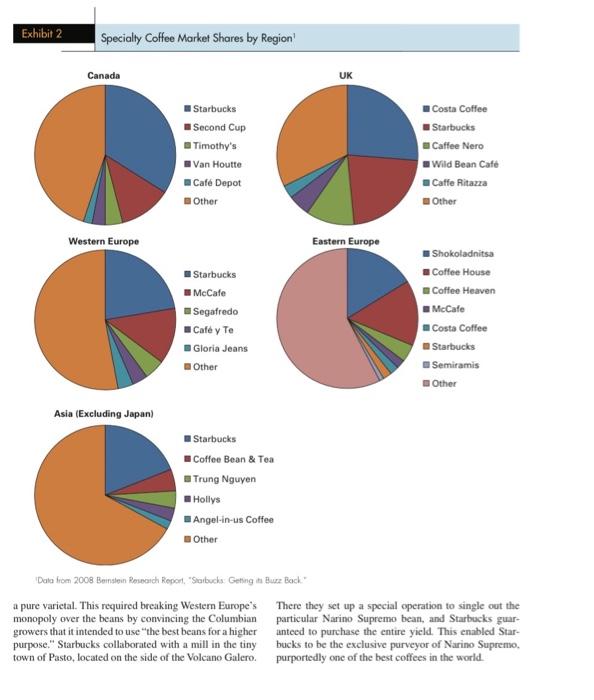
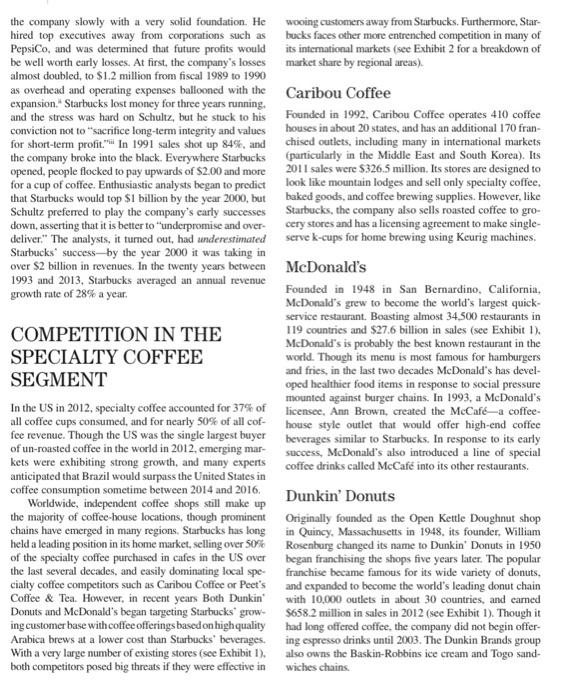
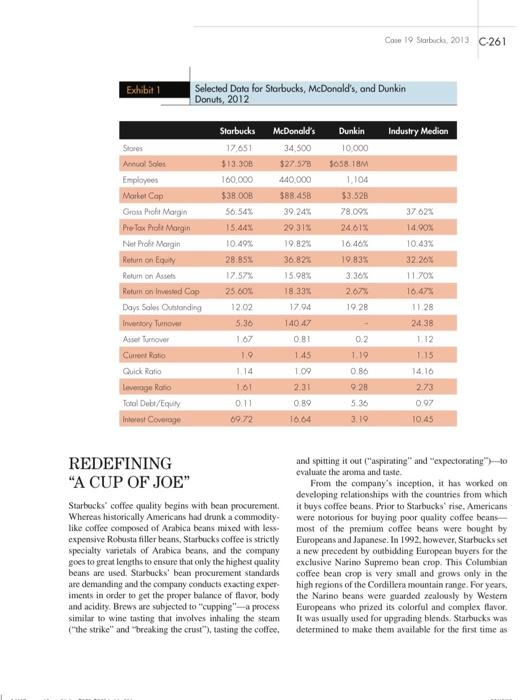
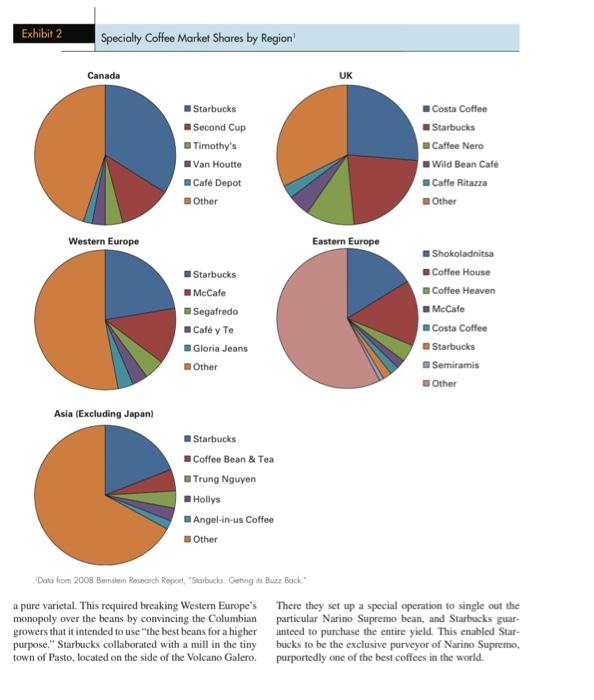
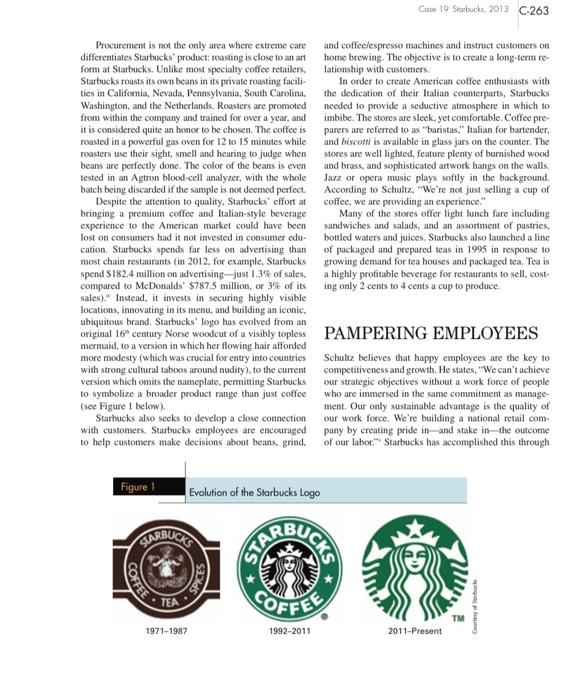
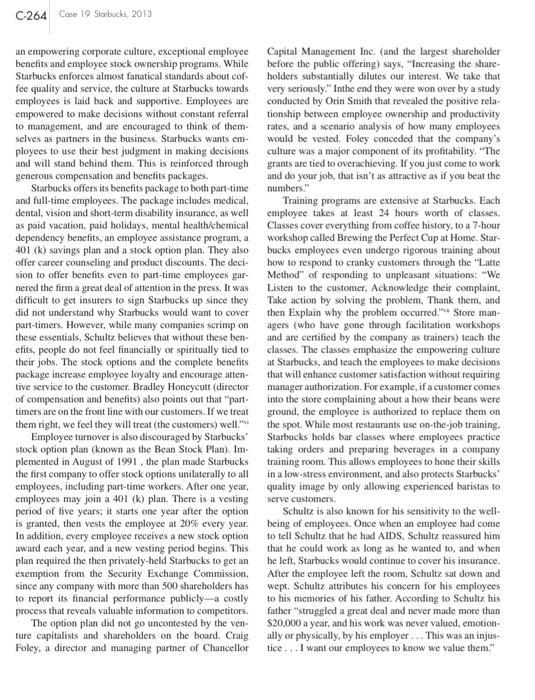
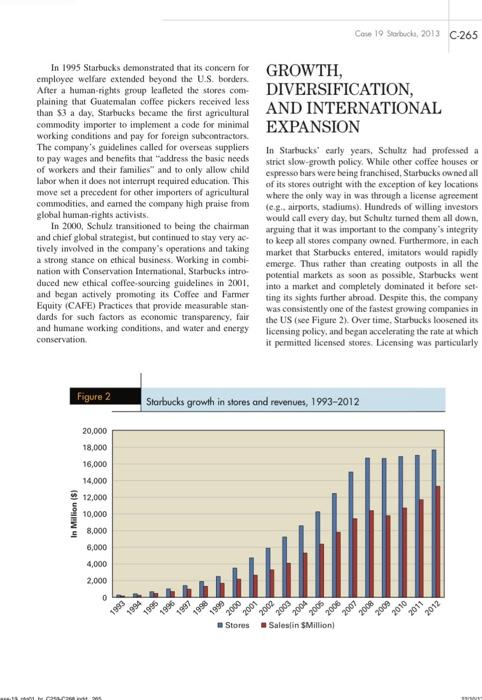
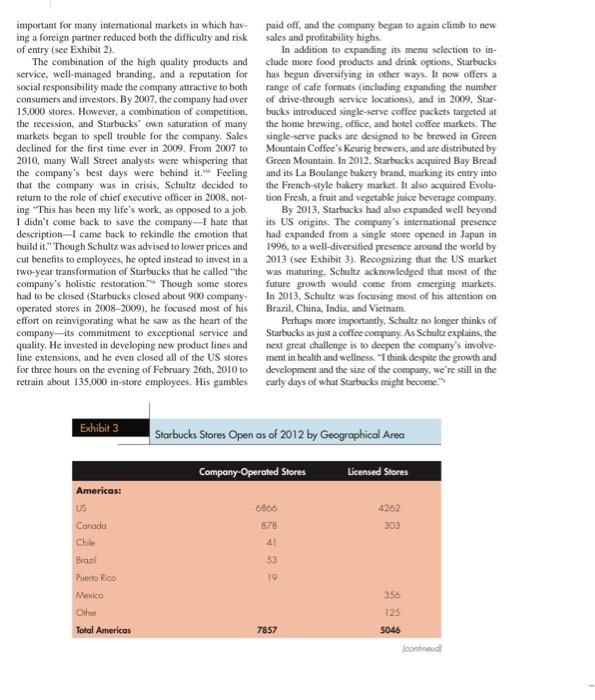
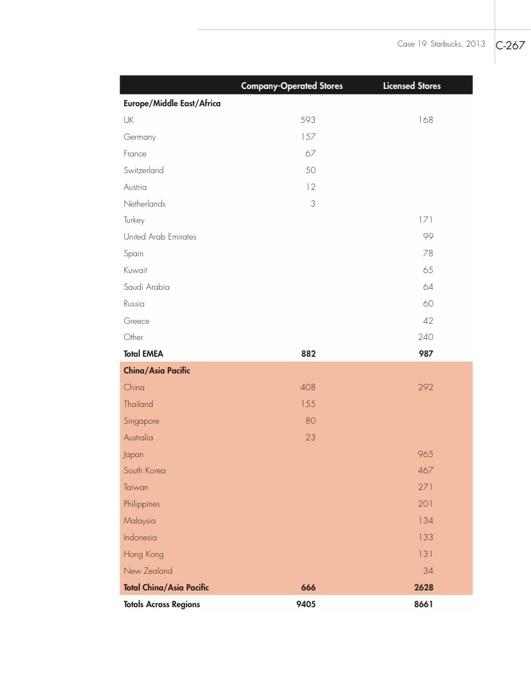
Exhibit 1 Selected Data for Starbucks, McDonald's, and Dunkin Donuts, 2012 REDEFINING "A CUP OF JOE" Starbocks" coffee quality begins with bean procurement. Whereas historically Americans had drunk a commodity. like coffee composed of Arabica beans mixed with lessexpensive Robasta filler beans, Starbucks coffee is strictly specialty varietals of Arabica beans, and the company goes to great lengths to ensure that only the highest quality beans are used. Starbucks' bean procurenent standards are demanding and the company conducts exacting exper: iments in order to get the proper balance of flavor, body and acidity. Brews are subjected to "cupping"- a process similar to wine tasting that involves inhaling the steam ("the strike" and "breaking the crust"), tasting the coffee, and spitting it out ("aspirating" and "expectoriting")- - to evaluate the aroma and taste. From the company's inception, it has worked on developing relationships with the countries from which it buys coffee beans. Prior to Starbucks' rise, Americans were notorious for buying poor quality coffee beansmost of the premium coffee beans were bought by Europeans and Japanese. In 1992, however, Starbucks set a new precedent by oubidding European buyers for the exclusive Narino Supremo bean crop. This Columbian coffee bean crop is very small and grows only in the high regions of the Cordillera moontain range. For years, the Narino beans were gaarded zealoasly by Westem Europeans who prized its colorful and complex flavor. It was usually used for upgrading blends. Starbucks was determined to make them available for the first time as Case 19 Surbucks, 2013C2 an empowering corporate culture, exceptional employee benefits and employee stock ownership programs. While Starbucks enforces almost fanatical standards about coffee quality and service, the culture at Starbucks towards employees is laid back and supportive. Employees are empowered to make decisions without constant referral to management, and are encouraged to think of themselves as partners in the business. Starbucks wants employees to use their best judgment in making decisions and will stand behind them. This is reinforced through generous compensation and benefits packages. Starbucks offers its benefits package to both part-time and full-time employees. The package includes medical, dental, vision and short-term disability insurance, as well as paid vacation, paid holidays, mental health/chemical dependency benefits, an employee assistance program, a 401 (k) savings plan and a stock option plan. They also offer career counseling and product discounts. The decision to offer benefits even to part-time employees garnered the firm a great deal of attention in the press. It was difficult to get insurers to sign Starbucks up since they did not understand why Starbucks would want to cover part-timers. However, while many companies scrimp on these essentials, Schultz believes that without these benefits, people do not feel financially or spiritually tied to their jobs. The stock options and the complete benefits package increase employee loyalty and encourage attentive service to the customer. Bradley Honeycut (director of compensation and benefits) also points out that "parttimers are on the front line with our customers. If we treat them right, we feel they will treat (the customers) well." Employee turnover is also discouraged by Starbucks' stock option plan (known as the Bean Stock Plan). Implemented in August of 1991, the plan made Starbucks the first company to offer stock options unilaterally to all employees, including part-time workers. After one year, employees may join a 401 (k) plan. There is a vesting period of five years; it starts one year after the option is granted, then vests the employee at 20% every year. In addition, every employee receives a new stock option award each year, and a new vesting period begins. This plan required the then privately-held Starbucks to get an exemption from the Security Exchange Commission, since any company with more than 500 shareholders has to report its financial performance publicly-a costly process that reveals valuable information to competitors. The option plan did not go uncontested by the venture eapitalists and shareholders on the board. Craig Foley, a director and managing partner of Chancellor Capital Management Ine, (and the largest shareholder before the public offering) says, "Increasing the sharebolders substantially dilutes our interest. We take that very seriously." Inthe end they were won over by a study conducted by Orin Smith that revealed the positive relationship between employee ownership and productivity rates, and a scenario analysis of how many employees would be vested. Foley conceded that the company's culture was a major component of its profitability. "The grants are tied to overachieving. If you just come to work and do your job, that isn't as attractive as if you beat the numbers:" Training programs are extensive at Starbucks. Each employce takes at least 24 hours worth of classes. Classes cover every thing from coffee history, to a 7-hour workshop called Brewing the Perfect Cup at Home. Starbucks employees even undergo rigorous training about bow to respond to cranky customers through the "Latte Method" of responding to unpleasant situations: "We Listen to the customer, Acknowledge their complaint, Take action by solving the problem, Thank them, and then Explain why the problem occurred. 4 Store managers (who have gone through facititation workshops and are certified by the company as trainers) teach the classes. The classes emphasize the empowering culture at Starbucks, and teach the employees to make decisions that will enhance customer satisfaction without requiring manager authorization. For example, if a customer comes into the store complaining about a how their beans were ground, the employee is authorized to replace them on the spot. While most restaurants use on-the-job training. Starbucks holds bar elasses where employees practice taking orders and preparing beverages in a company training room. This allows employees to hone their skills in a low-stress environment, and also protects Starbucks* quality image by only allowing experienced baristas to serve customers. Schulz is also known for his sensitivity to the wellbeing of employees. Once when an employee had come to tell Schultz that he had AIDS, Schultz, reassured him that he could work as long as he wanted to, and when be left, Starbucks would continue to cover his insurance. After the employee left the room, Schultz sat down and wept. Schultz attributes his concern for his employees to his memories of his father. According to Schultz his father "struggled a great deal and never made more than $20,000 a year, and his work was never valued, emotionally or physically, by his employer . . . This was an injustice . . I I want our employees to know we value them." Exhibit 2 Specialty Coffee Market Shares by Region' Asia (Excluding Japan) Eastern Europe a pure varietal. This required breaking Western Europe's monopoly over the beans by convincing the Columbian growers that it intended to use "the best beans for a higher purpose." Starbucks collaborated with a mill in the tiny town of Pasto, located on the side of the Volcano Galero. There they set up a special operation to single out the particular Narino Supremo bean, and Starbocks guaranteed to purchase the entire yield. This enabled Starbucks to be the exclusive purveyor of Narino Supremo. purportedly one of the best coffees in the world. important for many intemational markets in which having a foreign partner reduced both the difficulty and risk of entry (see Exhibit 2). The combination of the high quality products and service, well-managed branding, and a reputation for social responsibility made the company atractive to both consumers and investors. By 2007, the company had over 15,000 stores. However, a combination of competition, the recession, and Starbucks' own saturation of many markets began to spell trouble for the company. Sales declined for the first time ever in 2009 . From 2007 to 2010, many Wall Street analysts were whispering that the company's best days were behind it." Feeling that the company was in crisis. Schultz decided to return to the role of chief executive officer in 2008, noting "This has been my life's work, as opposed to a job. I didn't come back to save the company - I hate that description-1 came back to rekindle the emotion that build it." Though Schultz was advised to lower prices and cut benefits to employees, he opted instead to imest in a two-year transformation of Starbucks that he called the company's holistic restoration." Though some stores had to be closed (Starbucks closed about 900 company. operated stores in 2008-2009), he focused most of his effort on reinvigorating what he saw as the heart of the company-its commitment to exceptional service and quality. He invested in developing new product lines and line extensions, and he even closed all of the US stores for three hours on the evening of February 26th, 2010 to retrain about 135,000 in-store employees. His gambles paid off, and the company began to again climb to new sales and profitability highs. In addition to expanding its menu selection to include more food products and drink options, Starbucks has begun diversifying in other wayx. It now offers a range of cafe formats (including expanding the number of drive-through service locations), and in 2009. Starbucks introduced single-serve coffee packets targeted at the home brewing, office, and botel coffee markets. The single-serve packs are designed to be brewed in Green Mountain Coffee's Keurig brewers and are distributed by Green Mountain. In 2012, Starbucks acquired Bay Bread and its La Boalange bakery brand, marking its entry into the French-style bakery market. It also acquired Evolution Fresh, a fruit and vegetable juice beverage company. By 2013, Starbucks had also expanded well beyond its US origins. The company's international presence had expanded from a single stote openod in Japan in 1996, to a well-diversified presence around the world by 2013 (see Exhibit 3). Recognizing that the US market was maturing. Schultz acknowledged that most of the future growth woeld coene from emerging markets. In 2013. Schultz was focusing most of his attention on Brazil, Chma, India, and Vietnam. Perhaps more importantly. Schultz no longer thinks of Starbucks as just a coffee company. As Schultz explains, the next great challenge is to deepen the company's imolvement in bealth and wellness. "T think despite the growth and development and the sine of the company, we're still in the early days of what Starbucks might become.". In 1995 Starbucks demonstrated that its concern for employee welfare extended beyond the U.S. boeders. After a human-rights group leafleted the stores complaining that Guatenalan coffee pickers received less than $3 a day. Starbucks became the first agricultural comsmodity importer to implement a code for mininal working conditions and pay for foreign subeontractors. The company's guidelines called for overseas suppliers to pay wages and benefits that "address the basic needs of workers and their families" and to only allow child labor when it does not interrupt required edacation. This move set a precedent for other importers of agriculsural commodities, and eamed the company high praise from global human-righes activists. In 2000, Schulz transitioned to being the chairman and chief global strategist, but continoed to stay very actively involved in the company"s operations and taking a strong stance on ethical business. Working in combination with Conservation Intermational, Starbucks introduced new ethical coffee-soureing guidelines in 2001. and began actively pronsoting its Coffee and Farmer Equity (CAFE) Practices that provide measurable standards for sach factors as economic tmansparency, fair and bumane working conditions, and water and energy conservation. GROWTH, DIVERSIFICATION, AND INTERNATIONAL EXPANSION In Startusks' early years, Schultz had professed a strict slow-growth policy. While other coffee bouses of espresso bars were being franchised, Starbucks owned all of its stores outright with the exception of key locations where the oaly way in was through a license agreement (e.g, airports, stadiums). Hundreds of willing imeston would call every day, but Schultz, turned them all down. arguing that it was important to the company"s integrity to keep all stores company owned. Furthermore, in each market that Starbucks entered, imitators would rapidly emerge. Thus father than creating outposts in all the potential markets as soon as possible, Starbucks went into a market and completely dominated it before setting its sights further abroad. Despite this, the company Was consistently one of the fastest growing companies in the US (see Figure 2). Over time, Starbacks loosened its. licensing policy, and began accelerating the rate at which it permitted licensed stores. Licensing was particularly Exhibit 2 Specialty Coffee Market Shares by Region' Asia (Excluding Japan) Eastern Europe a pure varietal. This required breaking Western Europe's monopoly over the beans by convincing the Columbian growers that it intended to use "the best beans for a higher purpose." Starbucks collaborated with a mill in the tiny town of Pasto, located on the side of the Volcano Galero. There they set up a special operation to single out the particular Narino Supremo bean, and Starbocks guaranteed to purchase the entire yield. This enabled Starbucks to be the exclusive purveyor of Narino Supremo. purportedly one of the best coffees in the world. Procurement is not the only area where extreme care differentiates Starbucks' product: roasting is elose to an art form at Starbucks. Unlike most specialty coffee retailers, Starbucks roasts its own beans in its private roasting facilities in California, Nevada, Pennsylvania, South Carolina. Washington, and the Netherlands. Roasters are promoted from within the company and trained for over a year, and it is considered quite an honor to be chosen. The coffee is roasted in a powerful gas oven for 12 to 15 minutes while roasters use their sight, smell and hearing to judge when beans are perfectly done. The color of the beans is even tested in an Agtron blood-cell analyzer, with the whole batch being discarded if the sample is not deemed perfect. Despite the attention to quality, Starbucks' effort at bringing a premium coffee and Italian-style beverage experience to the American market could have been lost on consumers had it not invested in consumer education. Starbucks spends far less on advertising than most chain restaurants (in 2012, for example, Starbucks spend $182,4 million on advertising-just 1.3% of sales, compared to McDonalds' $787.5 million, or 35 of its sales)." Instead, it invests in securing highly visible locations, innovating in its menu, and building an iconic, ubiquitous brand. Starbucks' logo has evolved from an original 16bentury Norse woodcut of a visibly topless mermaid, to a version in which her flowing hair afforded more modesty (which was crucial for entry into countries with strong cultural taboos around nudity), to the current version which omits the nameplate, permitting Starbucks to symbolize a broader product range than just coffee (see Figure 1 below). Starbucks also seeks to develop a close connection with customers. Starbucks employees are encouraged to help customers make decisions about beans, grind. and coffee/espresso machines and instruct customers on home brewing. The objective is to create a long-term relationship with customers. In order to create American coffee enthusiasts with the dedication of their Italian counterparts, Starbucks needed to provide a seductive atmosphere in which to imbibe. The stores are sleek, yet comfortable, Coffee preparers are referred to as "baristas," Italian for barteader, and biscoti is available in glass jars on the counter. The stores are well lighted, feature plenty of burnished wood and brass, and sophisticated artwork hangs on the walls. Jazz or opera music plays softly in the background. According to Schultz, "We're not just selling a cup of coffec, we are providing an experience." Many of the stores offer light lunch fare including sandwiches and salads, and an assortment of pastries. bottled waters and juices. Starbucks also launched a line of packaged and prepared teas in 1995 in response to growing demand for tea bouses and packaged tea. Tea is a highly profitable beverage for restaurants to sell, costing only 2 cents to 4 cents a cup to produce. PAMPERING EMPLOYEES Schuliz believes that happy employees are the key to competitiveness and growth. He states, "We can't achieve our strategic objectives without a work force of people who are immersed in the same commitment as management. Our only sustainable advantage is the quality of our work force. We're building a national retail company by creating pride in-and stake in-the outcome of our labor,", Starbucks has accomplished this through the company slowly with a very solid foundation. He hired top executives away from corporations such as PepsiCo, and was determined that future profits would be well worth early losses. At first, the company's losses almost doubled, to $1.2 million from fiscal 1989 to 1990 as overhead and operating expenses ballooned with the expansion." Starbucks lost money for three years running. and the stress was hard on Schultz, but he stuck to his conviction not to "sacrifice long-term integrity and values for short-term profit."iii In 1991 sales shot up 84%, and the company broke into the black. Everywhere Starbucks opened, people flocked to pay upwards of $2.00 and more for a cup of coffee. Enthusiastic analysts began to predict that Starbucks would top $1 billion by the year 2000 , but Schultz preferred to play the company's carly successes down, asserting that it is better to "underpromise and overdeliver." The analysts, it turned out, had underestimated Starbucks' success - by the year 2000 it was taking in over $2 billion in revenues. In the twenty years between 1993 and 2013. Starbucks averaged an annual revenue growth rate of 28% a year. COMPETITION IN THE SPECIALTY COFFEE SEGMENT In the US in 2012, specialty coffee accounted for 37% of all coffee cups consumed, and for nearly 50% of all coffee revenue. Though the US was the single largest buyer of un-roasted coffee in the world in 2012, emerging markets were exhibiting strong growth, and many experts anticipated that Brazil would surpass the United States in coffee consumption sometime between 2014 and 2016. Worldwide, independent coffee shops still make up the majority of coffee-house locations, though prominent chains have emerged in many regions, Starbucks has long held a leading position in its home market, selling over 50% of the specialty coffee purchased in eafes in the US over the last several decades, and easily dominating local specialty coffee competitors such as Caribou Coffee or Peet's Coffee \& Tea. However, in recent years Both Dunkin' Donuts and McDonald's began targeting Starbucks' growing customer base with coffee offerings based on high quality Arabica brews at a lower cost than Starbucks' beverages. With a very large number of existing stores (see Exhibit 1). both competitors posed big threats if they were effective in wooing customers away from Starbucks. Furthermore, Starbucks faces other more entrenched competition in many of its international markets (see Exhibit 2 for a breakdown of market share by regional areas). Caribou Coffee Founded in 1992, Caribou Coffee operates 410 coffee houses in about 20 states, and has an additional 170 franchised outlets, including many in international markets (particularly in the Middle East and South Korea). Its 2011 sales were $326.5 million. Its stores are designed to look like mountain lodges and sell only specialty coffee, baked goods, and coffee brewing supplies. However, like Starbucks, the company also sells roasted coffee to grocery stores and has a licensing agreement to make singleserve k-cups for home brewing using Keurig machines. McDonald's Founded in 1948 in San Bemardino, California, McDonald's grew to become the world's largest quickservice restaurant. Boasting almost 34,500 restaurants in 119 countries and $27.6 billion in sales (see Exhibit 1). McDonald's is probably the best known restaurant in the world. Though its menu is most famous for hamburgers and fries, in the last two decades McDonald's has developed healthier food items in response to social pressure mounted against burger chains. In 1993, a McDonald's licensec, Ann Brown, created the McCafe-a coffeehouse style outlet that would offer high-end coffee beverages similar to Starbucks, In response to its early success, McDonald's also introduced a line of special coffee drinks called MeCafe into its other restaurants. Dunkin' Donuts Originally founded as the Open Kettle Doughnut shop in Quincy, Massachusetts in 1948, its founder, William Rosenburg changed its name to Dunkin' Donuts in 1950 began franchising the shops five years later. The popular franchise became famous for its wide variety of donuts, and expanded to become the world's leading donut chain with 10,000 outlets in about 30 countries, and camed $658.2 million in sales in 2012 (see Exhibit 1). Though it had long offered coffee, the company did not begin offering espresso drinks until 2003. The Dunkin Brands group also owns the Baskin-Robbins ice cream and Togo sandwiches chains
Step by Step Solution
There are 3 Steps involved in it

Get step-by-step solutions from verified subject matter experts
 Study Help