







Question: Answer the questions below. 7) The table below shows a linear regression. What is the correlation coefcent ofthe table shown below? A) I: 0.96 B)
Answer the questions below.
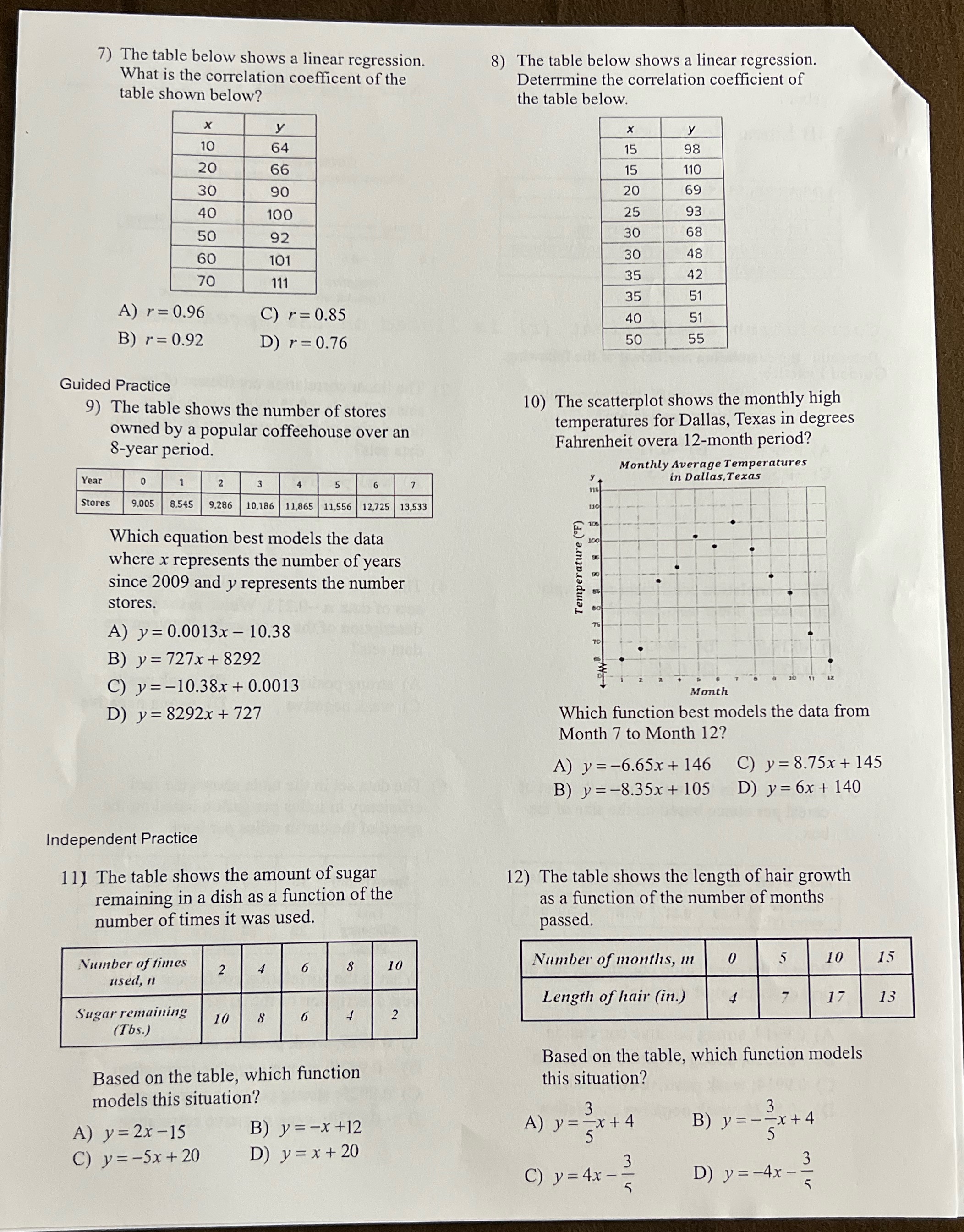
7) The table below shows a linear regression. What is the correlation coefcent ofthe table shown below? A) I": 0.96 B) r: 0.92 C) r= 0.85 D) r = 0.76 Guided Practice 9) The table shows the number of stores owned by a popular coffeehouse over an 8year period. 1 2 3 Which equation best models the data where x represents the number of years since 2009 and y represents the number stores. A) y= 0.0013x 10.38 B) y = 727): + 8292 C) y = 10.38x + 0.0013 D) y = 8292x + 727 Independent Practice 1 1} The table shows the amount of sugar remaining in a dish as a function of the number of times it was used. Number ({flli'.\\ 2 4 6 10 user], :1 Sugar rcnmiuing [(1 8 6 .1 2 (Tst Based on the table, which function models this situation? A) y=2x-15 B) y=-x+12 C)y=5x+20 D)y=x+20 4 snv mum 8) The table below shows a linear regression. Detemnine the correlation coefcient of the table below. 10) The scatteiplot shows the monthly high temperatures for Dallas, Texas in degrees Fahrenheit overa 12month period? Monthly Average Temperature: in Dallas/Texas l E? F n V a , - .' 4. ._ _.w 7 , 1B. 5 .c _ ,- | a . ' I E . . = n I ~ l :2 , . '. O l . I | z a 7 s s r u a n.- n u. Month Which function best models the data from Month 7 to Month 12? A) y=6.65x+146 C) y=8.75x+145 B) y=8.35x+105 D) y=6x+ 140 12) The table shows the length of hair growth as a function of the number of months passed. Number of momlis, m n..- Length Of hair (in.) I... Based on the table, which function models this situation? 3 A) y=-:x+4 B) y=x+4 3 C) y=4x% D) y=4x
Step by Step Solution
There are 3 Steps involved in it

Get step-by-step solutions from verified subject matter experts
 Study Help