







Question: Answer the questions below Question 1 A random sample X1,X2,...,x, is taken from a population, which has the probability distribution function F(x) and the density
Answer the questions below
Question 1
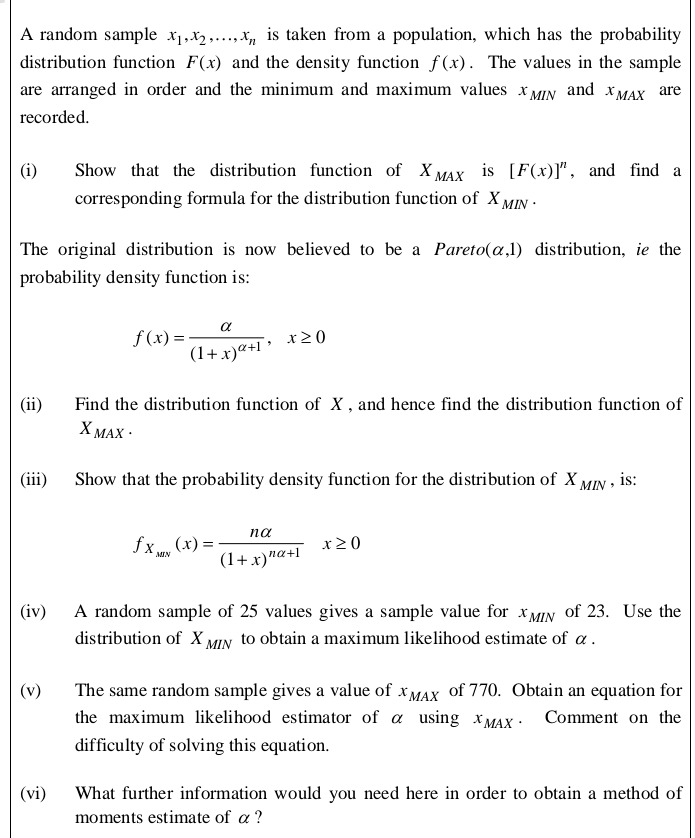
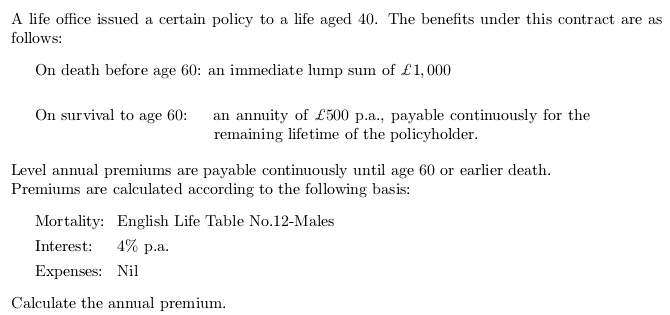
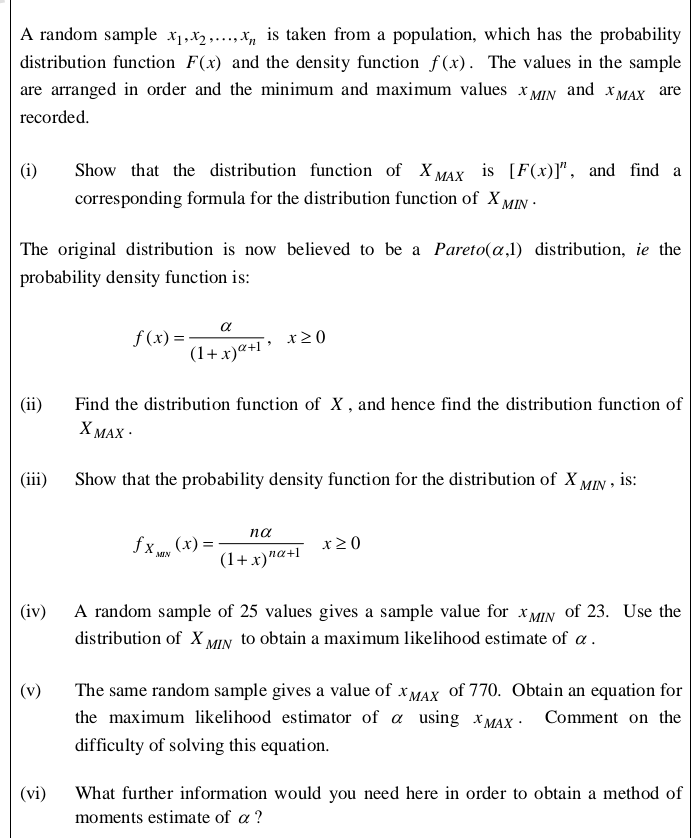
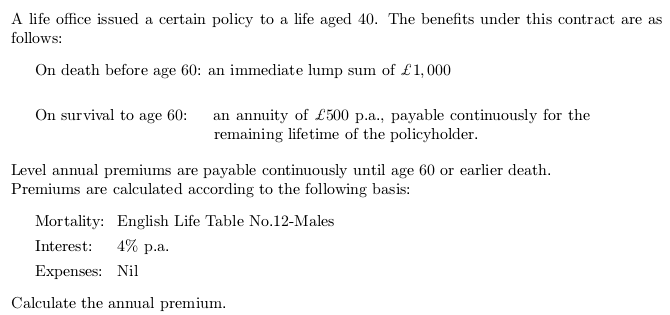
A random sample X1,X2,...,x, is taken from a population, which has the probability distribution function F(x) and the density function f(x) . The values in the sample are arranged in order and the minimum and maximum values X MIN and XMAX are recorded. (i) Show that the distribution function of X MAX is [F(x)]", and find a corresponding formula for the distribution function of X MIN The original distribution is now believed to be a Pareto(a,1) distribution, ie the probability density function is: f ( x ) =- (1+x)a+1. *20 (ii) Find the distribution function of X , and hence find the distribution function of X MAX . (iii) Show that the probability density function for the distribution of X MIN , is: na fx (x)= ( It x) nath x20 (iv) A random sample of 25 values gives a sample value for X MIN of 23. Use the distribution of X MIN to obtain a maximum likelihood estimate of a . (v) The same random sample gives a value of X MAX of 770. Obtain an equation for the maximum likelihood estimator of a using XMAX . Comment on the difficulty of solving this equation. (vi) What further information would you need here in order to obtain a method of moments estimate of a ?A life ofce issued a certain policy to a life aged 40. The benets under this contract are as follows: 011 death before age {it}: an immediate lump sum of 1,900 0n survival to age '50: an armuity of 500 p.a.1 payable continuously for the remaining lifetime of the policyholder. Level annual premiums are payable continuously until age {if} or earlier death. Premiums are calculated according to the following basis: Mortality: English Life Table No.12Males Interest: 4% pa. Expenses: Nil Calculate the annual premium
Step by Step Solution
There are 3 Steps involved in it

Get step-by-step solutions from verified subject matter experts
 Study Help