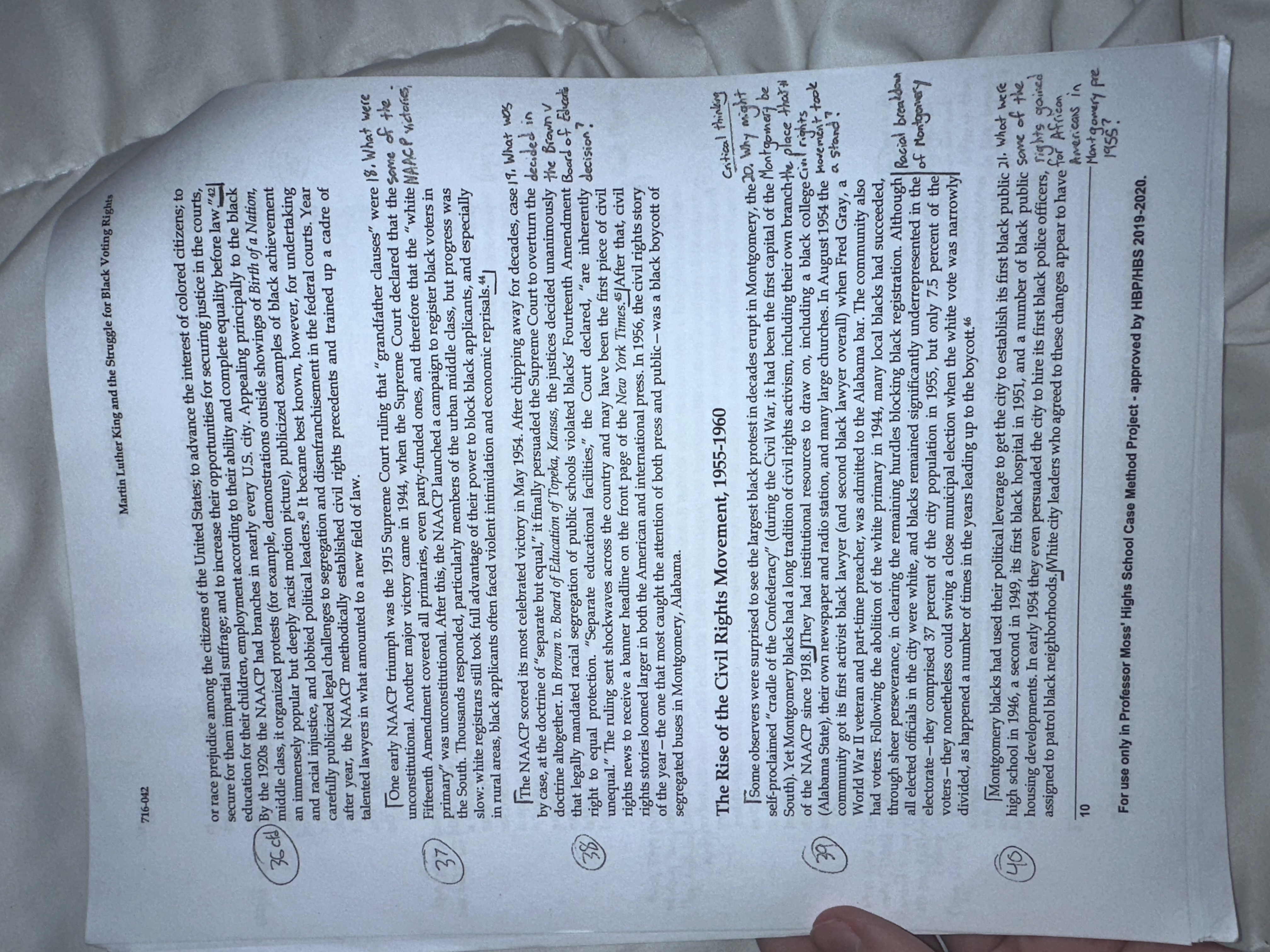
Question: Answer the questions that is on the packet, like the right side of the page in the picture from the text, by HIGHLIGHTING FROM THE
Answer the questions that is on the packet, like the right side of the page in the picture from the text, by HIGHLIGHTING FROM THE TEXT as the answer, thank you~
Martin Luther King and the Struggle for Black Voting Rights 716-042 or race prejudice among the citizens of the United States; to advance the interest of colored citizens; to secure for them impartial suffrage; and to increase their opportunities for securing justice in the courts, education for their children, employment according to their ability and complete equality before law "42/ ZC cfd) By the 1920s the NAACP had branches in nearly every U.S. city. Appealing principally to the black middle class, it organized protests (for example, demonstrations outside showings of Birth of a Nation, an immensely popular but deeply racist motion picture), publicized examples of black achievement and racial injustice, and lobbied political leaders.$3 It became best known, however, for undertaking carefully publicized legal challenges to segregation and disenfranchisement in the federal courts. Year after year, the NAACP methodically established civil rights precedents and trained up a cadre of talented lawyers in what amounted to a new field of law. One early NAACP triumph was the 1915 Supreme Court ruling that "grandfather clauses" were 18. What were unconstitutional. Another major victory came in 1944, when the Supreme Court declared that the some of the Fifteenth Amendment covered all primaries, even party-funded ones, and therefore that the "white NAACP victories, 37 primary" was unconstitutional. After this, the NAACP launched a campaign to register black voters in the South. Thousands responded, particularly members of the urban middle class, but progress was slow: white registrars still took full advantage of their power to block black applicants, and especially in rural areas, black applicants often faced violent intimidation and economic reprisals." The NAACP scored its most celebrated victory in May 1954. After chipping away for decades, case 19, What was by case, at the doctrine of " separate but equal," it finally persuaded the Supreme Court to overturn the decided in doctrine altogether. In Brown v. Board of Education of Topeka, Kansas, the justices decided unanimously the Brown v that legally mandated racial segregation of public schools violated blacks' Fourteenth Amendment Board of Educate right to equal protection. "Separate educational facilities," the Court declared, "are inherently decision? unequal." The ruling sent shockwaves across the country and may have been the first piece of civil rights news to receive a banner headline on the front page of the New York Times.45/After that, civil rights stories loomed larger in both the American and international press. In 1956, the civil rights story of the year - the one that most caught the attention of both press and public-was a black boycott of segregated buses in Montgomery, Alabama. The Rise of the Civil Rights Movement, 1955-1960 Critical thinking Some observers were surprised to see the largest black protest in decades erupt in Montgomery, the 20. Why might self-proclaimed "cradle of the Confederacy" (during the Civil War, it had been the first capital of the Montgomery be South). Yet Montgomery blacks had a long tradition of civil rights activism, including their own branch the place that's of the NAACP since 1918. They had institutional resources to draw on, including a black college Civil rights (Alabama State), their own newspaper and radio station, and many large churches. In August 1954 the Movement took community got its first activist black lawyer (and second black lawyer overall) when Fred Gray, a a stand . World War II veteran and part-time preacher, was admitted to the Alabama bar. The community also had voters. Following the abolition of the white primary in 1944, many local blacks had succeeded, through sheer perseverance, in clearing the remaining hurdles blocking black registration. Although| Racial breakdown all elected officials in the city were white, and blacks remained significantly underrepresented in the of Montgomery electorate-they comprised 37 percent of the city population in 1955, but only 7.5 percent of the voters-they nonetheless could swing a close municipal election when the white vote was narrowly! divided, as happened a number of times in the years leading up to the boycott.46 40 Montgomery blacks had used their political leverage to get the city to establish its first black public 21. What were high school in 1946, a second in 1949, its first black hospital in 1951, and a number of black public some of the housing developments. In early 1954 they even persuaded the city to hire its first black police officers, rights gained assigned to patrol black neighborhoods. White city leaders who agreed to these changes appear to have for African 10 Americans in Montgomery pre 1955? For use only in Professor Moss' Highs School Case Method Project - approved by HBP/HBS 2019-2020
Step by Step Solution
There are 3 Steps involved in it
1 Expert Approved Answer
Step: 1 Unlock
Question Has Been Solved by an Expert!
Get step-by-step solutions from verified subject matter experts
Step: 2 Unlock
Step: 3 Unlock
Students Have Also Explored These Related Accounting Questions!