Question: Please summarize the case study and help me answer the questions on page 10 (short answers). Thank you Page 1 Page 2 Page 3 Page
Please summarize the case study and help me answer the questions on page 10 (short answers). Thank you
Page 1
Page 2
Page 3
Page 4
Page 5
Page 6
Page 7
Page 8
Page 9
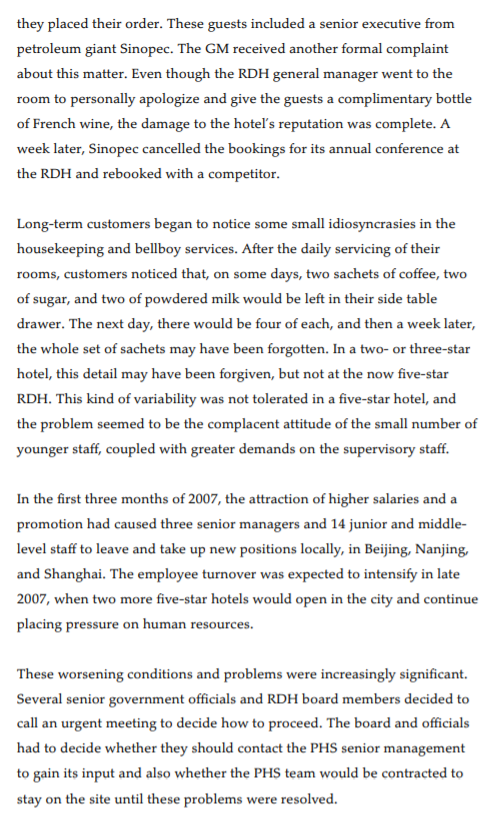
Page 10 (questions)
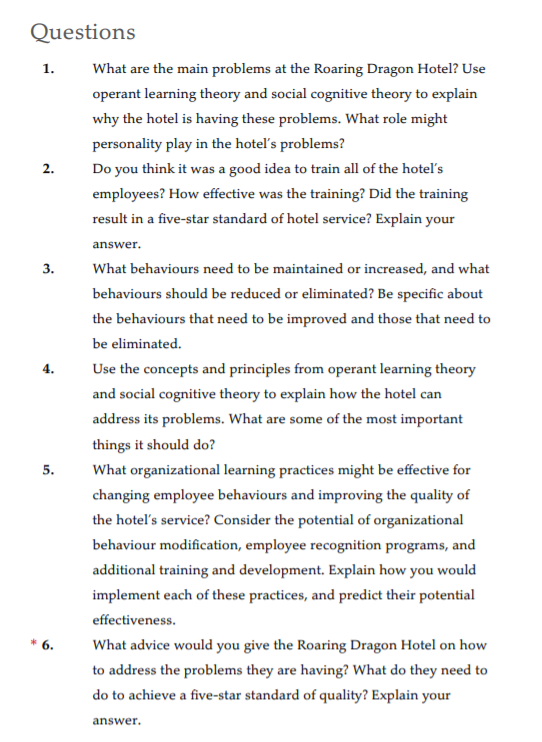
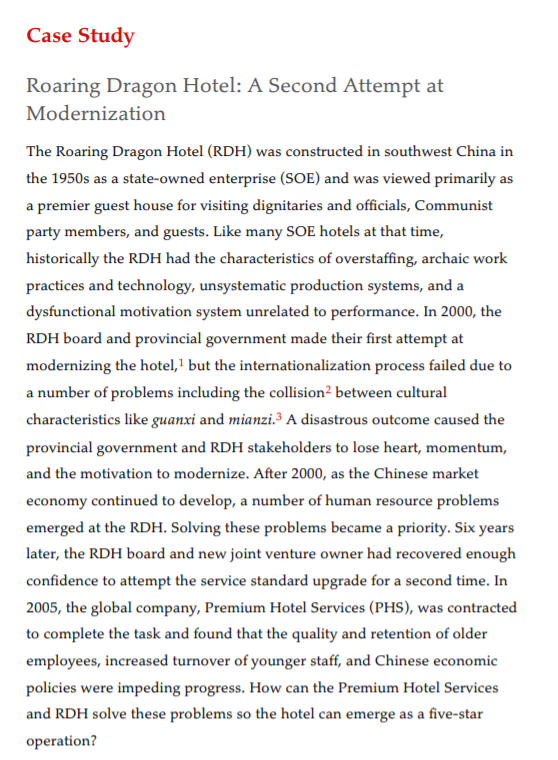
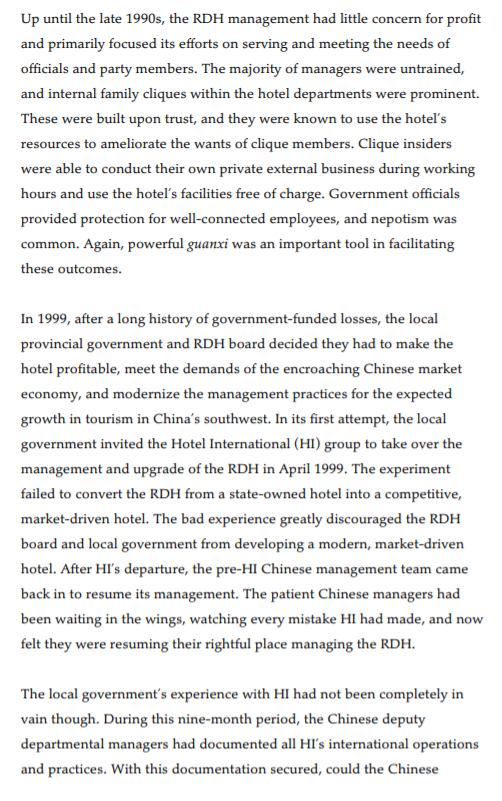
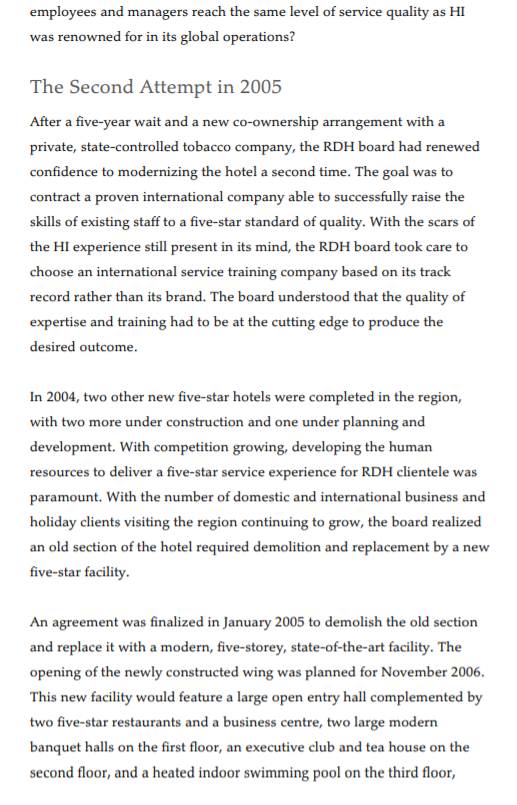
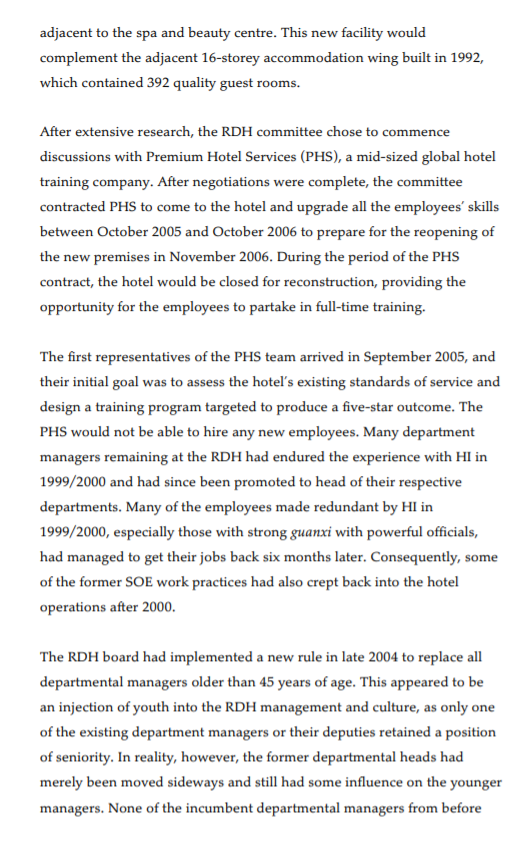
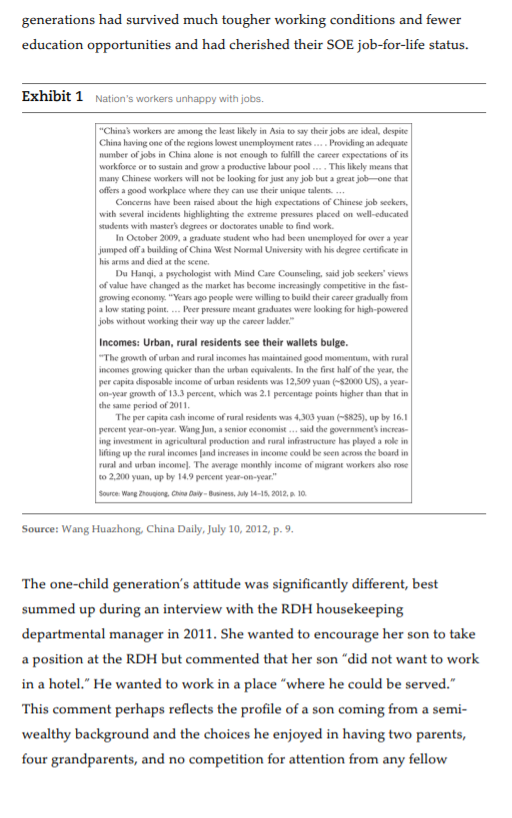
Case Study Roaring Dragon Hotel: A Second Attempt at Modernization The Roaring Dragon Hotel (RDH) was constructed in southwest China in the 1950s as a state-owned enterprise (SOE) and was viewed primarily as a premier guest house for visiting dignitaries and officials, Communist party members, and guests. Like many SOE hotels at that time, historically the RDH had the characteristics of overstaffing, archaic work practices and technology, unsystematic production systems, and a dysfunctional motivation system unrelated to performance. In 2000, the RDH board and provincial government made their first attempt at modernizing the hotel, but the internationalization process failed due to a number of problems including the collision between cultural characteristics like guanxi and mianzi. A disastrous outcome caused the provincial government and RDH stakeholders to lose heart, momentum, and the motivation to modernize. After 2000, as the Chinese market economy continued to develop, a number of human resource problems emerged at the RDH. Solving these problems became a priority. Six years later, the RDH board and new joint venture owner had recovered enough confidence to attempt the service standard upgrade for a second time. In 2005, the global company, Premium Hotel Services (PHS), was contracted to complete the task and found that the quality and retention of older employees, increased turnover of younger staff, and Chinese economic policies were impeding progress. How can the Premium Hotel Services and RDH solve these problems so the hotel can emerge as a five-star operation? Up until the late 1990s, the RDH management had little concern for profit and primarily focused its efforts on serving and meeting the needs of officials and party members. The majority of managers were untrained, and internal family cliques within the hotel departments were prominent. These were built upon trust, and they were known to use the hotel's resources to ameliorate the wants of clique members. Clique insiders were able to conduct their own private external business during working hours and use the hotel's facilities free of charge. Government officials provided protection for well-connected employees, and nepotism was common. Again, powerful guanxi was an important tool in facilitating these outcomes. In 1999, after a long history of government-funded losses, the local provincial government and RDH board decided they had to make the hotel profitable, meet the demands of the encroaching Chinese market economy, and modernize the management practices for the expected growth in tourism in China's southwest. In its first attempt, the local government invited the Hotel International (HI) group to take over the management and upgrade of the RDH in April 1999. The experiment failed to convert the RDH from a state-owned hotel into a competitive, market-driven hotel. The bad experience greatly discouraged the RDH board and local government from developing a modern, market-driven hotel. After HI's departure, the pre-HI Chinese management team came back in to resume its management. The patient Chinese managers had been waiting in the wings, watching every mistake HI had made, and now felt they were resuming their rightful place managing the RDH. The local government's experience with HI had not been completely in vain though. During this nine-month period, the Chinese deputy departmental managers had documented all He's international operations and practices. With this documentation secured, could the Chinese employees and managers reach the same level of service quality as HI was renowned for in its global operations? The Second Attempt in 2005 After a five-year wait and a new co-ownership arrangement with a private, state-controlled tobacco company, the RDH board had renewed confidence to modernizing the hotel a second time. The goal was to contract a proven international company able to successfully raise the skills of existing staff to a five-star standard of quality. With the scars of the HI experience still present in its mind, the RDH board took care to choose an international service training company based on its track record rather than its brand. The board understood that the quality of expertise and training had to be at the cutting edge to produce the desired outcome. In 2004, two other new five-star hotels were completed in the region, with two more under construction and one under planning and development. With competition growing, developing the human resources to deliver a five-star service experience for RDH clientele was paramount. With the number of domestic and international business and holiday clients visiting the region continuing to grow, the board realized an old section of the hotel required demolition and replacement by a new five-star facility. An agreement was finalized in January 2005 to demolish the old section and replace it with a modern, five-storey, state-of-the-art facility. The opening of the newly constructed wing was planned for November 2006. This new facility would feature a large open entry hall complemented by two five-star restaurants and a business centre, two large modern banquet halls on the first floor, an executive club and tea house on the second floor, and a heated indoor swimming pool on the third floor, adjacent to the spa and beauty centre. This new facility would complement the adjacent 16-storey accommodation wing built in 1992, which contained 392 quality guest rooms. After extensive research, the RDH committee chose to commence discussions with Premium Hotel Services (PHS), a mid-sized global hotel training company. After negotiations were complete, the committee contracted PHS to come to the hotel and upgrade all the employees' skills between October 2005 and October 2006 to prepare for the reopening of the new premises in November 2006. During the period of the PHS contract, the hotel would be closed for reconstruction, providing the opportunity for the employees to partake in full-time training. The first representatives of the PHS team arrived in September 2005, and their initial goal was to assess the hotel's existing standards of service and design a training program targeted to produce a five-star outcome. The PHS would not be able to hire any new employees. Many department managers remaining at the RDH had endured the experience with HI in 1999/2000 and had since been promoted to head of their respective departments. Many of the employees made redundant by HI in 1999/2000, especially those with strong guanxi with powerful officials, had managed to get their jobs back six months later. Consequently, some of the former SOE work practices had also crept back into the hotel operations after 2000. The RDH board had implemented a new rule in late 2004 to replace all departmental managers older than 45 years of age. This appeared to be an injection of youth into the RDH management and culture, as only one of the existing department managers or their deputies retained a position of seniority. In reality, however, the former departmental heads had merely been moved sideways and still had some influence on the younger managers. None of the incumbent departmental managers from before 2004 had been made redundant or asked to retire, partially due to the loss of face, or mianzi, it would have generated. After a month on site, the PHS leadership team completed the design of an intense training program it thought would effectively develop a human resource team able to produce the five-star standard of hotel service. Soon after, the PHS's training team began to arrive from a variety of locations around the world, and the intense training sessions commenced. After a short time, the PHS staff noticed two interesting conditions in the workplace that had the potential to create new problems not previously experienced at the RDH. In the developing Chinese market economy, changing government labour policies were enabling employees to change jobs-as well as their location from one city to another, more easily. Under the former planned-economy conditions, this had been forbidden or very difficult to do. The increasing demand for quality hotel employees to staff the growing number of new hotels in the region heralded the emergence of Chinese-style headhunting for quality hotel staff. Rival hotels' HR departments targeted talented employees from private, state- owned, and semi-private accommodation providers for recruitment. Smart recruiters enjoyed great success in attracting skilled and trained hotel employees by offering them significantly higher salaries and benefits. Another new phenomenon concerned the emerging one-child generation. This generation had not experienced previously difficult living and working conditions under SOE or China's planned economy. They wanted opportunities and a clear career path (see Exhibit 10). They were confident enough to change jobs if their existing conditions were not suitable or if they were made an attractive offer. The previous generations had survived much tougher working conditions and fewer education opportunities and had cherished their SOE job-for-life status. Exhibit 1 Nation's workers unhappy with jobs. "China's workers are among the least likely in Asia to say their jobs are ideal, despite China having one of the regions lowest unemployment rates.... Providing an adequate number of jobs in China alone is not enough to fulfill the career expectations of its workforce or to sustain and grow a productive labour pool .... This likely means that many Chinese workers will not be looking for just any job but a great job-one that offers a good workplace where they can use their unique talents.... Concerns have been raised about the high expectations of Chinese job seekers, with several incidents highlighting the extreme pressures placed on well-educated students with master's degrees or doctorates unable to find work. In October 2009, a graduate student who had been unemployed for over a year jumped off a building of China West Normal University with his degree certificate in his arms and died at the scene. Du Hangi, a psychologist with Mind Care Counseling, said job seekers' views of value have changed as the market has become increasingly competitive in the fast- growing economy. "Years ago people were willing to build their career gradually from a low stating point, ... Peer pressure meant graduates were looking for high-powered jobs without working their way up the career ladder." Incomes: Urban, rural residents see their wallets bulge. "The growth of urban and rural incomes has maintained good momentum, with rural incomes growing quicker than the urban equivalents. In the first half of the year, the per capita disposable income of urban residents was 12,509 yuan (-$2000 US), a year on-year growth of 13.3 percent, which was 2.1 percentage points higher than that in the same period of 2011 The per capita cash income of rural residents was 4,303 yuan (-8825). up by 16.1 percent year-on-year. Wang Jun, a senior economist ... said the government's increas ing investment in agricultural production and rural infrastructure has played a role in lifting up the rural incomes and increases in income could be seen across the board in rural and urban income). The average monthly income of migrant workers ako rose to 2,200 yuan, up by 14.9 percent year-on-year." Source: Warehoudong, China Daily - Business, July 16-15, 2012, 10 Source: Wang Huazhong, China Daily, July 10, 2012, p. 9. The one-child generation's attitude was significantly different, best summed up during an interview with the RDH housekeeping departmental manager in 2011. She wanted to encourage her son to take a position at the RDH but commented that her son "did not want to work in a hotel." He wanted to work in a place "where he could be served." This comment perhaps reflects the profile of a son coming from a semi- wealthy background and the choices he enjoyed in having two parents, four grandparents, and no competition for attention from any fellow siblings. This generation's expectations reflected the attitudes of the growing Chinese middle class. The social environment in the vicinity of the RDH was also changing. Nearby, one could now find clubs presenting live modern music every night to young customers from one-child backgrounds that proudly exhibited their dyed hair, modern clothing, and fashion trends. In contrast, during the day, hundreds of older Chinese people from large families, some clad in former blue Communist Party clothing, would gather in the vicinity of the nearby park to play traditional acoustic music on a variety of instruments, play chess-like games, and enjoy old-style dances and customs together. At the turn of the century, these contrasting characteristics could not have been imagined. Collectively, these conditions meant the RDH human resources department had to work harder to retain their good employees and to attract young recruits. Younger employees now had less concern about having a secure position with a famous five-star hotel like the RDH. They were more interested in making money, and short-term outcomes were their priority. The PHS trainers noticed these conditions and, in discussions with the GM, suggested the RDH human resources department must take care to place reliable dedicated employees with proven ability, the right attitude, and problem-solving skills in key decision-making positions. They noted the increased demands on the RDH HR team and were concerned the older managers might not have the capability to produce five-star outcomes. The long-serving RDH general manager said he would take care of this concern. However, he failed to raise the issue as a priority among his fellow directors and departmental managers. With most of the PHS training contract complete, only two PHS trainers remained when the RDH reopened with new facilities in November 2006. Not long afterward, a number of problems began to surface and two critical errors affected the RDH's status and placed the spotlight firmly on the quality of the hotel's human resources. A Japanese couple were given the keys to their "Superior Room" on the eighth level and, rather than being guided and accompanied to their room by a bell boy, were allowed to check in unaccompanied. They found the room had not been made up after the previous guests had checked out late earlier in the day. The housekeeping department head was notified and had to take urgent action to find the guests another room. The guests had to wait for a further 45 minutes in the hotel lobby for the problem to be solved. As they had just arrived from a long flight and had paid for a superior suite at 1950rmb ($330US) per night, the couple was not happy and wrote a letter of complaint to the RDH general manager. An older employee had failed to complete the relevant paper work correctly earlier in the day. Since it occurred at a demanding period with a significant number of new guests arriving, the supervisor had been called away and had not been present to double-check the documentation. A week later, three meals were delivered to the wrong room on the executive level. As the room was empty, no guests answered the door. The food and beverage staff member returned to the ground floor with the meals to the kitchen, and no one was sure of what to do. A female employee, a recent transfer from the supply department, had written the wrong room number on the delivery sheet. The supervisor was again taking care of another urgent duty and by the time she returned, nearly 40 minutes had passed and the food was cold. The guests in the room had rung the front desk to ask why it was taking so long. The food had to be prepared again, resulting in a 90-minute wait for the guests from the time they placed their order. These guests included a senior executive from petroleum giant Sinopec. The GM received another formal complaint about this matter. Even though the RDH general manager went to the room to personally apologize and give the guests a complimentary bottle of French wine, the damage to the hotel's reputation was complete. A week later, Sinopec cancelled the bookings for its annual conference at the RDH and rebooked with a competitor. Long-term customers began to notice some small idiosyncrasies in the housekeeping and bellboy services. After the daily servicing of their rooms, customers noticed that, on some days, two sachets of coffee, two of sugar, and two of powdered milk would be left in their side table drawer. The next day, there would be four of each, and then a week later, the whole set of sachets may have been forgotten. In a two- or three-star hotel, this detail may have been forgiven, but not at the now five-star RDH. This kind of variability was not tolerated in a five-star hotel, and the problem seemed to be the complacent attitude of the small number of younger staff, coupled with greater demands on the supervisory staff. In the first three months of 2007, the attraction of higher salaries and a promotion had caused three senior managers and 14 junior and middle- level staff to leave and take up new positions locally, in Beijing, Nanjing, and Shanghai. The employee turnover was expected to intensify in late 2007, when two more five-star hotels would open in the city and continue placing pressure on human resources. These worsening conditions and problems were increasingly significant. Several senior government officials and RDH board members decided to call an urgent meeting to decide how to proceed. The board and officials had to decide whether they should contact the PHS senior management to gain its input and also whether the PH$ team would be contracted to stay on the site until these problems were resolved. 3. Questions 1. What are the main problems at the Roaring Dragon Hotel? Use operant learning theory and social cognitive theory to explain why the hotel is having these problems. What role might personality play in the hotel's problems? 2. Do you think it was a good idea to train all of the hotel's employees? How effective was the training? Did the training result in a five-star standard of hotel service? Explain your answer. What behaviours need to be maintained or increased, and what behaviours should be reduced or eliminated? Be specific about the behaviours that need to be improved and those that need to be eliminated 4. Use the concepts and principles from operant learning theory and social cognitive theory to explain how the hotel can address its problems. What are some of the most important things it should do? 5. What organizational learning practices might be effective for changing employee behaviours and improving the quality of the hotel's service? Consider the potential of organizational behaviour modification, employee recognition programs, and additional training and development. Explain how you would implement each of these practices, and predict their potential effectiveness. 6. What advice would you give the Roaring Dragon Hotel on how to address the problems they are having? What do they need to do to achieve a five-star standard of quality? Explain your









 Study Help