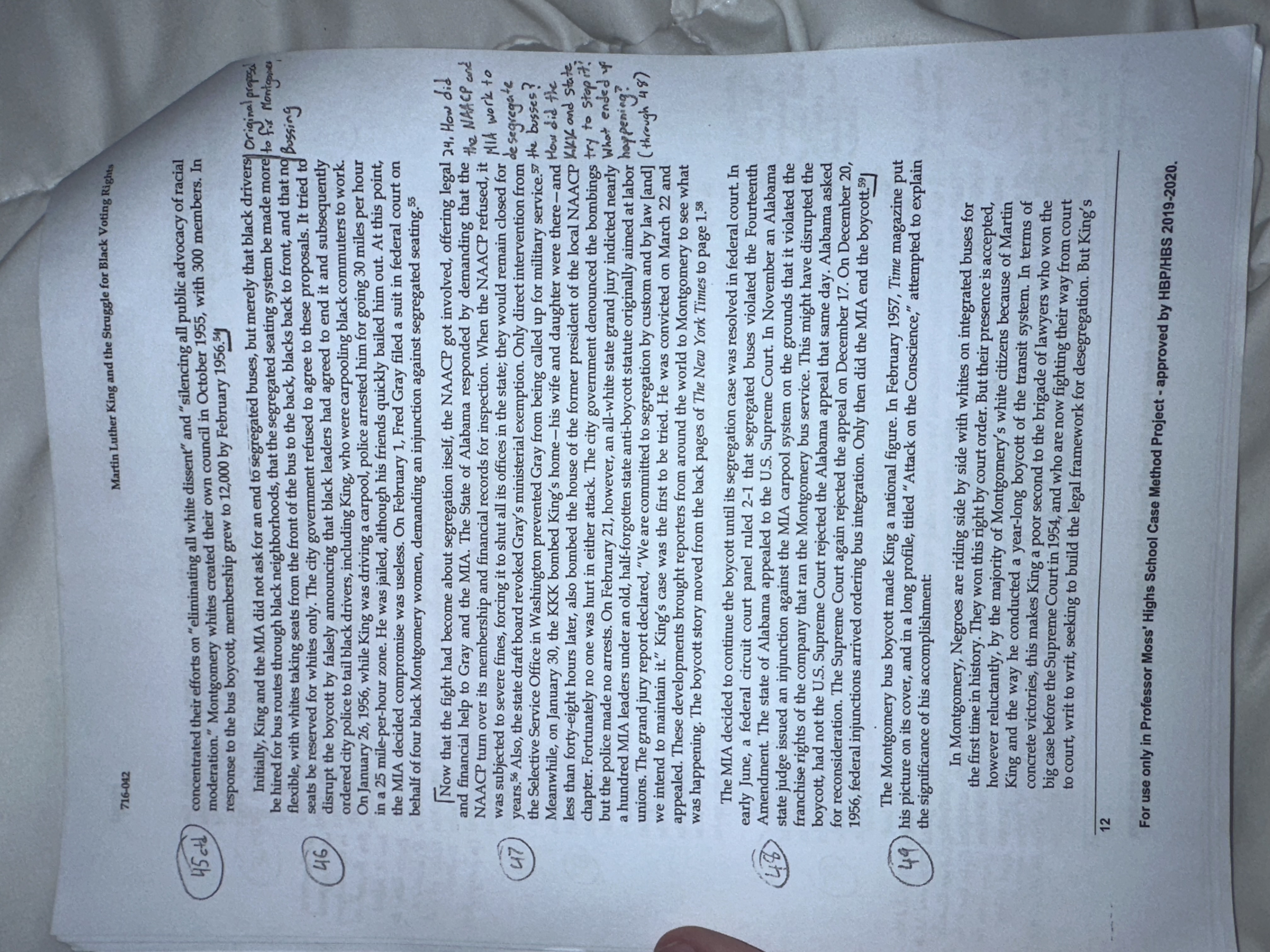
Question: Answer the questions that is on the packet, like the right side of the page in the picture from the text, by HIGHLIGHTING FROM THE
Answer the questions that is on the packet, like the right side of the page in the picture from the text, by HIGHLIGHTING FROM THE TEXT as the answer, thank you~
Martin Luther King and the Struggle for Black Voting Rights 716-042 45 ctl concentrated their efforts on "eliminating all white dissent" and "silencing all public advocacy of racial moderation." Montgomery whites created their own council in October 1955, with 300 members. In response to the bus boycott, membership grew to 12,000 by February 1956.sy Initially, King and the MIA did not ask for an end to segregated buses, but merely that black drivers Original proposal be hired for bus routes through black neighborhoods, that the segregated seating system be made more to fix Montopens flexible, with whites taking seats from the front of the bus to the back, blacks back to front, and that no Bussing seats be reserved for whites only. The city government refused to agree to these proposals. It tried to 46 disrupt the boycott by falsely announcing that black leaders had agreed to end it and subsequently ordered city police to tail black drivers, including King, who were carpooling black commuters to work. On January 26, 1956, while King was driving a carpool, police arrested him for going 30 miles per hour in a 25 mile-per-hour zone. He was jailed, although his friends quickly bailed him out. At this point, the MIA decided compromise was useless. On February 1, Fred Gray filed a suit in federal court on behalf of four black Montgomery women, demanding an injunction against segregated seating. $5 Now that the fight had become about segregation itself, the NAACP got involved, offering legal 24. How did and financial help to Gray and the MIA. The State of Alabama responded by demanding that the te NAACP and NAACP turn over its membership and financial records for inspection. When the NAACP refused, it MIA work to was subjected to severe fines, forcing it to shut all its offices in the state; they would remain closed ford 147 years.56 Also, the state draft board revoked Gray's ministerial exemption. Only direct intervention from de Segregate the Selective Service Office in Washington prevented Gray from being called up for military service.57 the busses ? Meanwhile, on January 30, the KKK bombed King's home-his wife and daughter were there-and How did the less than forty-eight hours later, also bombed the house of the former president of the local NAACP KKK and state chapter. Fortunately no one was hurt in either attack. The city government denounced the bombings try to stop it. but the police made no arrests. On February 21, however, an all-white state grand jury indicted nearly What ended of a hundred MIA leaders under an old, half-forgotten state anti-boycott statute originally aimed at labor happening? unions. The grand jury report declared, "We are committed to segregation by custom and by law [and] ( through 48) we intend to maintain it." King's case was the first to be tried. He was convicted on March 22 and appealed. These developments brought reporters from around the world to Montgomery to see what was happening. The boycott story moved from the back pages of The New York Times to page 1.58 The MIA decided to continue the boycott until its segregation case was resolved in federal court. In early June, a federal circuit court panel ruled 2-1 that segregated buses violated the Fourteenth Amendment. The state of Alabama appealed to the U.S. Supreme Court. In November an Alabama state judge issued an injunction against the MIA carpool system on the grounds that it violated the franchise rights of the company that ran the Montgomery bus service. This might have disrupted the boycott, had not the U.S. Supreme Court rejected the Alabama appeal that same day. Alabama asked for reconsideration. The Supreme Court again rejected the appeal on December 17. On December 20, 1956, federal injunctions arrived ordering bus integration. Only then did the MIA end the boycott.59/ The Montgomery bus boycott made King a national figure. In February 1957, Time magazine put his picture on its cover, and in a long profile, titled "Attack on the Conscience," attempted to explain the significance of his accomplishment: In Montgomery, Negroes are riding side by side with whites on integrated buses for the first time in history. They won this right by court order. But their presence is accepted, however reluctantly, by the majority of Montgomery's white citizens because of Martin King and the way he conducted a year-long boycott of the transit system. In terms of concrete victories, this makes King a poor second to the brigade of lawyers who won the big case before the Supreme Court in 1954, and who are now fighting their way from court to court, writ to writ, seeking to build the legal framework for desegregation. But King's 12 For use only in Professor Moss' Highs School Case Method Project - approved by HBP/HBS 2019-2020
Step by Step Solution
There are 3 Steps involved in it
1 Expert Approved Answer
Step: 1 Unlock
Question Has Been Solved by an Expert!
Get step-by-step solutions from verified subject matter experts
Step: 2 Unlock
Step: 3 Unlock
Students Have Also Explored These Related Accounting Questions!