Question: Answer the questions(given in the case study at the last) based on the case study below : Check for plagiarism trucks were discharged from the
Answer the questions(given in the case study at the last) based on the case study below :
Check for plagiarism
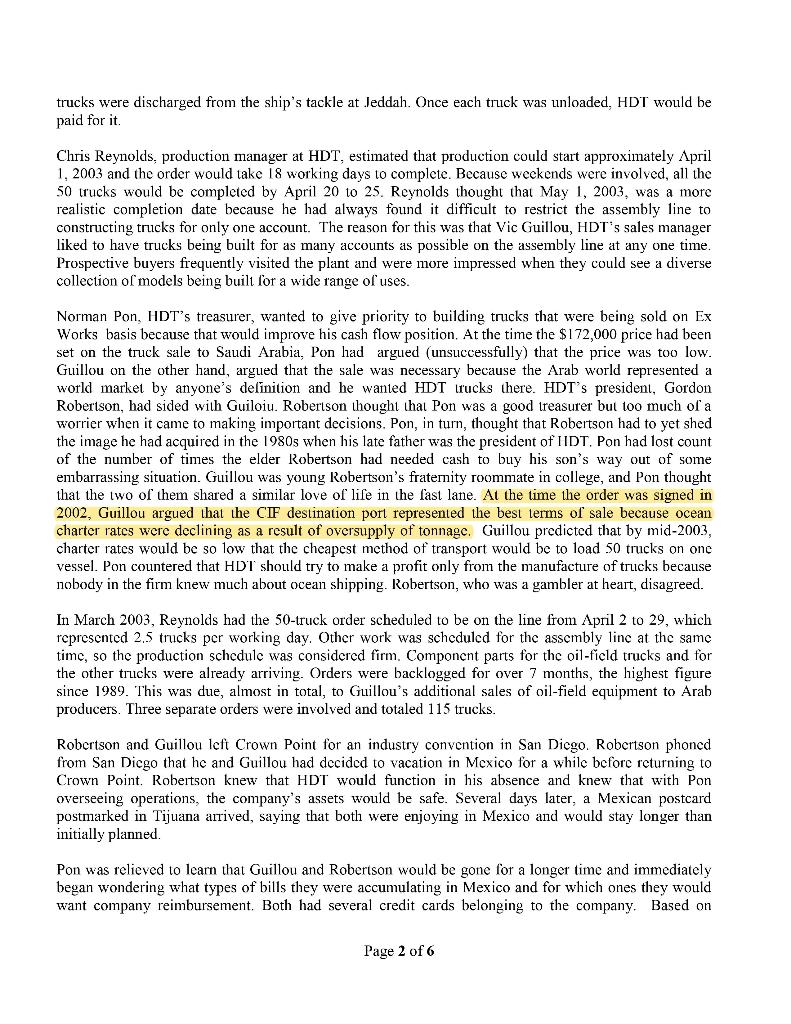
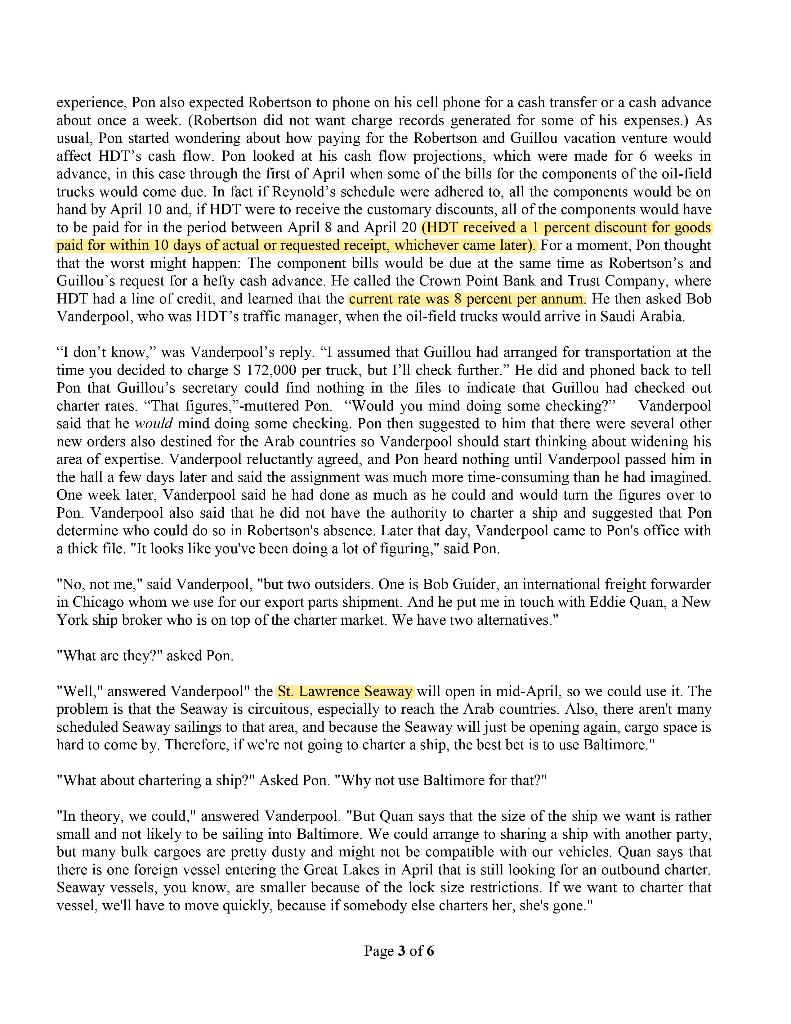
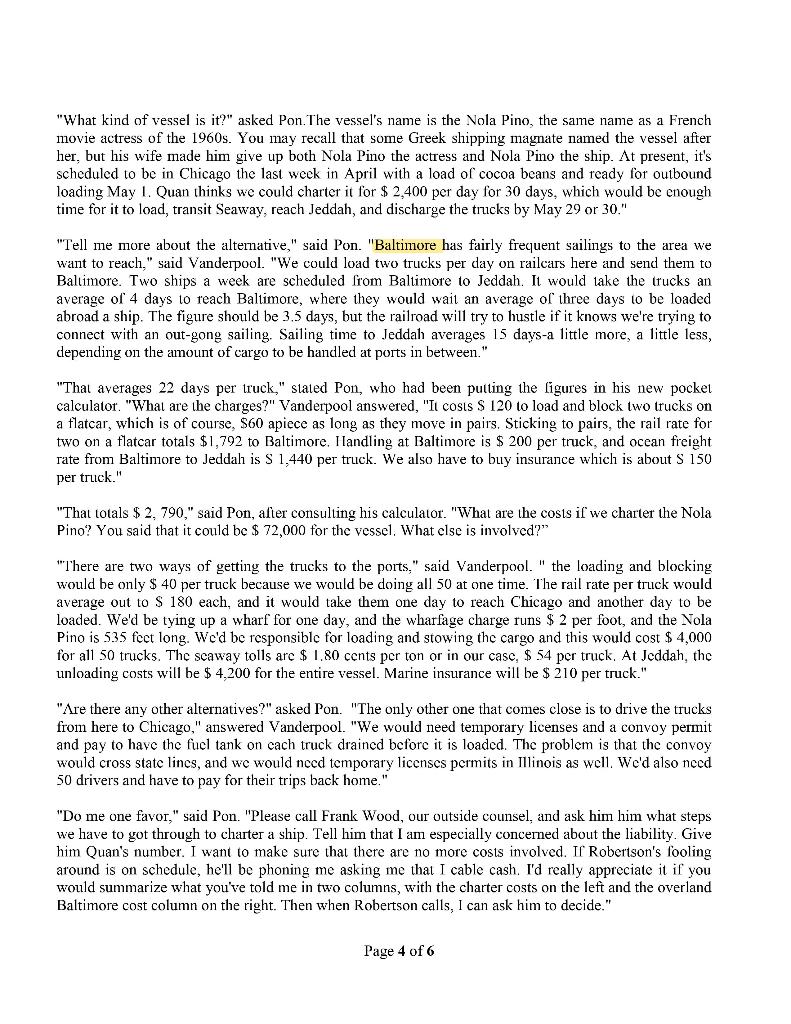
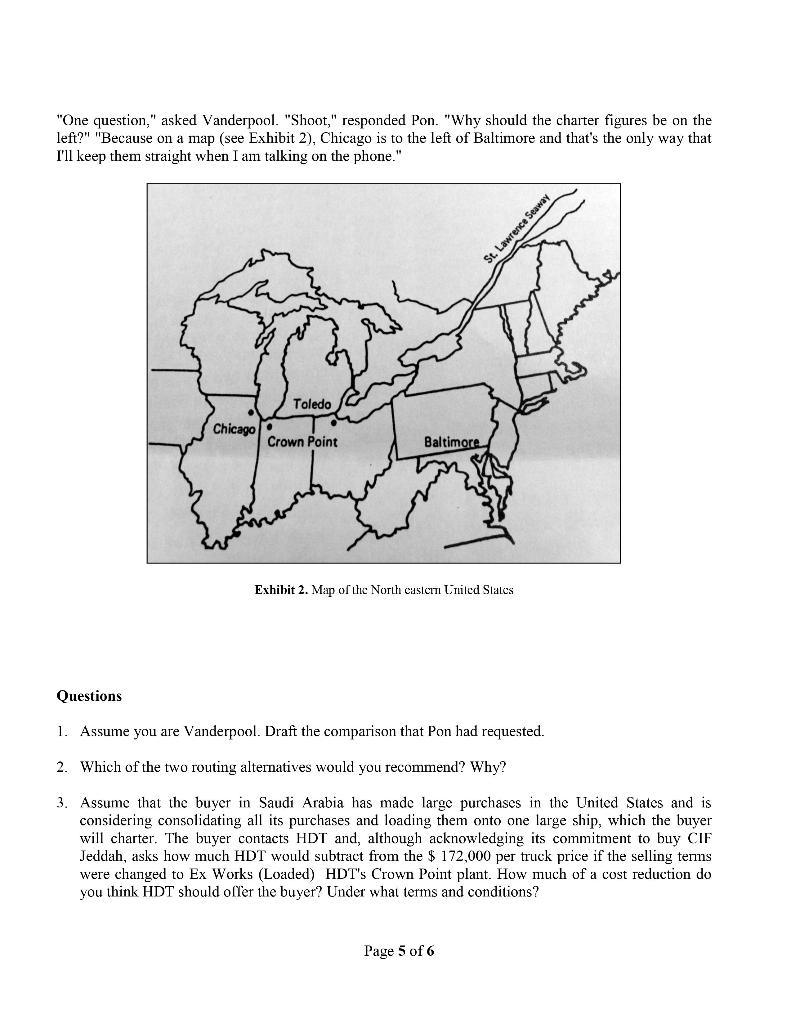
trucks were discharged from the ship's tackle at Jeddah. Once each truck was unloaded, HDT would be paid for it. Chris Reynolds, production manager at HDT, estimated that production could start approximately pril 1,2003 and the order would take 18 working days to complete. Because weekends were involyed, all the 50 trucks would be completed by April 20 to 25 . Reynolds thought that May 1,2003 , was a more realistic completion date because he had always found it difficult to restrict the assembly line to constructing trucks for only one account. The reason for this was that Vic Guillou, HDT's sales manager liked to have trucks being built for as many accounts as possible on the assembly line at any one time. Prospective buyers frequently visited the plant and were more impressed when they could see a diverse collection of models being built for a wide range of uses. Norman Pon, HDT's treasurer, wanted to give priority to building trucks that were being sold on Ex Works basis because that would improve his cash flow position. At the time the $172,000 price had been set on the truck sale to Saudi Arabia, Pon had argued (unsuccessfully) that the price was too low. Guillou on the other hand, argued that the sale was necessary because the Arab world represented a world market by anyone's delinition and he wanted HDT lrucks there. HDT's president, Gordon Robertson, had sided with Guiloiu. Robertson thought that Pon was a good treasurer but too much of a worrier when it came to making important decisions. Pon, in turn, thought that Robertson had to yet shed the image he had acquired in the 1980 s when his late father was the president of IIDT. Pon had lost count of the number of times the elder Robertson had needed cash to buy his son's way out of some embarrassing situation. Guillou was young Robertson's fratemity roommate in college, and Pon thought that the two of them shared a similar love of life in the last lane. At the time the order was signed in 2002, Guillou argued that the CIF destination port represented the best terms of sale because ocean charter rates were declining as a result of oversupply of tonnage. Guillou predicted that by mid-2003, charter rates would be so low that the cheapest method of transport would be to load 50 trucks on one vessel. Pon countered that HDT should try to make a profit only from the manufacture of trucks because nobody in the firm knew much about ocean shipping. Robertson, who was a gambler at heart, disagreed. In March 2003 , Reynolds had the 50 -truck order scheduled to be on the line from April 2 to 29 , which represented 2.5 trucks per working day. Other work was scheduled for the assembly line at the same time, so the production schedule was considered firm. Component parts for the oil-ficld trucks and for the other trucks were already arriving. Orders were backlogged for over 7 months, the highest figure since 1989 . This was due, almost in total, to Guillou's additional sales of oil-field equipment to Arab producers. Three separate orders were involved and totaled 115 trucks. Robertson and Guillou left Crown Point for an industry convention in San Diego. Robertson phoned from San Dicgo that he and Guillou had decided to vacation in Mexico for a while before returning to Crown Point. Robertson knew that HDT would function in his absence and knew that with Pon overseeing operations, the company's assets would be safe. Several days later, a Mexican postcard postmarked in Tijuana arrived, saying that both were enjoying in Mexico and would stay longer than initially planned. Pon was relieved to learn that Guillou and Roberison would be gone for a longer time and immediately began wondering what types of bills they were accumulating in Mexico and for which ones they would want company reimbursement. Both had several credit cards belonging to the company. Based on Page 2 of 6 experience, Pon also expected Robertson to phone on his cell phone for a cash transfer or a cash advance about once a week. (Robertson did not want charge records generated for some of his expenses.) As usual, Pon started wondering about how paying for the Robertson and Guillou vacation venture would affect HDT's cash flow. Pon looked at his cash flow projections, which were made for 6 weeks in advance, in this case through the first of April when some of the bills for the components of the oil-field trucks would come due. In fact if Reynold's schedule were adhered to, all the components would be on hand by April 10 and, if HDT were to receive the customary discounts, all of the components would have to be paid for in the period between April 8 and April 20 (HDT received a 1 percent discount for goods paid for within 10 days of actual or requested receipt, whichever came later). For a moment, Pon thought that the worst might happen: The component bills would be due at the same time as Robertson's and Guillou's request Cor a heliy cash advance. He called the Crown Point Bank and Trust Company, where HDT had a line of credit, and learned that the current rate was 8 percent per annum. He then asked Bob Vanderpool, who was HDT's traffic manager, when the oil-field trucks would arrive in Saudi Arabia. "I don't know," was Vanderpool's reply. "I assumed that Guillou had arranged for transportation at the time you decided to charge S 172,000 per truck, but I'll check further." He did and phoned back to tell Pon that Guillou's secretary could lind nothing in the liles to indicate that Guillou had checked out charter rates. "That ligures,"-multered Pon. "Would you mind doing some checking?" Vanderpool said that he would mind doing some checking. Pon then suggested to him that there were several other new orders also destined for the Arab countries so Vanderpool should start thinking about widening his area of expertise. Vanderpool reluctantly agreed, and Pon heard nothing until Vanderpool passed him in the hall a few days later and said the assignment was much more time-consuming than he had imagined. One week later. Vanderpool said he had done as much as he could and would turn the figures over to Pon. Vanderpool also said that he did not have the authority to charter a ship and suggested that Pon determine who could do so in Robertson's absence. I ater that day, Vanderpool came to Pon's office with a thick file, "It looks like you've been doing a lot of figuring," said Pon, "No, not me," said Vanderpool, "but two outsiders. One is Bob Guider, an international freight forwarder in Chicago whom we use for our export parts shipment. And he put me in touch with Eddie Quan, a New York ship broker who is on top of the charter market. We have two alternatives." "What are they?" asked Pon. "Well," answered Vanderpool" the St. Lawrence Seaway will open in mid-April, so we could use it. The problem is that the Seaway is circuitous, especially to reach the Arab countries. Also, there aren't many scheduled Seaway sailings to that area, and because the Seaway will just be opening again, cargo space is hard to come by. Therefore, if we're not going to charter a ship, the best bet is to use Baltimore." "What about chartering a ship?" Asked Pon. "Why not use Baltimore for that?" "In theory, we could," answered Vanderpool. "But Quan says that the size of the ship we want is rather small and not likely to be sailing into Baltimore. We could arrange to sharing a ship with another party, but many bulk cargoes are pretty dusty and might not be compatible with our vehicles. Quan says that there is one foreign vessel entering the Great Lakes in April that is still looking for an outbound charter. Seaway vessels, you know, are smaller because of the lock size restrictions. If we want to charter that vessel, we'll have to move quickly, because if somebody else charters her, she's gone." Page 3 of 6 "What kind of vessel is it?" asked Pon.The vessel's name is the Nola Pino, the same name as a French movie actress of the 1960s. You may recall that some Greek shipping magnate named the vessel after her, but his wife made him give up both Nola Pino the actress and Nola Pino the ship. At present, it's scheduled to be in Chicago the last week in April with a load of cocoa beans and ready for outbound loading May 1. Quan thinks we could charter it for $2,400 per day for 30 days, which would be enough time for it to load, transit Seaway, reach Jeddah, and discharge the trucks by May 29 or 30." "Tell me more about the altemative," said Pon. "Baltimore has fairly frequent sailings to the area we want to reach," said Vanderpool. "We could load two trucks per day on railcars here and send them to Baltimore. Two ships a week are scheduled from Baltimore to Jeddah. It would lake the trucks an average of 4 days to reach Baltimore, where they would wait an average of three days to be loaded abroad a ship. The figure should be 3.5 days, but the railroad will try to hustle if it knows we're trying to connect with an out-gong sailing. Sailing time to Jeddah averages 15 days-a little more, a little less, depending on the amount of cargo to be handled at ports in between." "That averages 22 days per truck," stated Pon, who had been putting the ligures in his new pocket calculator. "What are the charges?" Vanderpool answered, "I costs \$ 120 to load and block two trucks on a flatcar, which is of course, $60 apiece as long as they move in pairs. Sticking to pairs, the rail rate for two on a flatcar totals $1,792 to Baltimore. Ilandling at Baltimore is $200 per truck, and ocean freight rate from Baltimore to Jeddah is S1,440 per truck. We also have to buy insurance which is about S150 per truck." "That totals $2,790," said Pon, after consulting his calculator. "What are the costs if we charter the Nola Pino? You said that it could be $72,000 for the vessel. What else is involved?" "'here are two ways of getting the trucks to the ports," said Vanderpool. "the loading and blocking would be only $40 per truck because we would be doing all 50 at one time. The rail rate per truck would average out to $180 each, and it would take them one day to reach Chicago and another day to be loaded. We'd be tying up a wharf for one day, and the wharfage charge runs $2 per foot, and the Nola Pino is 535 fect long. We'd be responsible for loading and stowing the cargo and this would cost $4,000 for all 50 trucks. The scaway tolls are $1.80 cents per ton or in our casc, $54 per truck. At Jeddah, the unloading costs will be $4,200 for the entire vessel. Marine insurance will be $210 per truck." "Are there any other alternatives?" asked Pon. "The only other one that comes close is to drive the trucks from here to Chicago," answered Vanderpool. "We would need temporary licenses and a convoy permit and pay to have the fuel tank on each truck drained before it is loaded. The problem is that the convoy would cross state lincs, and we would need temporary licenses permits in Illinois as well. We'd also need 50 drivers and have to pay for their trips back home." "Do me one fayor," said Pon. "Please call Frank Wood, our outside counsel, and ask him him what steps we have to got through to charter a ship. Tell him that I am especially concerned about the liability. Give him Quan's number. I want to make sure that there are no more costs involved. If Robertson's fooling around is on schedule, he'll be phoning me asking me that I cable cash. I'd really appreciate it if you would summarize what you've told me in two columns, with the charter costs on the left and the overland Baltimore cost column on the right. Then when Robertson calls, I can ask him to decide." Page 4 of 6 "One question," asked Vanderpool. "Shoot," responded Pon. "Why should the charter figures be on the left?" "Because on a map (see Exhibit 2), Chicago is to the left of Baltimore and that's the only way that I'll keep them straight when I am talking on the phone." Exhibit 2. Map of tw North caslert Lililed Slates Questions 1. Assume you are Vanderpool. Draft the comparison that Pon had requested. 2. Which of the two routing alternatives would you recommend? Why? 3. Assume that the buyer in Saudi Arabia has made large purchases in the United States and is considering consolidating all its purchases and loading them onto one large ship, which the buyer will charter. The buyer contacts HDT and, although acknowledging its commitment to buy CIF Jeddah, asks how much HDT would subtract from the \$172,000 per truck price if the selling terms were changed to Ex Works (Loaded) HDT's Crown Point plant. How much of a cost reduction do you think HDT should offer the buyer? Under what terms and conditions? 4. Answer question 3 with regard to changing the terms of sale to delivery at port in Baltimore. The buyer would unload the trucks from the railcars. 5. Assume that the year 2005 and the cost to HDT of borrowing money is 12 percent per year. Because the buyer will pay for trucks as they are delivered, would it be advantageous for HDT to pay overtime to speed up production, ship the trucks as they are finished via the Port of Baltimore, and collect its payment earlier? Why or why not? Source: Murphy P.R., Wood D.F. (2010) - Contemporary Logistics Perspective, 10th Edition, Prentice Hall, NJ, USA









 Study Help