







Question: answer the qustion below CASE STUDY 3.1: Building the Better Mouse 92008 Victor E. Sower. Ph.D., CQ.E. You are sitting in on a meeting with
answer the qustion below 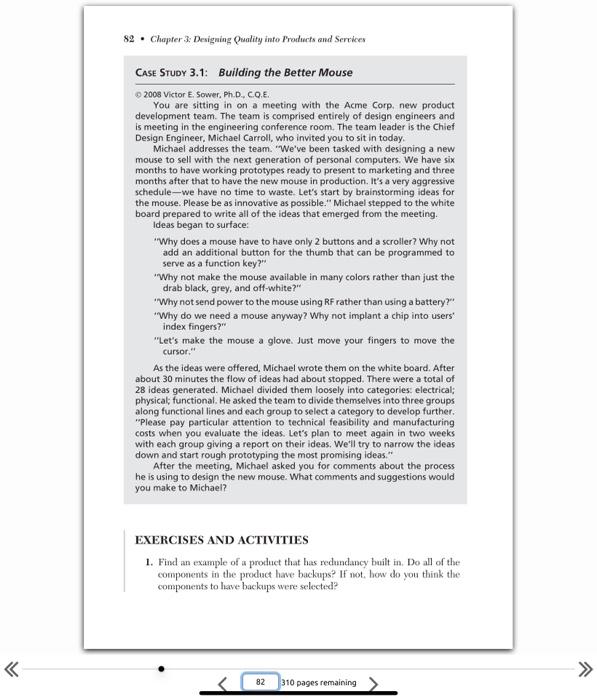
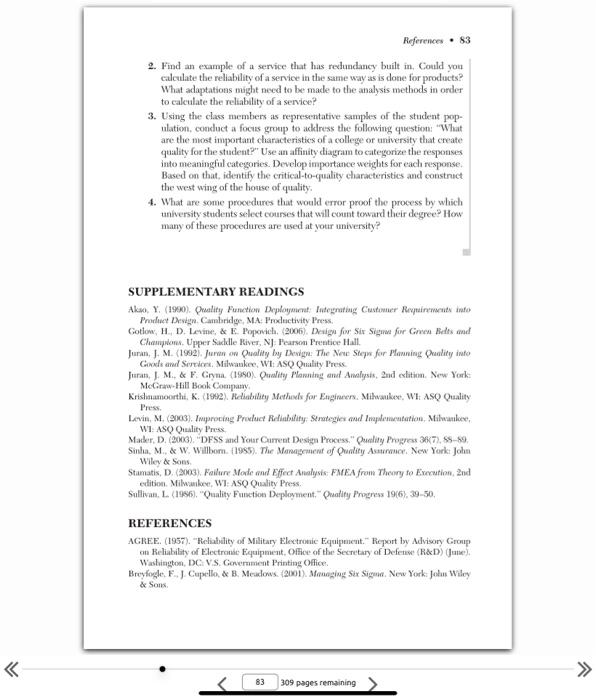
CASE STUDY 3.1: Building the Better Mouse 92008 Victor E. Sower. Ph.D., CQ.E. You are sitting in on a meeting with the Acme Corp, new product development team. The team is comprised entirely of design engineers and is meeting in the engineering conference room. The team leader is the Chief Design Engineer, Michael Carroll, who invited you to sit in today. Michael addresses the team. 'We've been tasked with designing a new mouse to sell with the next generation of personal computers. We have six months to have working prototypes ready to present to marketing and three months after that to have the new mouse in production. It's a very aggressive schedule-we have no time to waste. Let's start by brainstorming ideas for the mouse. Please be as innovative as possible." Michael stepped to the white board prepared to write all of the ideas that emerged from the meeting. Ideas began to surface: 'Why does a mouse have to have only 2 buttons and a scroller? Why not add an additional button for the thumb that can be programmed to serve as a function key?" "Why not make the mouse available in many colors rather than just the drab black, grey, and off-white?" 'Why not send power to the mouse using RF rather than using a battery?" 'Why do we need a mouse anyway? Why not implant a chip into users' index fingers?" "Let's make the mouse a glove. Just move your fingers to move the cursor, " As the ideas were offered, Michael wrote them on the white board. After about 30 minutes the flow of ideas had about stopped. There were a total of 28 ideas generated. Michael divided them loosely into categories: electrical; physical; functional. He asked the team to divide themselves into three groups along functional lines and each group to select a category to develop further. "Please pay particular attention to technical feasibility and manufacturing costs when you evaluate the ideas. Let's plan to meet again in two weeks with each group giving a report on their ideas. We'll try to narrow the ideas down and start rough prototyping the most promising ideas." After the meeting. Michael asked you for comments about the process he is using to design the new mouse. What comments and suggestions would you make to Michael? EXERCISES AND ACTIVTTIES 1. Find an example of a product that has redandancy built ia. Do all of the compenents in the product have backups? If not, how do you think the components to have backips were selected? References - 83 2. Find an example of a service that has reflundancy built in, Could you calculate the reliability of a service in the same way as is done for products? What adaptations nught need to be made to the analysis methods in order to calculate the reliability of a service? 3. U'sing the class members as representative samphes of the student population, conduct a focess groep to address the following question: "What are the nost important characteristics of a college of university that create quality for the student?" Use an affinity diagram to categorize the responses into meaningful categories. Develop importance weights for each response. Based on that, identify the eritical-to-quality characteristies and constnict the west wing of the house of quality: 4. What are some procedures that would error proof the process by which university students select courses that will count toward their degree? How many of these procedures are used at yotur university? SUPPLEMENTARY READINGS Akso. Y, (1990). Quatity Function Deployment: Lutegratieg Customer Reypintments info Product Design. Cambridge, M.A: Prodectivity Press. Champlons, Upper Suddlle Miver, N] Pearsom Prentice Hall. Juran, J. M. (1902). Jurmen on Quality by Dewgn: The Nowe Siepw for Planning Quadity info Goods and Sirvedrec, Milwaukex, WI: ASQ Quatity lrese Juran, J. M. \& F. Gryna (1950). Quality Planding and Amalysis, 2nd exlition. New York: McCraw-Hill Book Compary, Press. W1: ASQ Quedity Press: Maber, D. (2063). "DFSS and Your Curreat Design Process." Puility Progress 3(k7), 85-69, Wiley \& Sobs. Stamatis, D. (2003). Failure Mode and Effect Analysis. FMEA from Theory fo Erecution, and edlition. Milmanker, WT: ASQ Quality Press. Sullivas, L. (19s6). "Quality Function Deplayment, "Quafity Pregreas 19(6), 39-50, REFERENCES ACREE. (1957). "Fediability of Military Electronic Equipment." Report by Advisory Group on Keliability of Electronie Eqquipmerit, Offee of the Secretary of Deferewe (R\&DD) (Jane). Wastington, DC. V.S. Generament Printing Office. & Sons Step by Step Solution
There are 3 Steps involved in it
1 Expert Approved Answer
Step: 1 Unlock

Question Has Been Solved by an Expert!
Get step-by-step solutions from verified subject matter experts
Step: 2 Unlock
Step: 3 Unlock
 Study Help