







Question: Answer the study questions be specific marginalizing funding and people who suffer from mental illness. Study Questions laws in many countries, family members have limited
Answer the study questions be specific 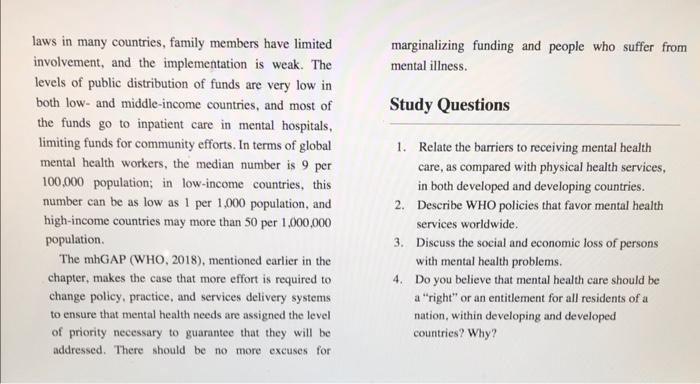
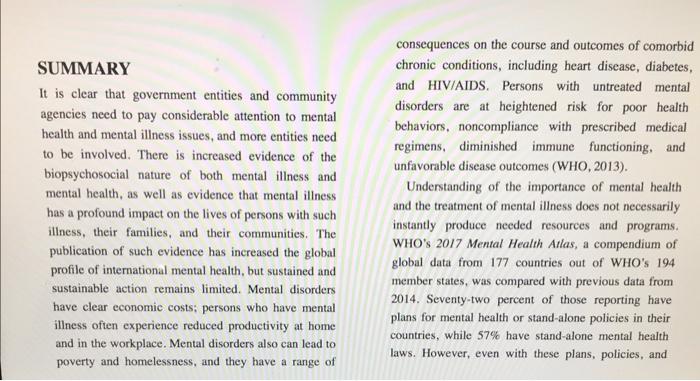
marginalizing funding and people who suffer from mental illness. Study Questions laws in many countries, family members have limited involvement, and the implementation is weak. The levels of public distribution of funds are very low in both low- and middle-income countries, and most of the funds go to inpatient care in mental hospitals, limiting funds for community efforts. In terms of global mental health workers, the median number is 9 per 100,000 population; in low-income countries, this number can be as low as 1 per 1,000 population, and high-income countries may more than 50 per 1,000,000 population The mhGAP (WHO, 2018), mentioned earlier in the chapter, makes the case that more effort is required to change policy, practice, and services delivery systems to ensure that mental health needs are assigned the level of priority necessary to guarantee that they will be addressed. There should be no more excuses for 1. Relate the barriers to receiving mental health care, as compared with physical health services, in both developed and developing countries. 2. Describe WHO policies that favor mental health services worldwide. 3. Discuss the social and economic loss of persons with mental health problems. 4. Do you believe that mental health care should be a "right" or an entitlement for all residents of a nation, within developing and developed countries? Why? SUMMARY It is clear that government entities and community agencies need to pay considerable attention to mental health and mental illness issues, and more entities need to be involved. There is increased evidence of the biopsychosocial nature of both mental illness and mental health, as well as evidence that mental illness has a profound impact on the lives of persons with such illness, their families, and their communities. The publication of such evidence has increased the global profile of international mental health, but sustained and sustainable action remains limited. Mental disorders have clear economic costs: persons who have mental illness often experience reduced productivity at home and in the workplace. Mental disorders also can lead to poverty and homelessness, and they have a range of consequences on the course and outcomes of comorbid chronic conditions, including heart disease, diabetes, and HIV/AIDS. Persons with untreated mental disorders are at heightened risk for poor health behaviors, noncompliance with prescribed medical regimens, diminished immune functioning, and unfavorable disease outcomes (WHO, 2013). Understanding of the importance of mental health and the treatment of mental illness does not necessarily instantly produce needed resources and programs. WHO's 2017 Mental Health Atlas, a compendium of global data from 177 countries out of WHO's 194 member states, was compared with previous data from 2014. Seventy-two percent of those reporting have plans for mental health or stand-alone policies in their countries, while 57% have stand-alone mental health laws. However, even with these plans, policies, and
Step by Step Solution
There are 3 Steps involved in it
1 Expert Approved Answer
Step: 1 Unlock

Question Has Been Solved by an Expert!
Get step-by-step solutions from verified subject matter experts
Step: 2 Unlock
Step: 3 Unlock
 Study Help