







Question: answer the two discussion questions Article 3: OM in the News: The Great Bacon Shortage AUGUST 12, 2021 tags: ethical dilemma, factory farms, Pork, process
answer the two discussion questions 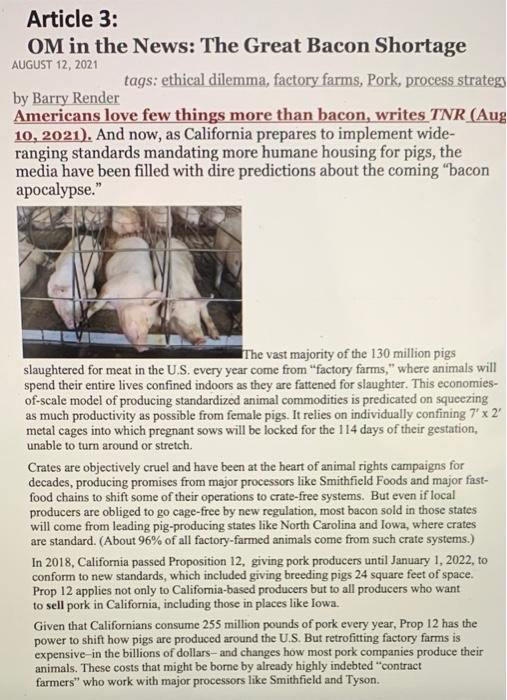
Article 3: OM in the News: The Great Bacon Shortage AUGUST 12, 2021 tags: ethical dilemma, factory farms, Pork, process strateg by Barry Render Americans love few things more than bacon, writes TNR (Aug 10, 2021). And now, as California prepares to implement wide- ranging standards mandating more humane housing for pigs, the media have been filled with dire predictions about the coming bacon apocalypse." The vast majority of the 130 million pigs slaughtered for meat in the U.S. every year come from "factory farms," where animals will spend their entire lives confined indoors as they are fattened for slaughter. This economies- of-scale model of producing standardized animal commodities is predicated on squeezing as much productivity as possible from female pigs. It relies on individually confining 7' x 2' metal cages into which pregnant sows will be locked for the 114 days of their gestation, unable to turn around or stretch. Crates are objectively cruel and have been at the heart of animal rights campaigns for decades, producing promises from major processors like Smithfield Foods and major fast- food chains to shift some of their operations to crate-free systems. But even if local producers are obliged to go cage-free by new regulation, most bacon sold in those states will come from leading pig-producing states like North Carolina and lowa, where crates are standard. (About 96% of all factory-farmed animals come from such crate systems.) In 2018, California passed Proposition 12, giving pork producers until January 1, 2022, to conform to new standards, which included giving breeding pigs 24 square feet of space. Prop 12 applies not only to California-based producers but to all producers who want to sell pork in California, including those in places like lowa. Given that Californians consume 255 million pounds of pork every year, Prop 12 has the power to shift how pigs are produced around the U.S. But retrofitting factory farms is expensive-in the billions of dollars-and changes how most pork companies produce their animals. These costs that might be borne by already highly indebted contract farmers" who work with major processors like Smithfield and Tyson. But even in gestation-stall-free systems, sows may be locked in individually confining farrowing crates to nurse their young, injected with drugs so that they can be impregnated artificially, and have their piglets euthanized if they don't gain weight fast enough. In industrial animal production, cruelty is systemic, endemic, and inescapable, even if it can be moderated by things like cage-free regulations. And, of course, all animals produced for food, regardless of production system, are slaughtered. Classroom discussion questions: 1. Discuss the productivity implications of this new law. 2. Discuss the ethical implications of the pork industry
Step by Step Solution
There are 3 Steps involved in it
1 Expert Approved Answer
Step: 1 Unlock

Question Has Been Solved by an Expert!
Get step-by-step solutions from verified subject matter experts
Step: 2 Unlock
Step: 3 Unlock
 Study Help