







Question: Answer these questions: 1. Identify two major problems about the firm relevant to marketing strategy 2. Analyze the two issues using concepts from marketing management
Answer these questions:
1. Identify two major problems about the firm relevant to marketing strategy
2. Analyze the two issues using concepts from marketing management
3. Present two to three alternative strategic marketing actions to solve the problems
4. Assess recommendations and implementation issues: Who will do what, when? What resources are needed? How will it be financed?
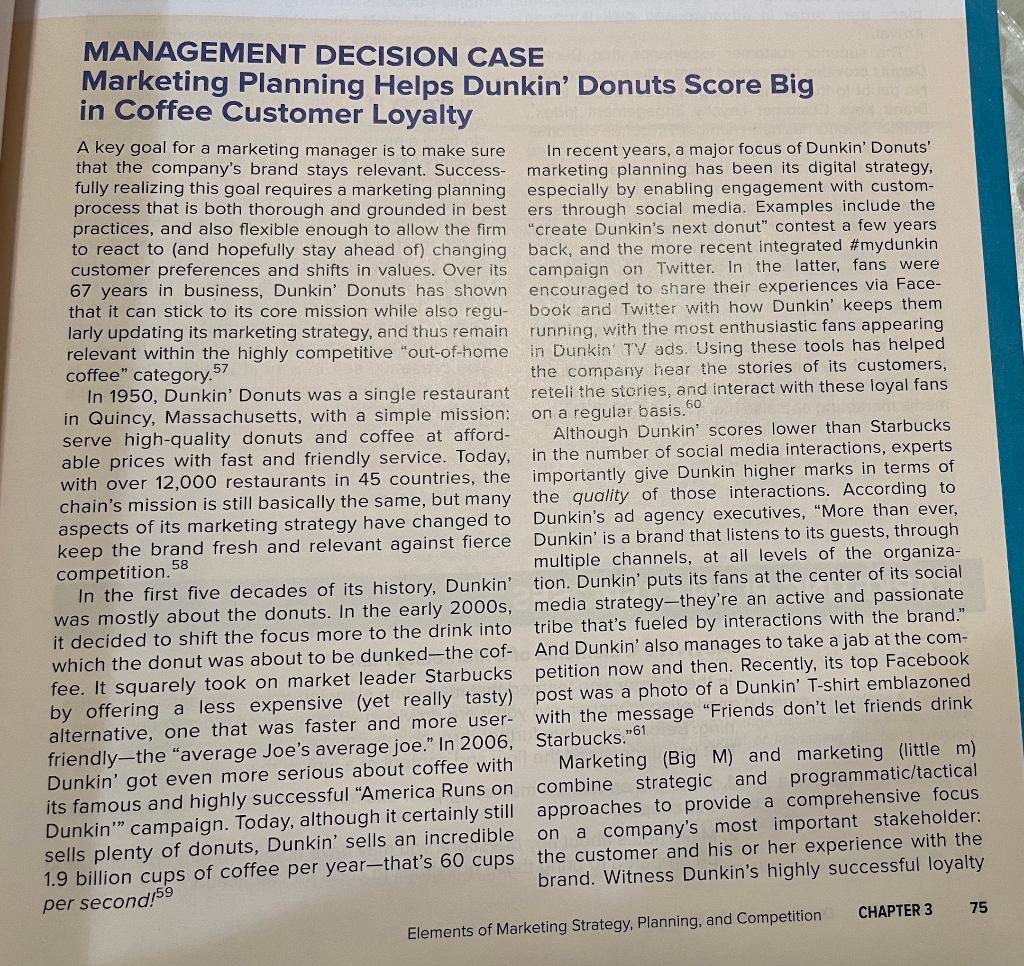
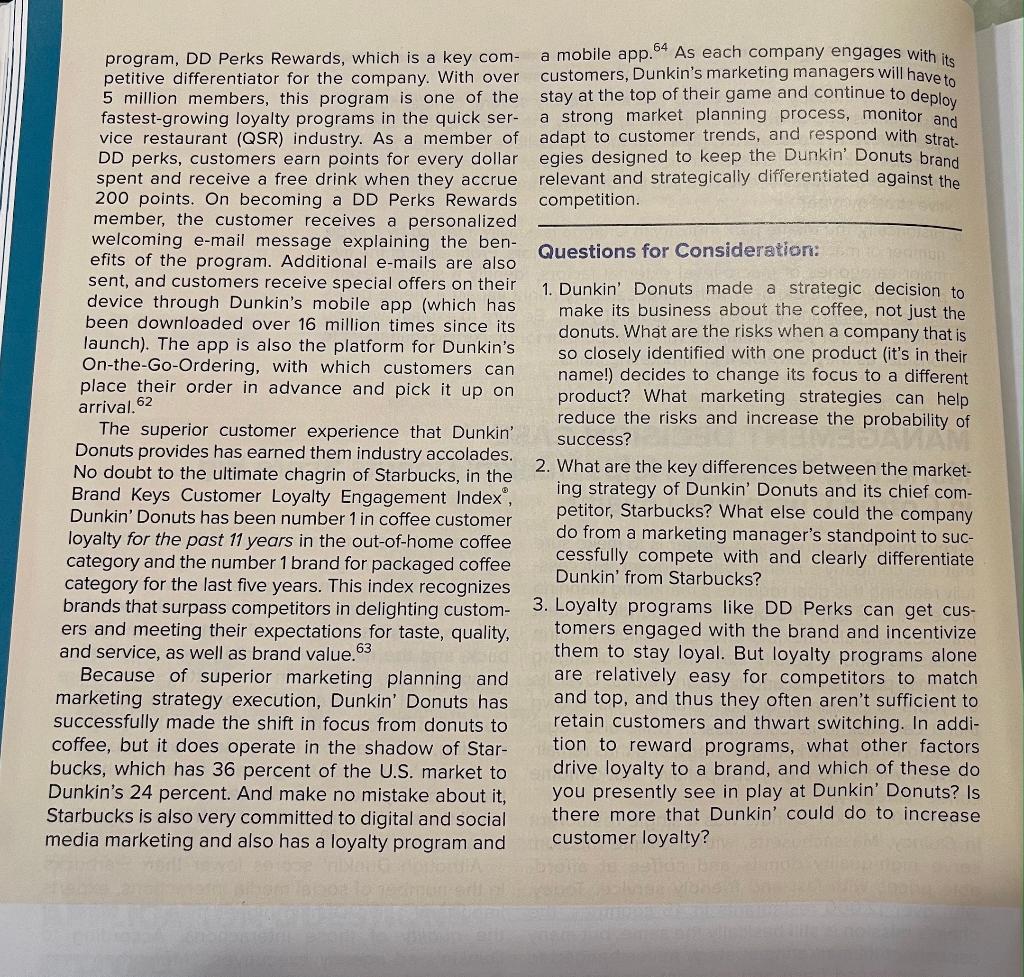
MANAGEMENT DECISION CASE Marketing Planning Helps Dunkin' Donuts Score Big in Coffee Customer Loyalty A key goal for a marketing manager is to make sure that the company's brand stays relevant. Success- fully realizing this goal requires a marketing planning process that is both thorough and grounded in best practices, and also flexible enough to allow the firm to react to (and hopefully stay ahead of) changing customer preferences and shifts in values. Over its 67 years in business, Dunkin' Donuts has shown that it can stick to its core mission while also regu- larly updating its marketing strategy, and thus remain relevant within the highly competitive "out-of-home 57 coffee" category. In 1950, Dunkin' Donuts was a single restaurant in Quincy, Massachusetts, with a simple mission: serve high-quality donuts and coffee at afford- able prices with fast and friendly service. Today, with over 12,000 restaurants in 45 countries, the chain's mission is still basically the same, but many aspects of its marketing strategy have changed to keep the brand fresh and relevant against fierce competition. 58 In the first five decades of its history, Dunkin' was mostly about the donuts. In the early 2000s, it decided to shift the focus more to the drink into which the donut was about to be dunked-the cof- fee. It squarely took on market leader Starbucks by offering a less expensive (yet really tasty) alternative, one that was faster and more user- friendly-the "average Joe's average joe." In 2006, Dunkin' got even more serious about coffee with its famous and highly successful "America Runs on Dunkin'" campaign. Today, although it certainly still sells plenty of donuts, Dunkin' sells an incredible 1.9 billion cups of coffee per year-that's 60 cups per second!59 In recent years, a major focus of Dunkin' Donuts' marketing planning has been its digital strategy, especially by enabling engagement with custom- ers through social media. Examples include the "create Dunkin's next donut" contest a few years back, and the more recent integrated #mydunkin campaign on Twitter. In the latter, fans were encouraged to share their experiences via Face- book and Twitter with how Dunkin' keeps them running, with the most enthusiastic fans appearing in Dunkin' TV ads. Using these tools has helped the company hear the stories of its customers, retell the stories, and interact with these loyal fans 60 on a regular basis. Although Dunkin' scores lower than Starbucks in the number of social media interactions, experts importantly give Dunkin higher marks in terms of the quality of those interactions. According to Dunkin's ad agency executives, "More than ever, Dunkin' is a brand that listens to its guests, through multiple channels, at all levels of the organiza- tion. Dunkin' puts its fans at the center of its social media strategy-they're an active and passionate tribe that's fueled by interactions with the brand." And Dunkin' also manages to take a jab at the com- petition now and then. Recently, its top Facebook post was a photo of a Dunkin' T-shirt emblazoned with the message "Friends don't let friends drink Starbucks."E "61 Marketing (Big M) and marketing (little m) combine strategic and programmatic/tactical approaches to provide a comprehensive focus on a company's most important stakeholder: the customer and his or her experience with the brand. Witness Dunkin's highly successful loyalty CHAPTER 3 75 Elements of Marketing Strategy, Planning, and Competition program, DD Perks Rewards, which is a key com- petitive differentiator for the company. With over 5 million members, this program is one of the fastest-growing loyalty programs in the quick ser- vice restaurant (QSR) industry. As a member of DD perks, customers earn points for every dollar spent and receive a free drink when they accrue 200 points. On becoming a DD Perks Rewards member, the customer receives a personalized welcoming e-mail message explaining the ben- efits of the program. Additional e-mails are also sent, and customers receive special offers on their device through Dunkin's mobile app (which has been downloaded over 16 million times since its launch). The app is also the platform for Dunkin's On-the-Go-Ordering, with which customers can place their order in advance and pick it up on arrival, 62 The superior customer experience that Dunkin' Donuts provides has earned them industry accolades. No doubt to the ultimate chagrin of Starbucks, in the Brand Keys Customer Loyalty Engagement Index", Dunkin' Donuts has been number 1 in coffee customer loyalty for the past 11 years in the out-of-home coffee category and the number 1 brand for packaged coffee category for the last five years. This index recognizes brands that surpass competitors in delighting custom- ers and meeting their expectations for taste, quality, and service, as well as brand value.63 e bord Because of superior marketing planning and marketing strategy execution, Dunkin' Donuts has successfully made the shift in focus from donuts to coffee, but it does operate in the shadow of Star- bucks, which has 36 percent of the U.S. market to Dunkin's 24 percent. And make no mistake about it, Starbucks is also very committed to digital and social media marketing and also has a loyalty program and a mobile app. As each company engages with its customers, Dunkin's marketing managers will have to stay at the top of their game and continue to deploy a strong market planning process, monitor and adapt to customer trends, and respond with strat- egies designed to keep the Dunkin' Donuts brand relevant and strategically differentiated against the competition. Questions for Consideration: 1. Dunkin' Donuts made a strategic decision to make its business about the coffee, not just the donuts. What are the risks when a company that is so closely identified with one product (it's in their name!) decides to change its focus to a different product? What marketing strategies can help reduce the risks and increase the probability of success? 2. What are the key differences between the market- ing strategy of Dunkin' Donuts and its chief com- petitor, Starbucks? What else could the company do from a marketing manager's standpoint to suc- cessfully compete with and clearly differentiate Dunkin' from Starbucks? 3. Loyalty programs like DD Perks can get cus- tomers engaged with the brand and incentivize them to stay loyal. But loyalty programs alone are relatively easy for competitors to match and top, and thus they often aren't sufficient to retain customers and thwart switching. In addi- tion to reward programs, what other factors drive loyalty to a brand, and which of these do you presently see in play at Dunkin' Donuts? Is there more that Dunkin' could do to increase customer loyalty? DovedStep by Step Solution
There are 3 Steps involved in it
1 Expert Approved Answer
Step: 1 Unlock

Question Has Been Solved by an Expert!
Get step-by-step solutions from verified subject matter experts
Step: 2 Unlock
Step: 3 Unlock
 Study Help