







Question: Answer this question please Definition. (pg. 259) If P is a stochastic matrix, then a steady-state vector (or equilibrium vector) for P is a probability
Answer this question please
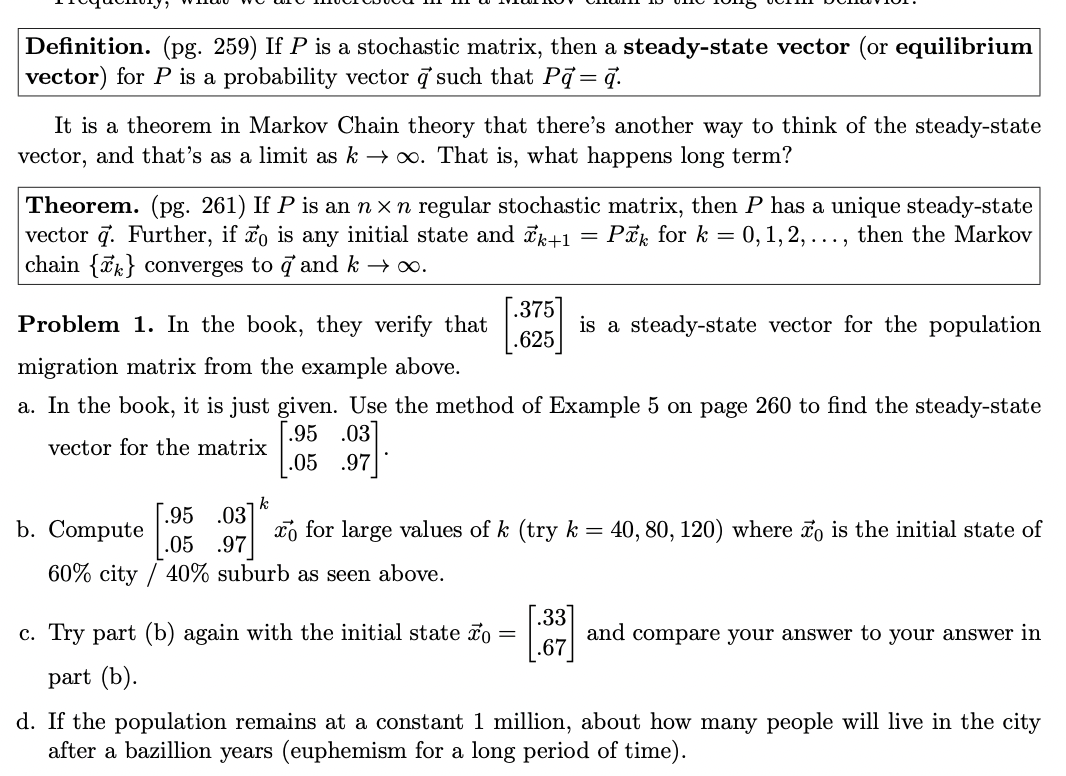
Definition. (pg. 259) If P is a stochastic matrix, then a steady-state vector (or equilibrium vector) for P is a probability vector q such that Pq = q. It is a theorem in Markov Chain theory that there's another way to think of the steady-state vector, and that's as a limit as k -> co. That is, what happens long term? Theorem. (pg. 261) If P is an n x n regular stochastic matrix, then P has a unique steady-state vector q. Further, if To is any initial state and Ck+1 = PEk for k = 0, 1, 2, ..., then the Markov chain {ck} converges to q and k -+ co. Problem 1. In the book, they verify that .375 .625 is a steady-state vector for the population migration matrix from the example above. a. In the book, it is just given. Use the method of Example 5 on page 260 to find the steady-state vector for the matrix 1.95 .03 .05 .97 .95 .03]k b. Compute .05 .97 To for large values of k (try k = 40, 80, 120) where To is the initial state of 60% city / 40% suburb as seen above. c. Try part (b) again with the initial state TO = 33 67 and compare your answer to your answer in part (b). d. If the population remains at a constant 1 million, about how many people will live in the city after a bazillion years (euphemism for a long period of time)
Step by Step Solution
There are 3 Steps involved in it

Get step-by-step solutions from verified subject matter experts
 Study Help