







Question: answer this qusetion by bython code Q3.2: let's go back to the example from the demo with documents: Call me soon, CALL to win, Pick
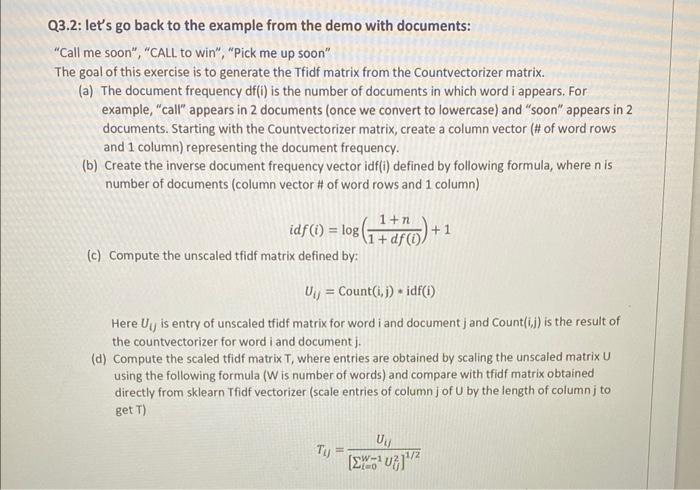
Q3.2: let's go back to the example from the demo with documents: "Call me soon", "CALL to win", "Pick me up soon" The goal of this exercise is to generate the Tfidf matrix from the Countvectorizer matrix. (a) The document frequency df(i) is the number of documents in which word i appears. For example, "call" appears in 2 documents (once we convert to lowercase) and "soon" appears in 2 documents. Starting with the Countvectorizer matrix, create a column vector (\# of word rows and 1 column) representing the document frequency. (b) Create the inverse document frequency vector idf(i) defined by following formula, where n is number of documents (column vector \# of word rows and 1 column) idf(i)=log(1+df(i)1+n)+1 (c) Compute the unscaled tfidf matrix defined by: Uij=Count(i,j)idf(i) Here Uij is entry of unscaled tfidf matrix for word i and document j and Count(i,j) is the result of the countvectorizer for word i and document j. (d) Compute the scaled tfidf matrix T, where entries are obtained by scaling the unscaled matrix U using the following formula ( W is number of words) and compare with tfidf matrix obtained directly from sklearn Tfidf vectorizer (scale entries of column j of U by the length of column j to getT) Tij=[i=0W1Uij2]1/2Uij
Step by Step Solution
There are 3 Steps involved in it

Get step-by-step solutions from verified subject matter experts
 Study Help