Question: Answer this to the point , or expect a dislike Automation Industry 4.0 has brought automation in manufacturing through multiple digital technologies (Mourtziset al., 2014).
Answer this to the point , or expect a dislike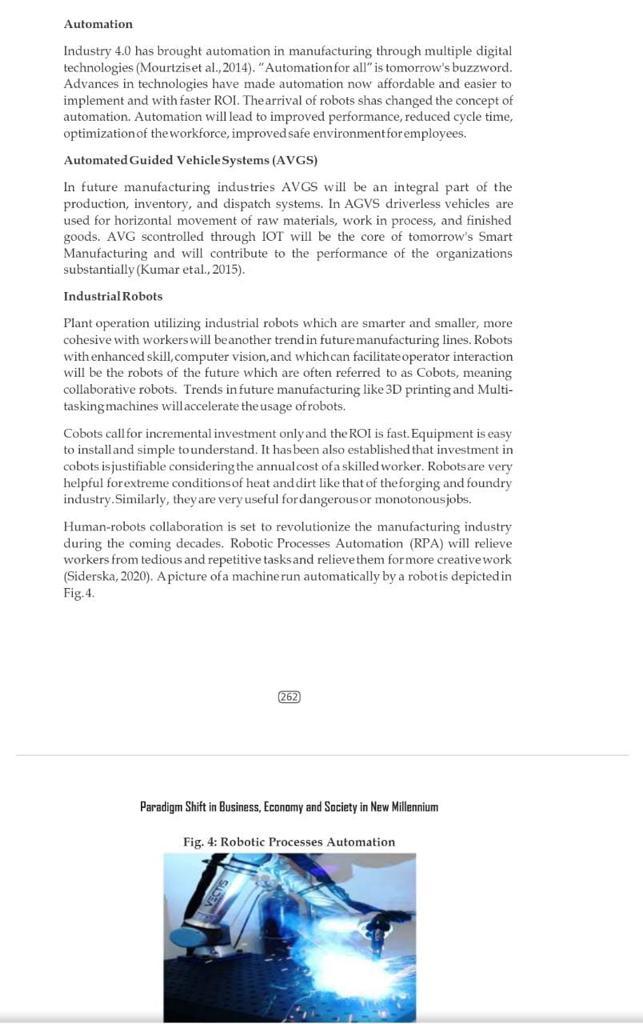
Automation Industry 4.0 has brought automation in manufacturing through multiple digital technologies (Mourtziset al., 2014). "Automation for all" is tomorrow's buzzword. Advances in technologies have made automation now affordable and easier to implement and with faster ROI. Thearrival of robots shas changed the concept of automation. Automation will lead to improved performance, reduced cycle time, optimization of the workforce, improved safe environment foremployees. Automated Guided VehicleSystems (AVGS) In future manufacturing industries AVGS will be an integral part of the production, inventory, and dispatch systems. In AGVS driverless vehicles are used for horizontal movement of raw materials, work in process, and finished goods. AVG scontrolled through IOT will be the core of tomorrow's Smart Manufacturing and will contribute to the performance of the organizations substantially (Kumar etal., 2015). Industrial Robots Plant operation utilizing industrial robots which are smarter and smaller, more cohesive with workers will beanother trend in futuremanufacturing lines. Robots with enhanced skill, computer vision, and which can facilitateoperator interaction will be the robots of the future which are often referred to as Cobots, meaning collaborative robots. Trends in future manufacturing like 3D printing and Multitasking machines will accelerate the usage of robots. Cobots call for incremental investment only and the ROI is fast. Equipment is easy to install and simple tounderstand. It has been also established that investment in cobots isjustifiable considering the annual cost of a skilled worker. Robotsare very helpful for extreme conditions of heat and dirt like that of theforging and foundry industry. Similarly, theyare very useful for dangerousor monotonousjobs. Human-robots collaboration is set to revolutionize the manufacturing industry during the coming decades. Robotic Processes Automation (RPA) will relieve workers from tedious and repetitive tasks and relieve them formore creative work (Siderska, 2020). A picture of a machinerun automatically by a robot is depicted in Fig. 4. (262) Paradigm Shift in Business, Economy and Society in New Millennium disrupted the globaleconomy but alsostarted a partialshutdown in many parts of India since march 2020. Asian Development Bank (ADB) sees India's economic growth slipping to 4% in financialyear 2021, while other ratings have further slashed its GDP growth forecast for the country to 3.5 per cent from a previous downgrade of 5.2 per cent. However, the Indian economy, after the destruction in the wake of the lockdown, is showing signs of recovering. Data from a variety of sources, such as exports and car sales, aswell as data from otheragencies, point to the onsetof a recovery.Undercomplete lockdown, less than a quarter of India's $2.8 trillion economic movement was functional. Up to 53% of businesses in the country were projected to be significantly affected. Supply chains have been put under pressure with thelockdownlimitations. Automation Industry 4.0 has brought automation in manufacturing through multiple digital technologies (Mourtziset al., 2014). "Automation for all" is tomorrow's buzzword. Advances in technologies have made automation now affordable and easier to implement and with faster ROI. Thearrival of robots shas changed the concept of automation. Automation will lead to improved performance, reduced cycle time, optimization of the workforce, improved safe environment foremployees. Automated Guided VehicleSystems (AVGS) In future manufacturing industries AVGS will be an integral part of the production, inventory, and dispatch systems. In AGVS driverless vehicles are used for horizontal movement of raw materials, work in process, and finished goods. AVG scontrolled through IOT will be the core of tomorrow's Smart Manufacturing and will contribute to the performance of the organizations substantially (Kumar etal., 2015). Industrial Robots Plant operation utilizing industrial robots which are smarter and smaller, more cohesive with workers will beanother trend in futuremanufacturing lines. Robots with enhanced skill, computer vision, and which can facilitateoperator interaction will be the robots of the future which are often referred to as Cobots, meaning collaborative robots. Trends in future manufacturing like 3D printing and Multitasking machines will accelerate the usage of robots. Cobots call for incremental investment only and the ROI is fast. Equipment is easy to install and simple tounderstand. It has been also established that investment in cobots isjustifiable considering the annual cost of a skilled worker. Robotsare very helpful for extreme conditions of heat and dirt like that of theforging and foundry industry. Similarly, theyare very useful for dangerousor monotonousjobs. Human-robots collaboration is set to revolutionize the manufacturing industry during the coming decades. Robotic Processes Automation (RPA) will relieve workers from tedious and repetitive tasks and relieve them formore creative work (Siderska, 2020). A picture of a machinerun automatically by a robot is depicted in Fig. 4. (262) Paradigm Shift in Business, Economy and Society in New Millennium disrupted the globaleconomy but alsostarted a partialshutdown in many parts of India since march 2020. Asian Development Bank (ADB) sees India's economic growth slipping to 4% in financialyear 2021, while other ratings have further slashed its GDP growth forecast for the country to 3.5 per cent from a previous downgrade of 5.2 per cent. However, the Indian economy, after the destruction in the wake of the lockdown, is showing signs of recovering. Data from a variety of sources, such as exports and car sales, aswell as data from otheragencies, point to the onsetof a recovery.Undercomplete lockdown, less than a quarter of India's $2.8 trillion economic movement was functional. Up to 53% of businesses in the country were projected to be significantly affected. Supply chains have been put under pressure with thelockdownlimitations









 Study Help