







Question: Answer to question 8, please Ccna Guide To Cisco Networking F als 5th Edition T Lab 4.1 Determine an IP Addressing Scheme for Network 192.3.2.0
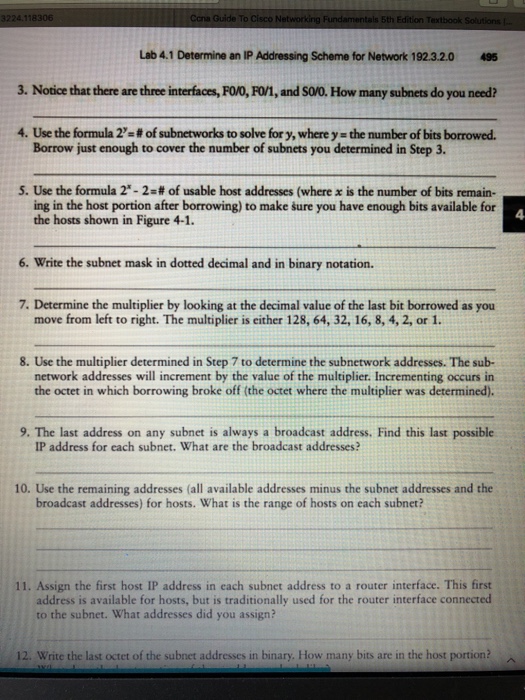
Ccna Guide To Cisco Networking F als 5th Edition T Lab 4.1 Determine an IP Addressing Scheme for Network 192.3.2.0 495 3. Notice that there are three interfaces, FO/O, FO/1, and SO/O. How many subnets do you need? 4. Use the formula 2". of subnetworks to solve for y, where y the number of bits borrowed. Borrow just enough to cover the number of subnets you determined in Step 3. 5. Use the formula 2, 2: # of usable host addresses (where x is the number of bits remain- ing in the host portion after borrowing) to make sure you have enough bits available for the hosts shown in Figure 4-1. 6. Write the subnet mask in dotted decimal and in binary notation. 7. Determine the multiplier by looking at the decimal value of the last bit borrowed as you move from left to right. The multiplier is either 128, 64, 32, 16, 8, 4,2, or 1. 8. Use the multiplier determined in Step 7 to determine the subnetwork addresses. The sub- network addresses will increment by the value of the multiplier. Incrementing occurs in the octet in which borrowing broke off (the octet where the multiplier was determined). 9. The last address on any subnet is always a broadcast address. Find this last possible IP address for each subnet. What are the broadcast addresses? 10. Use the remaining addresses (all available addresses minus the subnet addresses and the broadcast addresses) for hosts. What is the range of hosts on each subnet? 11. Assign the first host IP address in each subnet address to a router interface. This first address is available for hosts, but is traditionally used for the router interface connected to the subnet. What addresses did you assign? 12. Write the last octet of the subnet addresses in binary, How many bits are in the host portion
Step by Step Solution
There are 3 Steps involved in it

Get step-by-step solutions from verified subject matter experts
 Study Help