



Question: Any help with explaining the process to get to these figures would be extremely appreciated! kraft paper by the ton, converts it to heavy-duty paperboard
Any help with explaining the process to get to these figures would be extremely appreciated!
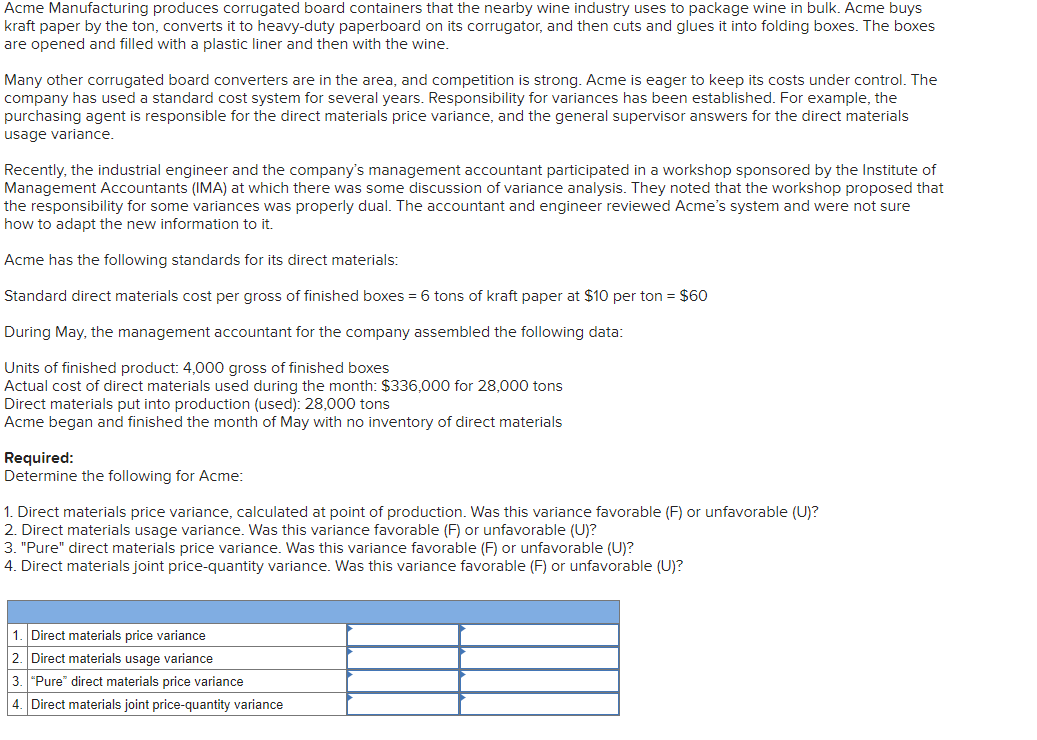
kraft paper by the ton, converts it to heavy-duty paperboard on its corrugator, and then cuts and glues it into folding boxes. The boxes are opened and filled with a plastic liner and then with the wine. Many other corrugated board converters are in the area, and competition is strong. Acme is eager to keep its costs under control. The company has used a standard cost system for several years. Responsibility for variances has been established. For example, the purchasing agent is responsible for the direct materials price variance, and the general supervisor answers for the direct materials usage variance. Recently, the industrial engineer and the company's management accountant participated in a workshop sponsored by the Institute of Management Accountants (IMA) at which there was some discussion of variance analysis. They noted that the workshop proposed that the responsibility for some variances was properly dual. The accountant and engineer reviewed Acme's system and were not sure how to adapt the new information to it. Acme has the following standards for its direct materials: Standard direct materials cost per gross of finished boxes \\( =6 \\) tons of kraft paper at \\( \\$ 10 \\) per ton \\( =\\$ 60 \\) During May, the management accountant for the company assembled the following data: Units of finished product: 4,000 gross of finished boxes Actual cost of direct materials used during the month: \\( \\$ 336,000 \\) for 28,000 tons Direct materials put into production (used): 28,000 tons Acme began and finished the month of May with no inventory of direct materials Required: Determine the following for Acme: 1. Direct materials price variance, calculated at point of production. Was this variance favorable (F) or unfavorable (U)? 2. Direct materials usage variance. Was this variance favorable (F) or unfavorable (U)? 3. \"Pure\" direct materials price variance. Was this variance favorable (F) or unfavorable (U)? 4. Direct materials joint price-quantity variance. Was this variance favorable (F) or unfavorable (U)
Step by Step Solution
There are 3 Steps involved in it

Get step-by-step solutions from verified subject matter experts