







Question: Any help would be appreciated on this problem- I am lost as to how to approach it: Demand for basic sneakers is given by: QD
Any help would be appreciated on this problem- I am lost as to how to approach it:
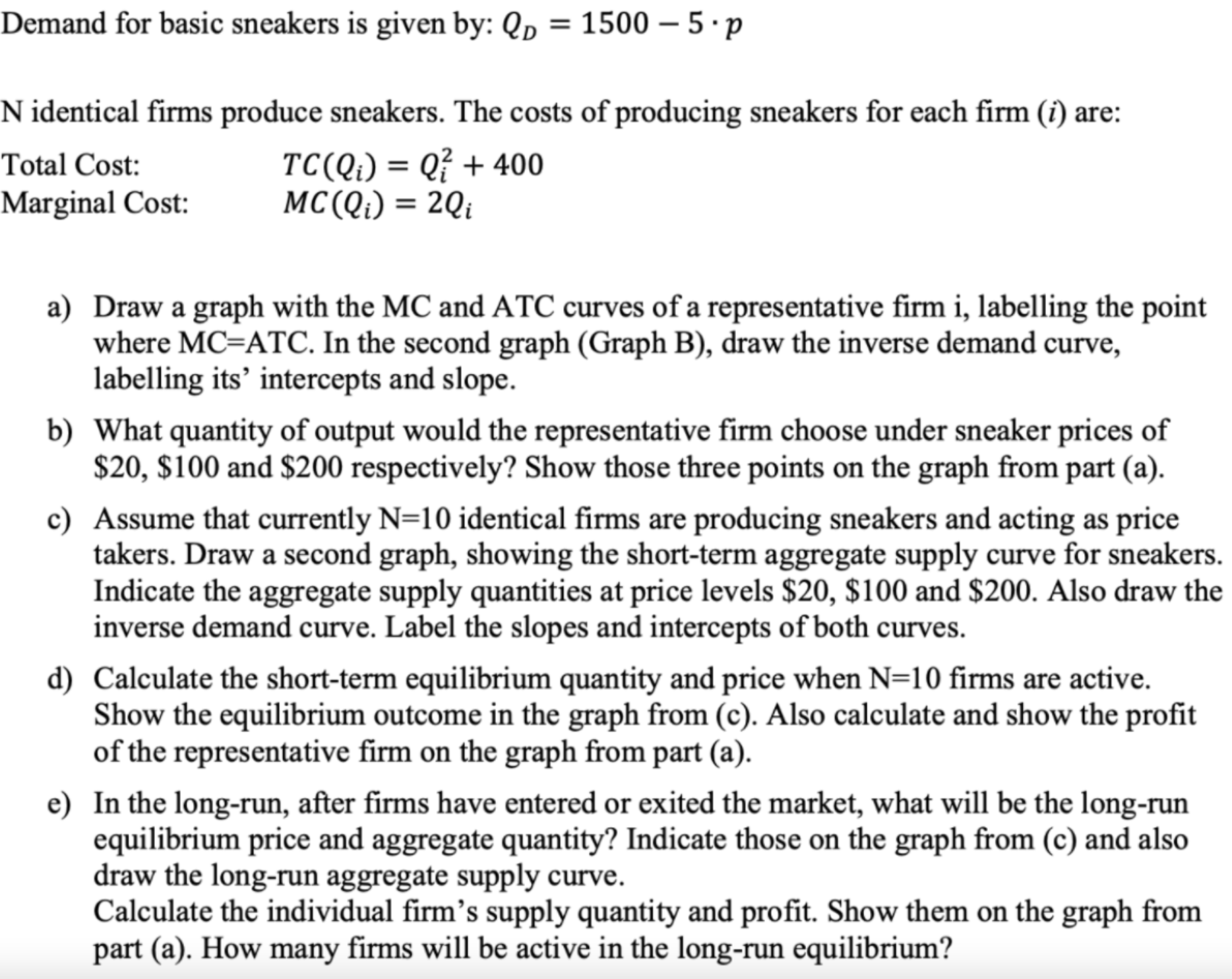
Demand for basic sneakers is given by: QD = 1500 5 -p N identical rms produce sneakers. The costs of producing sneakers for each rm (i) are: Total Cost: TC(Q,-) = Q} + 400 Marginal Cost: MC (0,) = 20,- 3) Draw a graph with the MC and ATC curves of a representative rm i, labelling the point b) where MC=ATC. In the second graph (Graph B), draw the inverse demand curve, labelling its' intercepts and slope. What quantity of output would the representative rm choose under sneaker prices of $20, $100 and $200 respectively? Show those three points on the graph from part (a). Assume that currently N=10 identical rms are producing sneakers and acting as price takers. Draw a second graph, showing the short-term aggregate supply curve for sneakers. Indicate the aggregate supply quantities at price levels $20, $100 and $200. Also draw the inverse demand curve. Label the slopes and intercepts of both curves. Calculate the short-terrn equilibrium quantity and price when N=10 rms are active. Show the equilibrium outcome in the graph from (c). Also calculate and show the prot of the representative rm on the graph from part (a). In the long-run, after rms have entered or exited the market, what will be the long-run equilibrium price and aggregate quantity? Indicate those on the graph from (c) and also draw the long-run aggregate supply curve. Calculate the individual rrn's supply quantity and prot. Show them on the graph from part (a). How many rms will be active in the long-run equilibrium
Step by Step Solution
There are 3 Steps involved in it

Get step-by-step solutions from verified subject matter experts
 Study Help