







Question: Any Sql helps? 1. Write a Cartesian product or Cross loin SQL statement to display the total number of rows from the Listings and zips
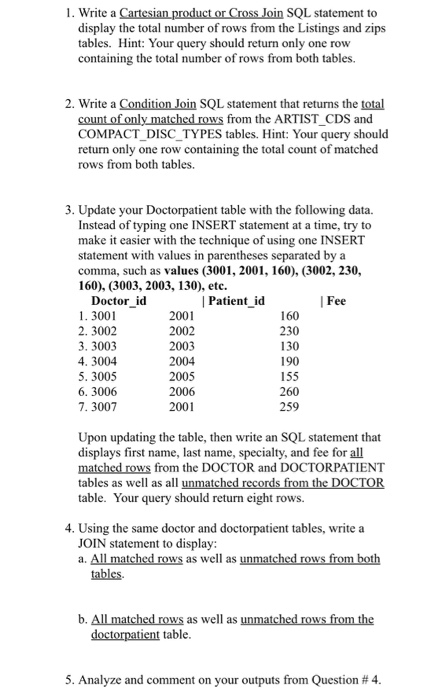

1. Write a Cartesian product or Cross loin SQL statement to display the total number of rows from the Listings and zips tables. Hint: Your query should return only one row containing the total number of rows from both tables. 2. Write a Condition Join SQL statement that returns the total from the ARTIST CDS and COMPACT DISC TYPES tables. Hint: Your query should return only one row containing the total count of matched rows from both tables. 3. Update your Doctorpatient table with the following data. Instead of typing one INSERT statement at a time, try to make it easier with the technique of using one INSERT statement with values in parentheses separated by a comma, such as values (3001, 2001, 160), (3002, 230, 160), (3003, 2003, 130), etc. Doctor id 1. 3001 2. 3002 3. 3003 4, 3004 5. 3005 6. 3006 7. 3007 | Patient_id 2001 2002 2003 2004 2005 2006 2001 160 230 130 190 155 260 259 Upon updating the table, then write an SQL statement that displays first name, last name, specialty, and fee for all matched rows from the DOCTOR and DOCTORPATIENT tables as well as all unmatched records from the DOCTOR table. Your query should return eight rows. 4. Using the same doctor and doctorpatient tables, write a JOIN statement to display: as well as tables. as well as doctorpatient table 5. Analyze and comment on your outputs from Question # 4
Step by Step Solution
There are 3 Steps involved in it

Get step-by-step solutions from verified subject matter experts
 Study Help