



Question: appendix iv contains five major columns of random numbers, each of which contains four two-digit columns. Use the first two digits on the left in
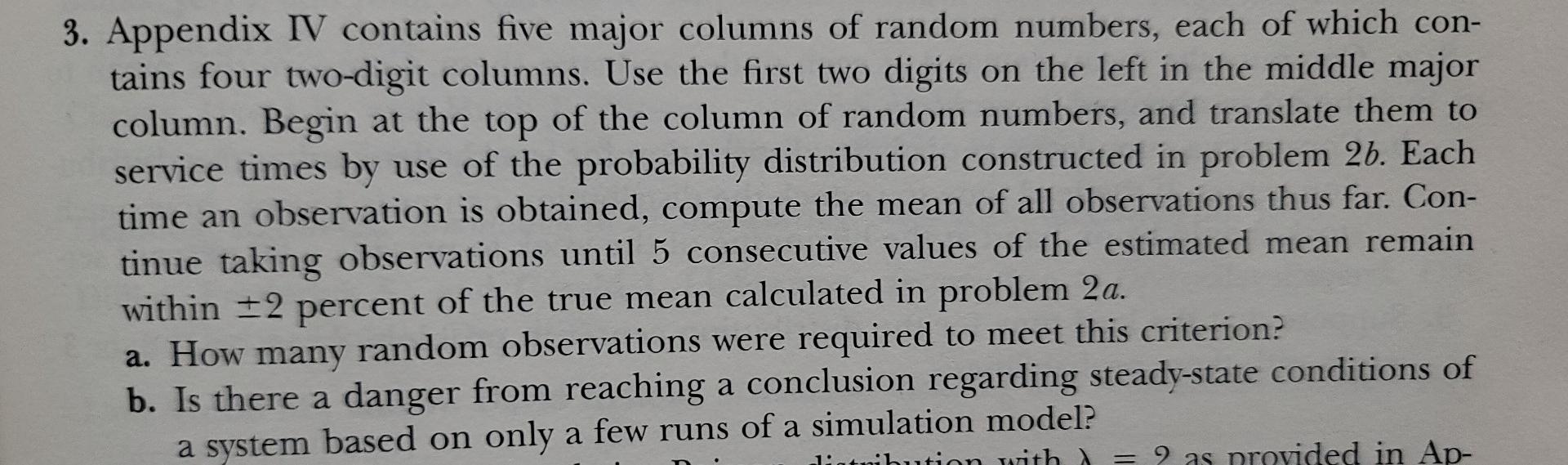
appendix iv contains five major columns of random numbers, each of which contains four two-digit columns. Use the first two digits on the left in the middle major column. Begin at the top of the column of random numbers, and translate them to service times by use of the probability distribution constructed in problem 2b. Each time an observation is obtained, compute the mean of all observation thus far. Continue taking observations until 5 consecutive values of the estimated mean remain within +/- 2 percent of the true mean calculated in problem 2a. a. How many random observations were required to meet this criterion? b. Is there a danger from reaching a conclusion regarding steady-state conditions of a system based on only a few runs of a simulation model?
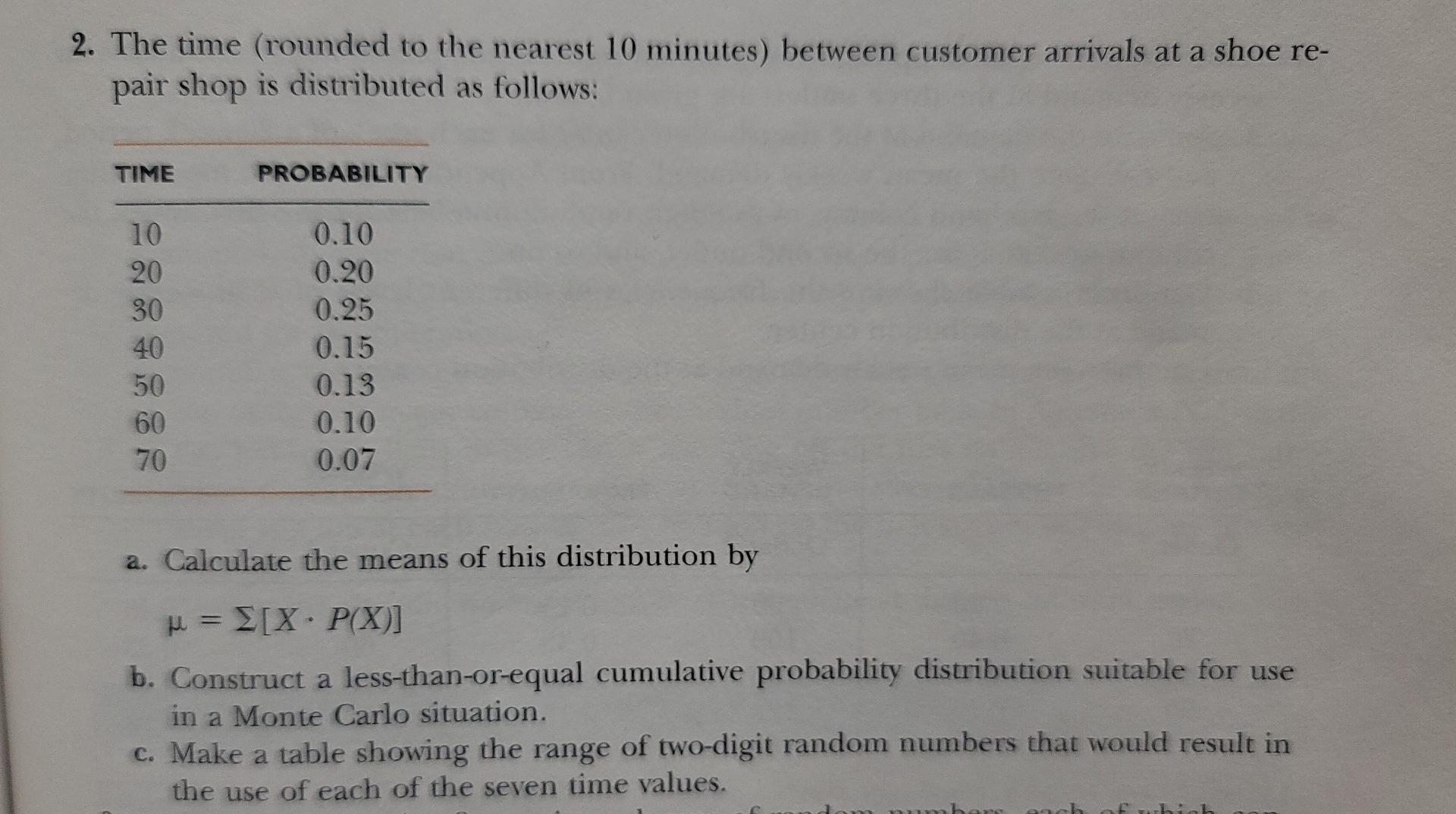
3. Appendix IV contains five major columns of random numbers, each of which con- tains four two-digit columns. Use the first two digits on the left in the middle major column. Begin at the top of the column of random numbers, and translate them to service times by use of the probability distribution constructed in problem 26. Each time an observation is obtained, compute the mean of all observations thus far. Con- tinue taking observations until 5 consecutive values of the estimated mean remain within +2 percent of the true mean calculated in problem 2a. a. How many random observations were required to meet this criterion? . b. Is there a danger from reaching a conclusion regarding steady-state conditions of a system based on only a few runs of a simulation model? = 9 as provided in Ap- 1:atnih with X 2. The time (rounded to the nearest 10 minutes) between customer arrivals at a shoe re- pair shop is distributed as follows: TIME PROBABILITY 10 20 30 40 50 60 70 0.10 0.20 0.25 0.15 0.13 0.10 0.07 a. Calculate the means of this distribution by pi = [X P(X)] b. Construct a less-than-or-equal cumulative probability distribution suitable for use in a Monte Carlo situation. c. Make a table showing the range of two-digit random numbers that would result in the use of each of the seven time values. ars ch h 3. Appendix IV contains five major columns of random numbers, each of which con- tains four two-digit columns. Use the first two digits on the left in the middle major column. Begin at the top of the column of random numbers, and translate them to service times by use of the probability distribution constructed in problem 26. Each time an observation is obtained, compute the mean of all observations thus far. Con- tinue taking observations until 5 consecutive values of the estimated mean remain within +2 percent of the true mean calculated in problem 2a. a. How many random observations were required to meet this criterion? . b. Is there a danger from reaching a conclusion regarding steady-state conditions of a system based on only a few runs of a simulation model? = 9 as provided in Ap- 1:atnih with X 2. The time (rounded to the nearest 10 minutes) between customer arrivals at a shoe re- pair shop is distributed as follows: TIME PROBABILITY 10 20 30 40 50 60 70 0.10 0.20 0.25 0.15 0.13 0.10 0.07 a. Calculate the means of this distribution by pi = [X P(X)] b. Construct a less-than-or-equal cumulative probability distribution suitable for use in a Monte Carlo situation. c. Make a table showing the range of two-digit random numbers that would result in the use of each of the seven time values. ars ch hStep by Step Solution
There are 3 Steps involved in it

Get step-by-step solutions from verified subject matter experts