



Question: Application 1: The Logistic Equation Uninhibited population growth can be modeled by dp dt -= KP, k = 0 This equation is not very accurate
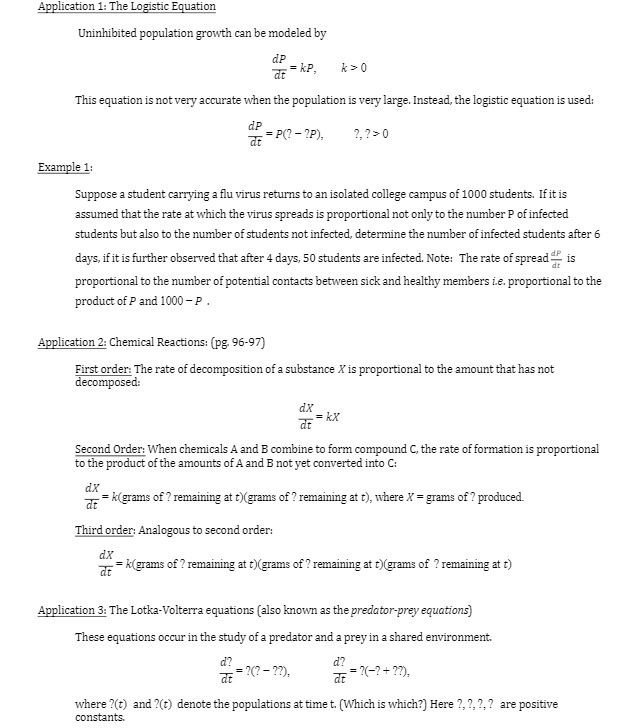
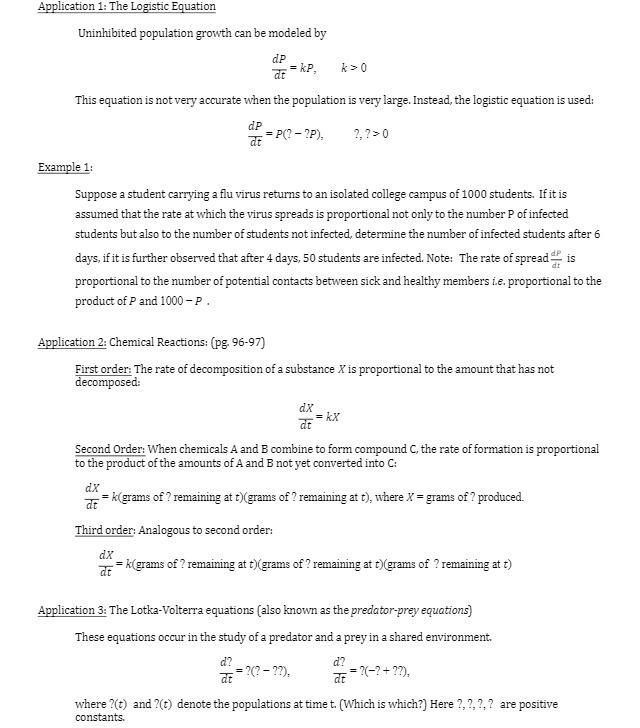
Application 1: The Logistic Equation Uninhibited population growth can be modeled by dp dt -= KP, k = 0 This equation is not very accurate when the population is very large. Instead, the logistic equation is used: dp dt = P(? - ?P), ?, ?=0 Example 1: Suppose a student carrying a flu virus returns to an isolated college campus of 1000 students. If it is assumed that the rate at which the virus spreads is proportional not only to the number P of infected students but also to the number of students not infected, determine the number of infected students after 6 days, if it is further observed that after 4 days, 50 students are infected. Note: The rate of spread S is proportional to the number of potential contacts between sick and healthy members ie. proportional to the product of P and 1000 - P. Application 2: Chemical Reactions: (pg. 96-97) First order: The rate of decomposition of a substance X is proportional to the amount that has not decomposed: dx -= kx Second Order: When chemicals A and B combine to form compound C, the rate of formation is proportional to the product of the amounts of A and B not yet converted into C: dx = k( grams of ? remaining at t) (grams of ? remaining at t), where X = grams of ? produced. Third order: Analogous to second order: dx -= k(grams of ? remaining at t) (grams of ? remaining at t)(grams of ? remaining at t) Application 3: The Lotka-Volterra equations (also known as the predator-prey equations) These equations occur in the study of a predator and a prey in a shared environment. d? = ?(? - ??). d? - =?(-?+ ??), where ?(t) and ?(t) denote the populations at time t. (Which is which?) Here ?, ?, ?, ? are positive constants
Step by Step Solution
There are 3 Steps involved in it

Get step-by-step solutions from verified subject matter experts